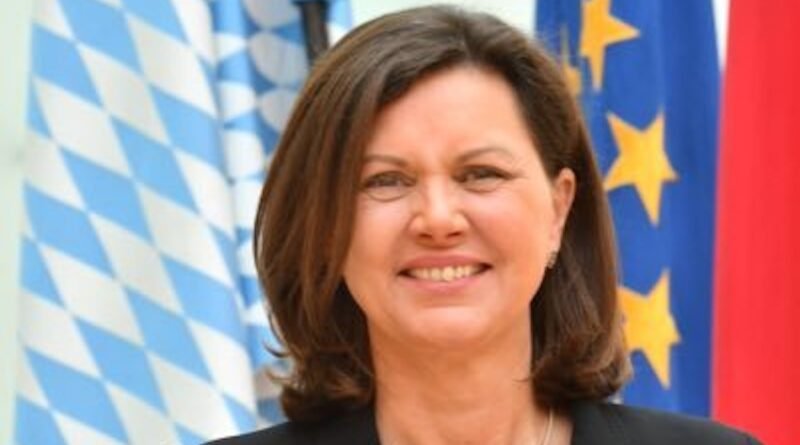
Berlin, Nov 2026 : Germany is poised to elect its first woman president, with governing parties rallying behind Ilse Aigner, a centre-right politician from Bavaria, as their candidate to succeed outgoing President Frank-Walter Steinmeier next year. The nomination marks a historic moment for Germany, which has had only male presidents since the establishment of its post-World War II federal republic in 1949.
Aigner, 61, currently serves as speaker of the Bavarian state legislature. She belongs to the Christian Social Union (CSU), the smallest of the three parties in Chancellor Friedrich Merz's coalition government. Her candidacy, which has long been backed by the conservative bloc, received formal support on Monday from leaders of Merz's Christian Democratic Union (CDU) and the centre-left Social Democratic Party (SPD).
With the governing coalition holding a majority in the electoral assembly and Aigner also receiving a favourable response from the opposition Greens, she is widely expected to secure the presidency.
Presenting herself as a candidate capable of bringing different political groups together, Aigner said she wanted to represent a "strong centre" at a time when Germany is facing growing political polarisation.
She described the broad support emerging for her nomination as an important signal against populist and extremist forces. Aigner said her political commitment was to overcome divisions, bring people together and reach citizens who felt marginalised. She also stressed her opposition to every attack on human dignity.
Chancellor Merz welcomed her nomination, saying it was time for a woman to occupy Germany's highest constitutional office. He also highlighted Aigner's professional background as an electrical engineer, noting that she would be the first president with such qualifications. According to Merz, her experience reflected the lives and working realities of millions of Germans.
The new president will be elected on January 30 by the Federal Convention, a special constitutional assembly comprising all 630 members of the Bundestag, the lower house of parliament, and an equal number of delegates selected by Germany's 16 state legislatures.
Steinmeier, who has served two five-year terms, is constitutionally barred from seeking a third consecutive term.
Aigner has been involved in politics since her late teens and entered the Bavarian state legislature in 1994. She served as Germany's agriculture minister between 2008 and 2013 under former Chancellor Angela Merkel. Subsequently, she held the portfolios of economy and transport in the Bavarian government before becoming speaker of the state legislature eight years ago.
She has developed a relatively liberal reputation within conservative politics. In 2019, during her tenure as parliamentary speaker, she supported Germany's first openly transgender legislator.
Although the German president largely performs ceremonial and representative duties, the office carries constitutional significance and can become particularly important during political crises. The president is expected to remain above party politics and act as a unifying figure.
Steinmeier demonstrated the potential influence of the office in 2017, when he played an active role in encouraging rival political parties to negotiate the formation of a government after an inconclusive election.
Germany's political landscape has since become more complicated, with increasing support for the far-right Alternative for Germany (AfD) creating challenges for coalition-building and political stability.
The AfD has announced plans to field its own presidential candidate. Its co-leader Alice Weidel criticised Aigner's nomination, questioning her ability to remain politically impartial. Weidel argued that Aigner had repeatedly failed to set aside her party affiliations while serving as speaker of the Bavarian legislature.
Germany has had 12 presidents since 1949, all of them men. While women have occupied several other senior constitutional positions, including the chancellorship, the presidency has remained beyond their reach.
Angela Merkel became Germany's first female chancellor in 2005 and held the office until 2021. Four women have also served as speaker of the Bundestag, including the incumbent, Julia Klockner.
Aigner's election would therefore represent a landmark in German political history, while placing renewed attention on the role of the presidency as a symbol of national unity amid growing political divisions.
(Disclaimer :The content of this article is sourced from a news agency and has not been edited by the Mavericknews30 team.)