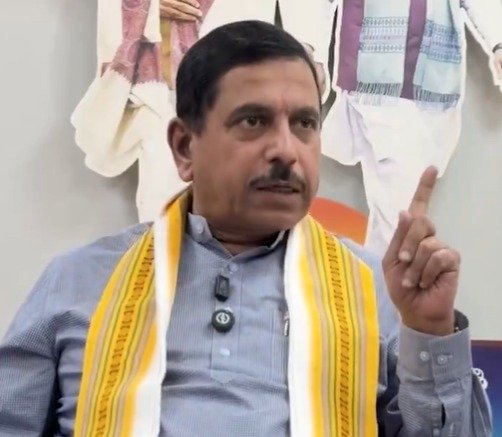
HUBBALLI, November 2026 : Union Minister for New and Renewable Energy Pralhad Joshi on Monday strongly criticised the Karnataka government over allegations that petrol sold in the state contained between 26 and 39 per cent ethanol, asserting that the claims were misleading and unsupported by the country's production capacity.
Addressing reporters in Hubballi, Joshi accused the Congress government of spreading misinformation about ethanol blending and attempting to undermine the Centre's efforts to promote domestic ethanol production under the Atmanirbhar Bharat initiative. He said the allegations reflected a lack of understanding of the fuel-blending programme and could create unnecessary public concern.
Congress leaders and Karnataka ministers had alleged that petrol samples tested in the state showed ethanol content ranging from 26 to 39 per cent. Joshi rejected the claims, arguing that India did not produce sufficient ethanol to support blending at such high levels.
"The Congress leaders have claimed that petrol contains 39 per cent ethanol. However, there is not even enough ethanol production in the country to support such a claim," he said.
He alleged that the state government was deliberately making baseless statements about ethanol content in petrol, including claims of concentrations between 26 and 31 per cent.
Joshi Questions Karnataka's Fuel Testing Process
The Union Minister questioned the methodology adopted by the Karnataka government while collecting and testing petrol samples. He alleged that the process did not follow legally prescribed procedures and that the findings had not been officially published in a transparent manner.
According to Joshi, the state government had collected 63 fuel samples but released findings relating to only 14. Reports from six laboratories were made public, while 11 samples were reportedly found to contain ethanol levels ranging from 21 to 39 per cent.
He said that 896 fuel samples, including 56 from Karnataka, had been tested across the country and reports had been submitted.
Joshi also questioned the involvement of the Shriram Research Institute, which the Karnataka government had identified as one of the institutions conducting the tests. He alleged that the institute was not included in the list of eligible laboratories for petrol sample testing under Schedule 3.
He further claimed that representatives of oil marketing companies and the Central Government had not been invited during the testing process. According to him, the petrol pump owner and concerned officials should be present during sample collection and testing to ensure compliance with the prescribed legal procedure.
Centre Cites Results of Nationwide Ethanol Tests
Taking to social media platform X, Joshi accused Karnataka Minister Rizwan Arshad of choosing sensationalism over responsible governance.
He said that instead of raising concerns through unverified claims of 26-31 per cent ethanol in petrol, the state government should have examined the official test results.
Joshi stated that all 893 samples tested across 27 States and Union Territories had complied with the prescribed ethanol blending range of 19-21 per cent.
He further claimed that all 56 samples from Karnataka tested by oil marketing companies were compliant, recording ethanol content between 19 and 20 per cent, with an average of 19.30 per cent.
The figures cited by Joshi were presented as evidence that the allegations made by the state government were not supported by the oil marketing companies' testing results.
Ethanol Blending and Farmers' Interests
Defending the Centre's ethanol blending policy, Joshi said the programme was designed to reduce dependence on imported fossil fuels, strengthen India's energy security and create additional income opportunities for farmers.
He maintained that ethanol was more expensive than petrol, but the government had continued to encourage its production and blending because of its wider economic and agricultural benefits.
Citing prices, he said petrol was priced at around Rs 53, while ethanol cost approximately Rs 56.70. He argued that oil marketing companies would incur financial losses if they blended ethanol in excessive quantities.
"If ethanol costs more than petrol, why would oil companies add it in higher quantities and incur losses?" he asked.
Joshi claimed that approximately 1.66 crore farmers had received payments linked to ethanol production and that ethanol blending had resulted in savings of Rs 1.94 lakh crore for the country.
He challenged Rahul Gandhi and the Karnataka Congress government to explain their opposition to ethanol production and blending, asking whether they were opposed to measures intended to benefit farmers.
Political Row Intensifies Over Fuel Prices
Joshi also accused the Congress of attempting to turn ethanol blending into another political controversy after its protests over issues such as the Special Intensive Revision (SIR) of electoral rolls, electronic voting machines and other matters.
Taking a swipe at Rahul Gandhi, he alleged that the Congress leadership had failed to raise these issues effectively and was now using ethanol blending to target the Centre.
The Union Minister also criticised the Karnataka government's taxation policy, claiming that while the base price of petrol was around Rs 53, the state was imposing nearly Rs 30 in taxes on petrol and diesel.
He accused the Congress government of acting against the interests of farmers by questioning a policy that, according to him, had supported agricultural incomes and reduced India's dependence on imported energy.
The controversy has brought renewed attention to India's ethanol blending programme, fuel quality testing standards and the responsibilities of state and central authorities in verifying petrol composition. While the Karnataka government has raised concerns over alleged high ethanol content in certain samples, Joshi has maintained that the nationwide test results show compliance with the prescribed 19-21 per cent blending range.