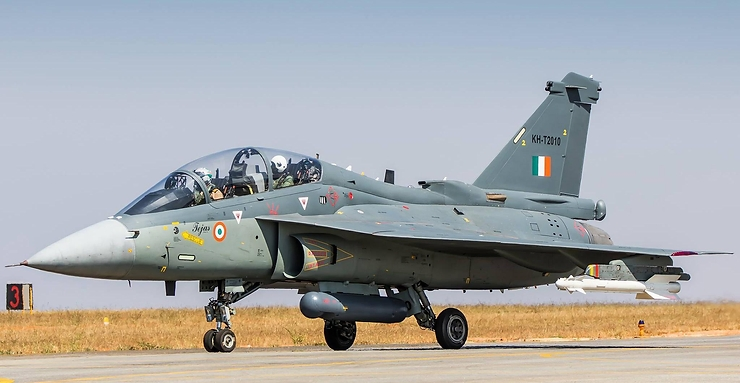
New Delhi, Aug 2026 : Saab’s Gripen-F two-seat fighter has completed its maiden flight, marking a significant milestone for the Swedish aerospace major’s programme, while India’s TEJAS two-seat variant continues to face delays linked to engine availability and developmental challenges.
The contrast has drawn attention because both aircraft programmes depend on engines from GE Aerospace, highlighting the importance of reliable engine supplies in determining the pace of fighter development and production.
The Gripen-F completed its first flight on August 28, 2026, from Saab’s facility in Linköping, Sweden. The 40-minute sortie was flown by Saab chief test pilot Jakob Högberg alongside Brazilian Air Force Lieutenant Colonel Abdon de Rezende Vasconcelos.
According to Saab, the maiden flight was aimed at validating the aircraft’s core systems and initial flight performance. It represents the beginning of a broader flight-test campaign through which the company will progressively evaluate the aircraft’s systems, handling characteristics and operational capabilities.
The Gripen-F was developed primarily to meet Brazil’s requirement for a two-seat variant under its F-X2 fighter programme. Brazil ordered eight Gripen-F aircraft along with 28 single-seat Gripen-E fighters. More than 350 Brazilian engineers and technicians have participated in the programme, making industrial cooperation and technology transfer important components of the project.
The Gripen-F retains combat capability rather than functioning solely as a conventional training aircraft. Its rear cockpit is designed to operate independently, allowing the aircraft to undertake operational missions as well as advanced pilot training. The two-seat version is slightly longer than the Gripen-E and uses the same General Electric F414G engine, although it does not feature the internal Mauser BK27 cannon fitted to the single-seat version.
India’s TEJAS programme, meanwhile, has encountered a different trajectory. The two-seat TEJAS variant, intended to support pilot training, conversion and selected operational roles, has faced delays amid wider challenges affecting the supply of engines and aircraft production.
Hindustan Aeronautics Limited (HAL) has been dealing with engine supply constraints involving GE Aerospace. GE’s F404 engine powers the TEJAS Mk-1, while the F414 family is associated with newer Indian fighter programmes. Delays in engine deliveries have consequently emerged as an important constraint on aircraft manufacturing and testing.
HAL has had to prioritise deliveries of the single-seat TEJAS Mk-1A, while progress on the two-seat version has remained behind the desired schedule. The trainer is considered important because it can help the Indian Air Force convert pilots to the aircraft more efficiently and provide greater flexibility for training and operational requirements.
The situation has also highlighted India’s continuing dependence on foreign propulsion technology. While the airframe and several major systems of the TEJAS are being developed and manufactured domestically, the absence of a fully indigenous high-performance fighter engine remains a significant challenge.
Cost and localisation issues surrounding foreign engines have further complicated the situation. India has explored potential cooperation with companies such as France’s Safran and Britain’s Rolls-Royce as part of its long-term effort to secure advanced propulsion capabilities. However, replacing existing engine arrangements is a complex process requiring technology, testing, certification and substantial industrial investment.
The challenges have also renewed interest in India’s indigenous engine-development efforts, including the Kaveri programme. A successful domestic fighter engine could eventually reduce dependence on overseas suppliers and potentially support future aircraft programmes, including advanced TEJAS variants and the Advanced Medium Combat Aircraft.
The Gripen-F milestone demonstrates the importance of a coordinated international industrial partnership. Brazil’s involvement in the programme has provided Saab with additional engineering resources, while the partnership has enabled local participation in development and manufacturing.
For India, the comparison offers an important lesson. Developing a modern fighter involves more than designing and testing the aircraft itself. Engines, avionics, components, supply chains, production infrastructure and industrial partnerships must all progress in parallel.
The TEJAS two-seater remains important to the Indian Air Force’s training and operational ecosystem. Delays in its availability can create additional pressure on pilot conversion and squadron induction schedules.
Ultimately, the contrasting progress of the Gripen-F and TEJAS two-seater underlines a broader reality of modern fighter development: technological capability must be matched by dependable industrial capacity. While Saab has now moved its two-seat Gripen into flight testing, India continues to work through propulsion and production challenges that have slowed the TEJAS programme.
The shared involvement of GE Aerospace in both programmes makes the comparison particularly significant, but their different industrial structures and programme requirements mean the timelines cannot be attributed to engine supply alone. For India, strengthening domestic propulsion capability and building resilient defence supply chains will remain crucial to ensuring that future fighter programmes move from design to production without similar bottlenecks.
(Disclaimer :The content of this article is sourced from a news agency and has not been edited by the Mavericknews30 team.)