India’s bio-economy is set to reach 300 billion Dollars by 2030, with biotechnology set to drive the next Industrial Revolution, while Biotech Startups in India had already grown from just 50-60 in 2014 to over 11,000 today, Union Minister Dr. Jitendra Singh said today, urging industry leaders, Startups and investors to seize emerging opportunities through greater investment and participation in genomics, multi-omics and advanced biotechnology.
Drawing a parallel with the transformative role of Information Technology in the previous industrial revolution, the Minister said that biotechnology is now emerging as a strategic technology platform that will shape the future of healthcare, agriculture and global economic competitiveness. He cautioned that businesses must adapt to the rapidly changing technological landscape, as those failing to embrace emerging technologies risk becoming irrelevant.
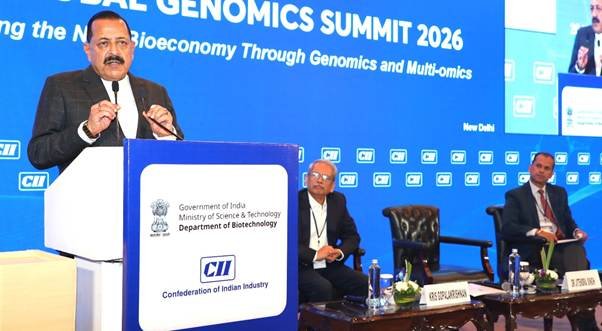
Addressing the CII Global Genomics Summit 2026, themed ‘Powering the Next Bioeconomy Through Genomics and Multi-omics’, at New Delhi, Dr. Jitendra Singh said the summit provided an important platform to bring together the frontiers of science and technology with industry participation, translating scientific discoveries into healthcare solutions, economic opportunities and overall national development. He appreciated CII for bringing together industry representatives, startups and other stakeholders to advance India's biotechnology ecosystem.
Dr. Jitendra Singh said that the convergence of DNA sequencing, computational biology, Artificial Intelligence and different omics technologies, including metabolomics, transcriptomics and proteomics, would transform the understanding of complex diseases and enable more personalised healthcare. The same disease could require different treatment approaches for different individuals, making genomics an increasingly essential component of future medical practice. He said these technologies were no longer confined to research laboratories but were becoming indispensable for healthcare systems, businesses and nations seeking to remain competitive.
Emphasising India's unique advantage in genomic research, the Minister said the country's extraordinary genetic diversity could become a major global asset for research and development. India's diverse population groups and wide spectrum of diseases provide an extensive knowledge base for generating genomic data and developing solutions relevant to populations across the world. He said greater investment in genomic research would not only strengthen India's scientific capabilities but also create significant industrial and commercial opportunities.
Referring to the Genome India Project, he said whole-genome sequencing of 10,000 individuals representing 80 different population groups had already been undertaken, creating a valuable foundation for future research. He encouraged industry stakeholders to partner with government initiatives and translate this scientific resource into practical applications.
The Minister also drew attention to the extensive opportunities biotechnology offers in agriculture and livestock, beyond healthcare. Genomics and advanced biotechnology can help improve crop productivity, nutritional quality and resistance to pests and diseases, while supporting climate-resilient agriculture. In livestock, genomic applications can improve breeding practices and strengthen disease surveillance. He said the breadth of these applications offered businesses opportunities to specialise in different sectors and build sustainable, innovation-driven enterprises.
Speaking about India's rapidly expanding biotechnology ecosystem, Dr. Jitendra Singh said the government had introduced the BioE3 Policy- Biotechnology for Economy, Environment and Employment, to accelerate biotechnology-led growth. The establishment of bio-foundries and other enabling infrastructure is aimed at supporting research, startups and industry in translating scientific discoveries into commercially viable products.
He said India's biotechnology startup ecosystem had grown from just 50-60 startups in 2014 to over 11,000 today, while the country's bio-economy had expanded from approximately 10 billion Dollars to nearly 195 billion Dollars. With the target of reaching 300 billion Dollars by 2030, India is entering a significant phase of biotechnology-led economic growth.
Citing India's growing global credibility in biotechnology, the Minister referred to the country's DNA vaccine for COVID-19, which was supplied to 30 countries, and said Indian biotechnology products were increasingly gaining international acceptance. He also referred to developments in HPV vaccines, research on haemophilia treatment and cost-effective CAR-T cell therapy for cancer at Tata Memorial Centre as examples of India's growing capabilities in advanced healthcare research. He said these achievements demonstrated that India had reached a stage where its biotechnology innovations could find wider global markets and attract greater industry participation.
Dr. Jitendra Singh called upon the private sector to increase investment in research and development and build stronger partnerships with government institutions, research organisations and startups. He referred to the ₹1 lakh crore Research, Development and Innovation (RDI) Scheme as an important initiative to accelerate private-sector participation in high-impact technologies. He also urged business leaders to support scientific research through Corporate Social Responsibility (CSR) funding, particularly in areas such as cancer, diabetes and other major healthcare challenges. Describing research funding as a contribution to the well-being of society, he said investment in scientific research could create benefits extending far beyond individual businesses.
During his interaction with industry representatives, the Minister said that the biggest bottleneck in India's journey towards becoming a genomic powerhouse was the mindset, calling for greater openness towards emerging technologies and new business opportunities. Responding to concerns regarding regulatory processes for biotechnology products and advanced therapies, he said the government was working in consultation with the Ministry of Health and Family Welfare and the Indian Council of Medical Research (ICMR) to simplify procedures and address overlapping regulatory requirements. He invited industry representatives to share specific challenges and practical suggestions so that these could be examined through better institutional coordination.
Concluding his address, Dr. Jitendra Singh called upon CII to act as an important bridge between the government and industry, facilitating greater investment, research partnerships and wider participation in India's biotechnology ecosystem. He said the success of India's scientific and technological progress would ultimately be measured not merely by the number of genomes sequenced or research papers published, but by the lives improved, products developed and economic opportunities created. He called for collective efforts to harness India's scientific potential towards Atmanirbhar Bharat and Viksit Bharat 2047.