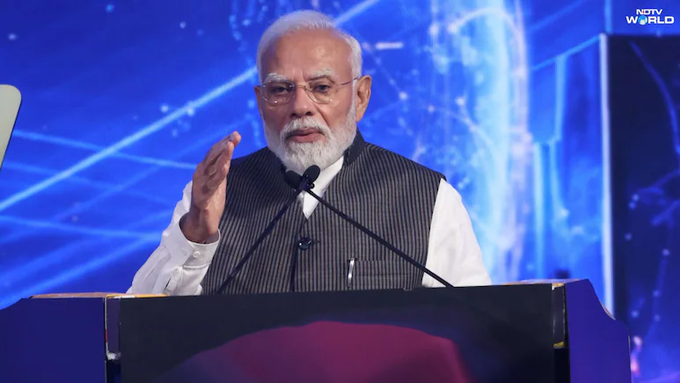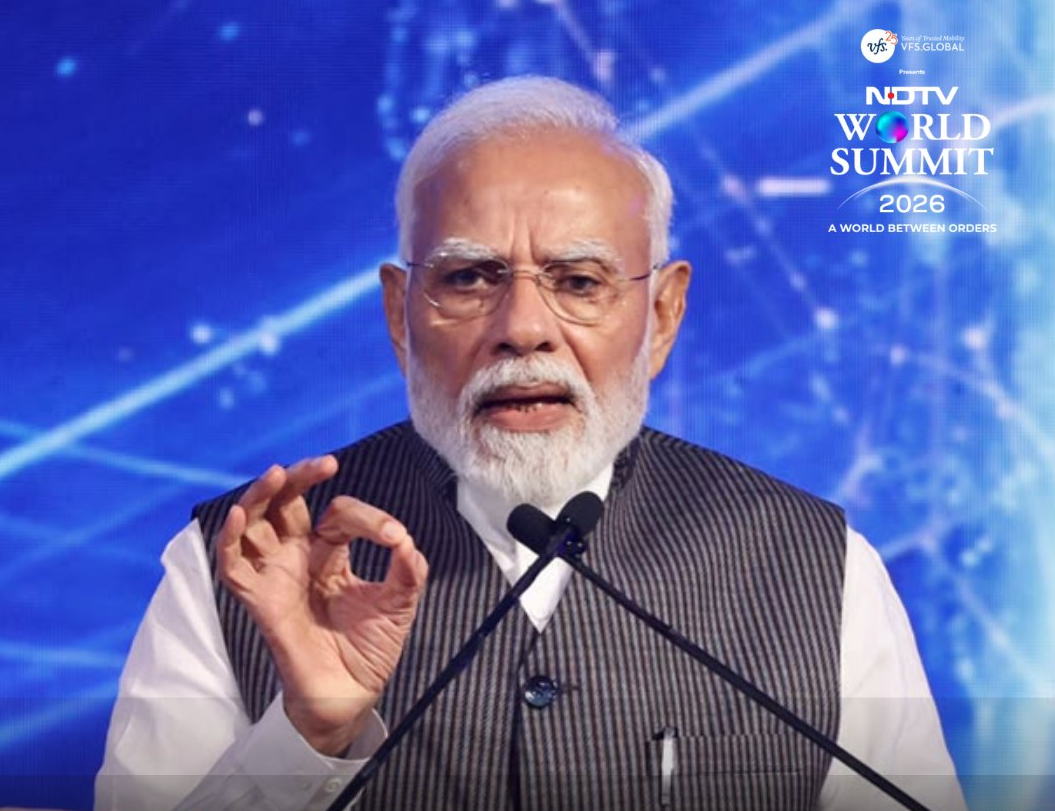
New Delhi, October 2026 : Prime Minister Narendra Modi on Thursday said India was undergoing a significant transformation from the world’s “back office” to its “brain office”, with global businesses increasingly relying on the country’s intellectual capital, research capabilities and technological expertise rather than merely its manpower.
Addressing the NDTV World Summit, Modi highlighted India’s progress in employment generation, research, innovation, semiconductor design and domestic manufacturing as key indicators of its changing global position.
The Prime Minister said nearly 70 lakh new jobs had been created in a short period under the Viksit Bharat Rozgar Yojana. He also cited tax relief for the middle class, stating that individuals with annual incomes of up to ₹12 lakh had received relief under the revised income tax framework, helping improve disposable income.
Highlighting India's research capabilities, Modi said the country ranked third globally in research publications. Around 1.5 lakh patents were filed in 2025, reflecting growing innovation and technological development. He added that approximately 20 per cent of the world's design workforce was based in India, with Indian engineers contributing to advanced semiconductor designs, including chips at the 2–3 nanometre scale. Academic institutions and students have designed more than 300 types of chips, he said.
Modi also pointed to the expansion of Global Capability Centres (GCCs), noting that India hosted more than half of the world's GCCs. While these centres earlier focused largely on support services, they are increasingly undertaking high-value activities such as cloud engineering, data analytics and product development.
“The world, which once relied solely on India’s manpower, now places its trust in India’s mind-power,” the Prime Minister said, describing the shift as a move from “talent at scale” to “thinking at scale”.
Emphasising economic security, Modi said government policies and investment decisions were aimed at strengthening domestic capabilities and reducing dependence on foreign suppliers, particularly during potential global crises.
As an example, he cited the resumption of domestic production of Penicillin-G in Kakinada, Andhra Pradesh, after years of reliance on imports. He attributed the development to the Production Linked Incentive (PLI) scheme.
The PLI scheme for Active Pharmaceutical Ingredients (APIs), he said, had attracted investments exceeding ₹5,000 crore and supported nearly 40 projects, helping strengthen India's supply chain for essential medicines.
Modi said such initiatives were advancing the vision of Atmanirbhar Bharat and positioning India as a global centre for innovation, advanced technology and manufacturing.