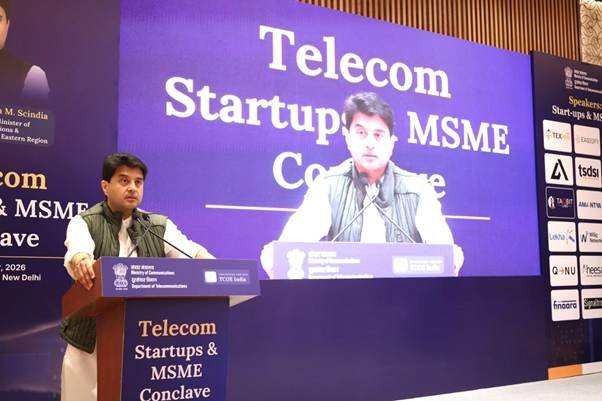
Union Minister for Communications and Development of North Eastern Region Shri Jyotiraditya M. Scindia today chaired the Telecom Startups and MSME Conclave 2026, organised by the Department of Telecommunications (DoT), Ministry of Communications, at Leaders Lounge, Bharat Mandapam, New Delhi. The Conclave underscored the Government's commitment to strengthening indigenous telecom innovation, promoting entrepreneurship and facilitating the development and commercialisation of homegrown technologies.
The Conclave brought together telecom startups, Micro, Small and Medium Enterprises (MSMEs), industry leaders, investors, academia and government representatives on a common platform to showcase indigenous products and solutions, deliberate on challenges faced by domestic innovators and explore opportunities for scaling up Indian telecom technologies.
Ms. Debjani Ghosh, Distinguished Fellow at NITI Aayog and Chief Architect of the NITI Frontier Tech Hub, delivered the keynote address during the session, highlighting the importance of fostering innovation, strengthening collaboration among stakeholders and creating an enabling ecosystem for technology-led entrepreneurship.
The Conclave featured presentations and discussions across five key thematic areas covering the telecom technology stack, namely Radio Access Network (RAN) and Core, Applications, Chipsets, Security and Standards. Each thematic group was represented by the concerned DoT officials, who apprised participants of various Government initiatives, policy interventions and enabling frameworks being undertaken by the Department to support startups and MSMEs and strengthen the overall telecom innovation ecosystem. The Conclave also featured 11 exhibition stalls set up by startups and MSMEs, providing them an opportunity to showcase their innovative indigenous products, technologies and solutions to policymakers, industry leaders, investors and other stakeholders.
The Union Minister also felicitated the winners of the Emerging Technologies Hackathon 2026 (ETH 2026), organised by TCoE India. The Hackathon received over 2,870 registrations and 620 applications across nine technology domains, with participation from students, startups, companies and academic institutions. The winners were recognised with awards and prize money for their innovative solutions. Entra Innovations LLP secured the First Prize for VAAYU, an indigenously designed tyre-pressure sensor system-on-chip; Dawniens International Private Limited received the Second Prize for Cablesmith, a robotic optical patch panel solution enabling remote provisioning of fibre connections; while the Joint Third Prize was awarded to IIT Bombay (Team DRISTI) for KAVACH, a security engine for private 5G networks, and the Military College of Telecommunication Engineering (Team RUDRA) for VajraLink, an anti-jamming communication solution for drones.
Speaking during the conclave, the Union Minister said, “Today has been an exhilarating experience in terms of the re-emergence of India’s entrepreneurial strength in the past decade. Our country has always been the home of innovation, technology, science and entrepreneurship. For thousands of years, India has contributed in the advancement of mankind. Over the last decade, India has moved from being the consumer of technology to becoming the creator of technology. Under the leadership of Hon’ble Prime Minister Shri Narendra Modi, today India has risen as the 4th largest economy and market in the world. From a country that had only few hundred startups in 2014, India has now gone beyond 2,00,000 startups and this has happened because of multiple prompt approaches by the Hon’ble Prime Minister.”
He also added that, “The telecom sector is the most profound example of India becoming the creator of technology due to the volume to test technology. From a country that only had 25 crore internet connections to now 110 crore internet connections, from 6 crore broadband connections to 104 crore broadband connections. We are the only telecom network market in the world that is growing at double digit numbers.”
The Department of Telecommunications (DoT) is implementing various initiatives to strengthen the indigenous telecom innovation ecosystem, including the Telecom Technology Development Fund (TTDF), Technology Development and Investment Promotion (TDIP) Scheme and 100 5G Use Case Labs, which support research and development, global standardisation, product validation and deployment. Complementing these initiatives, the Telecommunications Act, 2023, through the frameworks for Captive Non-Public Networks (CNPNs) and Regulatory Sandbox, provides an enabling policy environment for enterprise networks and live testing of innovative telecom technologies.
In this context, the Conclave featured dedicated sessions on Captive Telecommunication Services and Regulatory Sandbox, wherein DoT representatives apprised participants of the relevant regulatory frameworks and their provisions. Ericsson shared global perspectives and industry experiences on both subjects. The sessions also provided a platform for interaction among user agencies, industry representatives, startups and other stakeholders to exchange views on potential applications, implementation requirements and opportunities arising from these frameworks.
The Conclave reaffirmed DoT's commitment to fostering collaboration among startups, MSMEs, academia, investors and industry, strengthening indigenous technological capabilities and creating an enabling environment for innovation and entrepreneurship, in alignment with the vision of Viksit Bharat@2047.