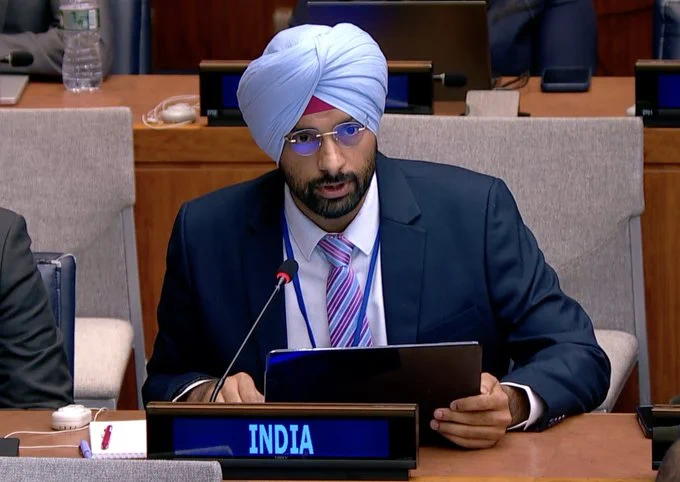
United Nations, October 2026 : India has warned Pakistan that it will not be deterred by nuclear threats or attempts to use the risk of nuclear escalation to escape accountability for terrorism, asserting that any terrorist attack against the country will receive a fitting response.
Addressing the United Nations General Assembly's First Committee, which deals with disarmament and international security issues, Anmol Sher Bedi, Senior Adviser at India's Permanent Mission to the UN Conference on Disarmament in Geneva, said New Delhi would not allow nuclear threats to constrain its response to terrorism.
“India will not bow to nuclear blackmail,” Bedi said on Friday, responding to remarks by Pakistan's Permanent Representative to the UN in Geneva, Tahir Andrabi.
He made it clear that India would respond to future terrorist attacks and would hold both the perpetrators and their sponsors accountable.
“Any terrorist attack against India will receive a fitting response,” Bedi said, adding that New Delhi would “make no distinction between those who sponsor terrorism and those who mastermind it”.
Referring to Operation Sindoor, India's military action against terrorist infrastructure in Pakistan last year, Bedi said it followed the Pahalgam terror attack, in which Pakistan-based terrorists killed 26 civilians.
“India acted in self-defence,” he said, describing the actions as “measured, targeted, and designed to be non-escalatory”.
Bedi cautioned against treating nuclear weapons as routine instruments of state policy, arguing that the use of nuclear threats to shield terrorism could increase regional instability rather than encourage restraint.
“Nuclear weapons must not be treated as routine instruments of statecraft,” he said. A strategy that relies on a nuclear threat to limit the consequences of terrorist activities, he added, “raises the risk of escalation and not the prospect of restraint”.
At the same time, Bedi reassured the international community that India's nuclear capabilities were defensive in nature and were not directed against any particular country.
“They are shaped by our own security environment,” he said.
India has declared a no-first-use policy, under which it undertakes not to be the first to use nuclear weapons. New Delhi has consistently maintained that its nuclear doctrine is intended to serve its national security interests.
Bedi also raised concerns about Pakistan's record on nuclear proliferation, referring to the activities of the network established by Abdul Qadeer Khan, who led Pakistan's nuclear programme. The network was involved in transferring nuclear technology and expertise to other countries, including North Korea, in exchange for missile-related technology.
“On proliferation, India refers to the history of the AQ Khan network, which contributed to the Security Council Resolution 1540 almost two decades back,” Bedi said.
He argued that the history was particularly relevant amid demands for expanded nuclear cooperation and transfers of advanced weapons and military capabilities.
“We urge all states and all responsible suppliers to exercise the highest degree of vigilance, not because of India, but for their own security,” he said.
Adopted in 2004, UN Security Council Resolution 1540 is a binding measure requiring countries to prevent non-state actors, including terrorist groups, from acquiring weapons of mass destruction and related materials. It also established the 1540 Committee to monitor implementation.
Bedi further accused Pakistan of contributing to regional instability through what he described as recurring cycles of terrorism, denial and appeals for restraint after India's response.
“In India's experience, crises in the region have tended to follow a recurring pattern: first, provocation; second, denial of responsibility; and third, appeals for restraint once a response has been made,” he said.
“That is how instability becomes useful, and that is how the cycle keeps on repeating,” he added.
The Indian representative also criticised Pakistan's governance structure, alleging that the military exercised decisive power without adequate democratic accountability.
“Those in power are neither elected by people nor accountable to them, their decisions carry no risk and impose no cost for those who take them,” Bedi said. “That is how crisis becomes an instrument of power.”
He pointed to UN Secretary-General Antonio Guterres's recent visit to Pakistan, during which Guterres met Army Chief Asim Munir, as an indication of the military's influence in the country.
Bedi also defended India's decision to place the Indus Waters Treaty in abeyance, arguing that the agreement had been based on trust and cooperation that Pakistan had undermined.
Responding to Andrabi's remarks on Kashmir, Bedi said Pakistan repeatedly raised the issue irrespective of the subject under discussion.
He reiterated India's position that Jammu and Kashmir is an integral part of the country and called on Pakistan to vacate the territories India describes as being under its illegal occupation.
The exchange at the First Committee underscored continuing tensions between the two countries over terrorism, nuclear deterrence, regional security and Kashmir, with India urging the international community to remain vigilant against nuclear proliferation and the use of nuclear threats to shield terrorist activities.