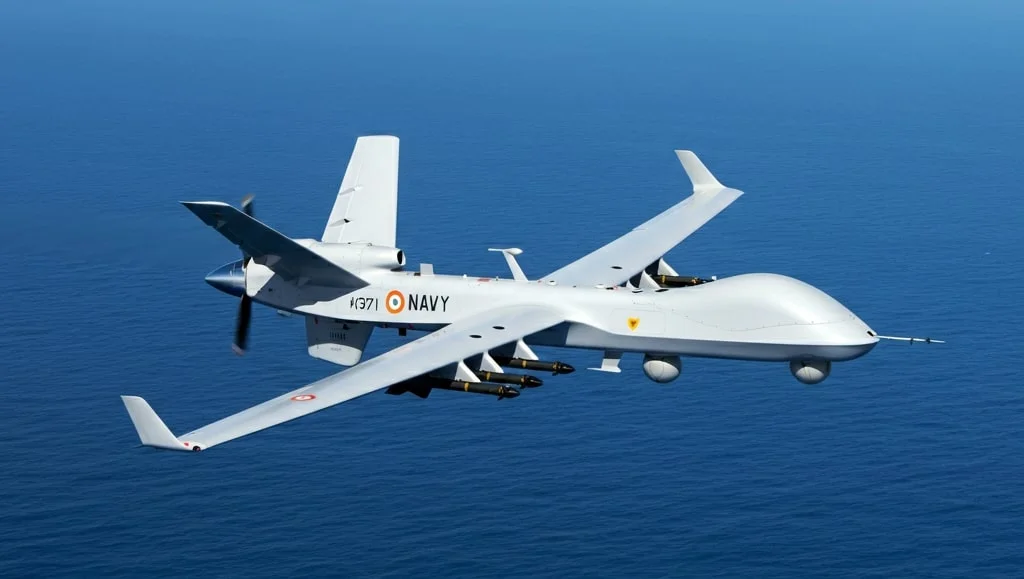
New Delhi, November 2026 : The Indian Navy has issued a Request for Information (RFI) for the acquisition of Long Range Autonomous Aerial Vehicles (LR-AAVs) to strengthen its maritime Intelligence, Surveillance and Reconnaissance (ISR) capabilities. The proposed unmanned platforms are expected to improve persistent monitoring across vast ocean areas and support a range of naval operations.
According to the RFI, the Navy is seeking aerial vehicles capable of remaining airborne for more than 12 hours, allowing them to undertake extended surveillance missions, wide-area maritime patrols and continuous intelligence gathering.
The platforms must carry an integrated sensor payload exceeding 20 kg, enabling the deployment of advanced electro-optical, infrared and other surveillance equipment required for maritime monitoring.
A key requirement is unassisted Vertical Take-Off and Landing (VTOL) capability. This would allow the aircraft to operate directly from naval vessels without requiring dedicated launch and recovery infrastructure, providing greater flexibility during deployments at sea.
The Navy has also specified a Beyond Line of Sight (BLOS) communication range exceeding 350 nautical miles, enabling operators to control and monitor missions over considerable distances.
Another important feature is the integration of artificial intelligence-enabled target detection and tracking systems. These capabilities are expected to support faster identification, classification and monitoring of maritime contacts while reducing the workload of operators.
The LR-AAVs must support autonomous operations during both day and night to ensure round-the-clock surveillance. They will also need to operate reliably from moving naval platforms under challenging maritime conditions, including adverse weather and high sea states.
The proposed applications include Maritime Domain Awareness, Search and Rescue (SAR), long-range BLOS missions and vessel tracking. These capabilities could strengthen the Navy's ability to monitor strategic sea lanes, India's Exclusive Economic Zone and wider areas of interest across the Indian Ocean Region.
The procurement initiative also offers an opportunity for India's indigenous unmanned aerial vehicle and defence technology industry. Domestic manufacturers and defence start-ups working on autonomous aviation, AI-based sensing, secure communication systems and naval unmanned platforms could participate in developing solutions to meet the Navy's requirements.
The RFI marks an important step towards expanding India's shipborne unmanned surveillance capabilities and strengthening maritime security through advanced autonomous technologies.
(Disclaimer :The content of this article is sourced from a news agency and has not been edited by the Mavericknews30 team.)