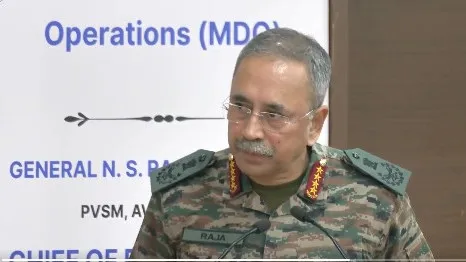
New Delhi, November 2026 : Chief of Defence Staff (CDS) General NS Raja Subramani has called for accelerating India's military space capabilities, highlighting the growing space-related capabilities of Pakistan with assistance from China and possible support from Turkey. He said India must strengthen its space-based military assets to maintain its strategic advantage amid the changing security environment.
Addressing a session on the Future of Warfare and India's Preparedness to Conduct Multi-Domain Operations at the Vivekananda International Foundation on Friday, General Subramani said Pakistan's space programme was steadily advancing with Chinese assistance. He added that Pakistan's national space agency, Suparco, was also working to develop indigenous capabilities.
"Pakistan's space capability is improving with Chinese assistance. Suparco is also pursuing the development of its own capabilities, and it is reasonable to expect support from Turkey as well," the CDS said.
He observed that growing military cooperation among Pakistan, China and Turkey had become an important factor in India's security assessment, particularly following the closer ties among the three countries during and after Operation Sindoor.
Pakistan Could Access Advanced Chinese Technologies
General Subramani warned that Pakistan could potentially benefit from China's advanced capabilities in intelligence, surveillance and reconnaissance (ISR), as well as positioning, navigation and timing systems.
Access to such technologies could significantly improve Pakistan's operational awareness and military effectiveness, he said.
"Any capabilities available to China in areas such as ISR, positioning, navigation and timing could potentially be leveraged by Pakistan. This is something India must take into account in its strategic planning," he stated.
He emphasised that India would need to respond by strengthening its own surveillance networks and space-based military infrastructure to address emerging challenges.
52 Military Satellites Planned Under SBS Phase-III
Highlighting India's efforts to strengthen its military space architecture, the CDS underlined the importance of the Space Based Surveillance (SBS) Phase-III programme.
Under the initiative, India plans to deploy 52 dedicated military satellites over the next three years. The programme is intended to enhance the country's surveillance capabilities and provide stronger support for military operations.
Approved by the Cabinet Committee on Security in October 2024, the project will be implemented under the Defence Space Agency and Headquarters Integrated Defence Staff.
With a total estimated outlay of Rs 26,968 crore, the programme envisages an important role for both public and private-sector organisations. The Indian Space Research Organisation (ISRO) will build and launch 21 satellites, while private-sector companies will develop the remaining 31.
The participation of private companies reflects the expanding role of India's domestic space industry in projects linked to national security and defence preparedness.
China Developing Technologies to Target Satellites
General Subramani also drew attention to the rapid expansion of China's space capabilities. He noted that Beijing had developed sophisticated technologies that could potentially disrupt or target satellites.
China is widely believed to possess anti-satellite systems and electronic warfare capabilities that can interfere with satellite communications and navigation networks. Such technologies pose additional challenges for countries that increasingly depend on space-based infrastructure for military operations.
Against this backdrop, the CDS stressed the need for India to continue investing in advanced space, surveillance and defence technologies.
He said the changing nature of warfare required military preparedness across multiple domains, including land, sea, air, cyber and space. Space-based capabilities are becoming increasingly important for communication, intelligence gathering, navigation and operational coordination.
The CDS's remarks highlighted the need for India to strengthen its military space infrastructure as regional security dynamics evolve. The planned satellite deployment under SBS Phase-III is expected to form a significant part of these efforts, supporting India's preparedness for future multi-domain military operations.
(Disclaimer :The content of this article is sourced from a news agency and has not been edited by the Mavericknews30 team.)