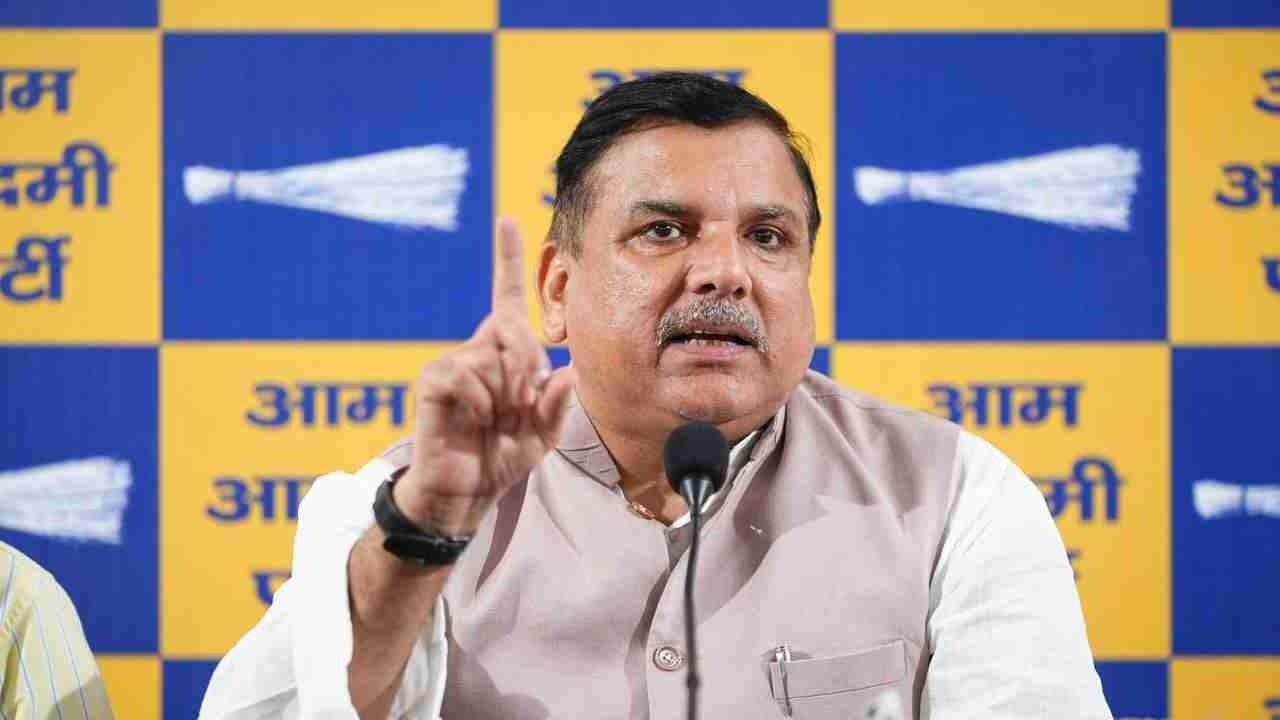
New Delhi, November 2026: The Aam Aadmi Party (AAP) has made its position clear on the proposed Delimitation Bill, with senior party leader and Rajya Sabha MP Sanjay Singh declaring that the party will oppose the legislation strongly in both Houses of Parliament.
Singh alleged that the Bharatiya Janata Party (BJP) was not bringing a genuine delimitation measure but a “BJP Victory Bill”. He claimed that if the Bill were passed, votes supporting the BJP would be grouped together while votes opposing the party would be concentrated in other constituencies. Citing Assam and Jammu and Kashmir as recent examples, he alleged that delimitation in these regions had been carried out to consolidate the BJP's electoral support.
He warned that history would never forgive opposition parties that supported the Bill. Singh also argued that the Women's Reservation Bill had already been passed unanimously and could be implemented immediately if Prime Minister Narendra Modi was genuinely committed to women's representation.
Singh Calls It a 'BJP Victory Bill'
Singh accused the BJP of introducing what he described as another misleading initiative under the name of delimitation. He said that although the proposed legislation was officially called the Delimitation Bill, its actual purpose was to help the BJP win elections.
He claimed that if the number of parliamentary seats increased following delimitation, the responsibility for determining constituency boundaries would rest with the Election Commission, headed by Chief Election Commissioner Gyanesh Kumar. Singh alleged that the process could be used to group voters supporting the BJP in selected constituencies while bringing together voters opposed to the party in others.
According to him, such an exercise could give the BJP an electoral advantage by determining constituency boundaries in a manner favourable to its political interests.
Cites Assam and Jammu and Kashmir as Examples
To support his allegations, Singh referred to the delimitation exercises carried out in Assam and Jammu and Kashmir.
He claimed that in Assam, one constituency had approximately 26 lakh voters, while another had only around 12 lakh. Similarly, he said that in Jammu and Kashmir, the population of one constituency was approximately 1.80 lakh, compared with just 73,000 in another.
Singh argued that constituency boundaries should be determined primarily on the basis of population. He questioned the differences in population between constituencies and alleged that the proposed exercise would favour the BJP rather than ensure fair representation.
Raises Concerns About Dalit, Backward and Tribal Communities
Singh further alleged that the delimitation exercise could disadvantage Dalits, backward communities and tribal populations if they were concentrated in constituencies where the BJP had limited electoral support.
He claimed that voters belonging to communities that largely did not support the BJP could be grouped together in a single constituency, while BJP supporters could be placed in separate constituencies with smaller populations.
Giving an example, he referred to Nagpur and alleged that supporters of the Rashtriya Swayamsevak Sangh (RSS) and the BJP could be grouped in one constituency. He claimed that even if a constituency containing Dalit, backward and Muslim voters had a population of 30 lakh, it would still elect only one MP.
In contrast, he alleged that a constituency with a BJP-supporting population of just five lakh could also elect one MP. He argued that this would create an imbalance in electoral representation.
Warns Opposition Parties Against Supporting the Bill
Singh claimed that under such an arrangement, one MP could be elected from a constituency containing 35 lakh voters opposed to the BJP, while another could be elected from a constituency with only five lakh BJP supporters.
He compared the situation with Hungary, where, according to him, a political leader remained in power for 25 years before eventually losing an election.
Singh also criticised opposition parties that were reportedly considering supporting the proposed legislation. Referring to speculation that the Dravida Munnetra Kazhagam (DMK) might support the BJP on the issue, he warned that such a decision would be politically damaging.
He said that if the DMK supported the Bill, history would not forgive the party. Singh urged opposition parties not to endorse what he described as legislation designed to strengthen the BJP electorally.
Questions BJP's Stand on Women's Reservation
Singh also challenged the BJP's stated position that the Delimitation Bill was necessary to implement women's reservation.
He pointed out that the Women's Reservation Bill had been passed in 2023 with the support of all political parties. According to him, the Modi government could implement the provision immediately if it genuinely wanted to increase women's representation.
He demanded that the government provide 33 per cent reservation for women in the existing 543 Lok Sabha seats. He also called for 33 per cent reservation for women in all State Legislative Assemblies.
Singh questioned why the BJP government was not implementing women's reservation under the existing framework, alleging that the issue was being used to justify the proposed delimitation exercise.
AAP Vows Strong Opposition in Parliament
Reiterating his party's position, Singh said opposition parties supporting the Bill would be endorsing a measure that, in AAP's assessment, could distort electoral representation.
He alleged that the BJP would group votes against it in larger constituencies while concentrating its own supporters in constituencies with smaller populations, potentially allowing the party to win parliamentary seats with fewer voters.
Singh said the proposed exercise could amount to a serious betrayal of the country's democratic interests. He maintained that AAP was firmly opposed to the Delimitation Bill and would resist it forcefully in both the Lok Sabha and the Rajya Sabha.
The party's opposition, he said, was based on its concern that constituency boundaries could be drawn in a way that gives one political party an unfair electoral advantage.