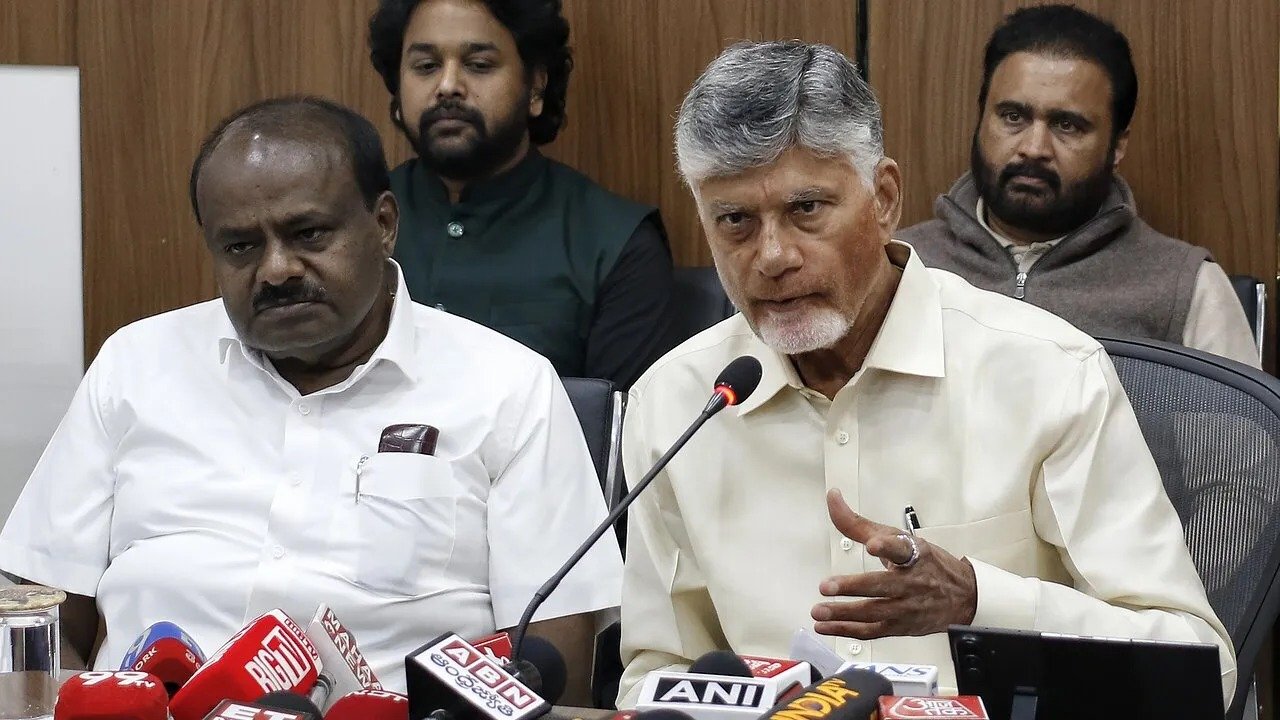
Amaravati, November 2026 : Andhra Pradesh Chief Minister and Telugu Desam Party (TDP) president N. Chandrababu Naidu has appealed to all political parties to support the proposed Delimitation Bill, stating that a 50 per cent increase in the number of Lok Sabha seats would benefit all states without affecting their existing share of parliamentary representation.
Backing the Centre's proposal to link delimitation with the implementation of women's reservation, Naidu said the legislation should be supported in the larger interest of the country. He urged political parties to arrive at a broad consensus and ensure that the aspirations of women for greater representation in politics are fulfilled.
Addressing a press conference in Amaravati alongside Union ministers H.D. Kumaraswamy and Ram Mohan Naidu, the Chief Minister maintained that increasing the strength of the Lok Sabha by 50 per cent would not cause injustice to any state.
South India's Share in Lok Sabha to Remain Unchanged
Naidu said South India currently has 129 Lok Sabha seats, and this number would increase to 195 following delimitation. However, the region's share of representation in the Lower House would remain unchanged at 23.76 per cent, he said.
Explaining the proposed changes for individual southern states, Naidu stated that Andhra Pradesh's parliamentary seats would increase from the existing 25 to 38, while its share of representation would remain at 4.6 per cent.
Karnataka, which currently has 28 Lok Sabha seats, would have 42 after delimitation, with its representation remaining unchanged at 5.16 per cent.
The number of seats in Tamil Nadu would rise to 59, Telangana would have 26 seats and Kerala would have 30. These changes, according to Naidu, would increase the overall parliamentary representation of the southern states while protecting their existing proportion of seats.
He argued that the proposed expansion would provide additional representation without reducing the relative political strength of South India in Parliament.
Naidu Highlights Need for Fresh Delimitation
The TDP chief also referred to the changing population-to-representative ratio to underline the need for a fresh delimitation exercise.
He said that under the previous delimitation based on the 2001 Census, one Member of Parliament represented approximately 19 lakh people. This figure has since increased to around 27 lakh.
Naidu stated that a fresh exercise could bring the number down to approximately 18 lakh people per MP, thereby improving the level of parliamentary representation.
He cautioned, however, that if constituency boundaries were determined on the basis of the 2026 Census, southern states could face significant losses in their political representation.
Such a situation, he said, could create unnecessary public dissatisfaction and unrest, besides raising concerns about the representation of both men and women.
According to Naidu, the proposed approach to delimitation should take into account the need for fair representation while ensuring that states do not face a disadvantage.
Calls for Consensus on Women's Reservation
Naidu said a fresh delimitation exercise was due by 2029 and argued that, after a gap of 33 years, the number of parliamentary constituencies needed to be increased in line with the country's changing requirements and the aspirations of women.
He recalled that an earlier Delimitation Bill had failed to secure passage because of a lack of majority support. He noted that several major national policies in the past had been adopted through broad political consensus.
Stressing that the time had come to fulfil the promise of women's reservation in legislatures, he appealed to all Members of Parliament to vote in favour of the proposed Bill during the parliamentary session scheduled for the end of November.
"The time has come to provide reservations for women in politics as well; we must now focus on the future," Naidu said.
He urged parties that had opposed the Bill during the previous parliamentary session not to repeat their earlier position. Opposing the legislation, he argued, would effectively delay greater representation for women in elected bodies.
Naidu called upon political parties and public representatives to support the measure and avoid what he described as a historic mistake.
Points to Women's Representation in Parliament and Andhra Pradesh
Highlighting the need for greater participation of women in politics, Naidu referred to their representation in the Lok Sabha. He said women accounted for 13.96 per cent of the total MPs elected in the 2024 general elections, compared with 14 per cent in 2019.
He observed that women were making progress across different sectors and said their participation in public life and decision-making needed to increase further.
Referring to Andhra Pradesh's experience, Naidu said the state had introduced 9 per cent reservation for women in local governing bodies as early as 1986. In the most recent elections, he said, 60 per cent of the seats were allocated to women. He also pointed out that several women had been elected as mayors in different cities.
The Chief Minister further stated that Andhra Pradesh had implemented 33 per cent reservation for women in education and employment.
He added that women's achievements across sectors demonstrated their growing capabilities and potential. According to Naidu, their representation could exceed 50 per cent if opportunities were determined solely on merit.
Reiterating his appeal, Naidu said all political parties should rise above differences and support the Delimitation Bill. He maintained that a consensus-driven approach would help expand parliamentary representation while advancing the objective of greater participation of women in India's political system.