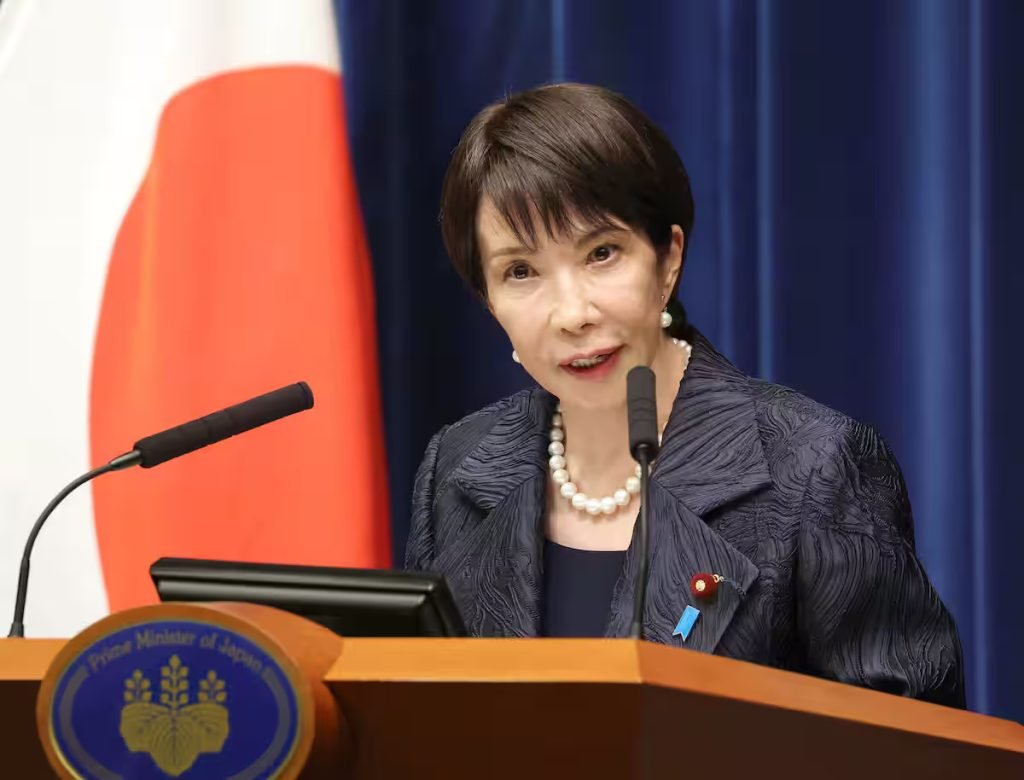
Tokyo, Aug 2026 : Japanese Prime Minister Sanae Takaichi on Monday pledged to pursue a “responsible active fiscal policy” and accelerate the government’s growth strategy after the country’s economy expanded for a second consecutive quarter, although weaker domestic demand and the fallout from the conflict in West Asia continued to weigh on the outlook.
Japan’s economy grew at an annualised rate of 1.1 per cent in the April-June quarter of 2026, according to preliminary government data. While the expansion marked another quarter of positive growth, it fell short of market expectations of 2.0 per cent.
On a quarter-on-quarter basis, Japan’s real gross domestic product (GDP) increased 0.3 per cent, compared with the 0.5 per cent growth forecast by economists. The figures showed that external demand continued to support the economy, while domestic demand remained under pressure.
Exports contributed around 0.5 percentage points to quarterly growth, partly offsetting a 0.2 percentage-point decline in domestic demand.
Takaichi described the latest figures as evidence that the economy remained on a path of “moderate recovery”, while acknowledging the impact of the situation in the Middle East and weakness in domestic consumption.
“Despite the impact of the situation in the Middle East, real growth was +0.3 per cent quarter-on-quarter and +1.1 per cent annualised,” Takaichi said in a post on X, noting that the economy had recorded positive growth for three consecutive quarters.
She said domestic demand had weakened partly because of special factors, including higher tobacco prices, but maintained that external demand remained positive and helped the economy achieve overall growth.
Investment and Consumption Remain Weak
The latest data highlighted continued weaknesses in business investment and household consumption.
Capital expenditure was the biggest drag on growth, declining 1.2 per cent during the quarter, sharply contrasting with market expectations for a 0.4 per cent increase.
Private consumption also remained subdued as households continued to face pressure from the rising cost of living. Higher energy prices and uncertainty arising from the West Asia conflict have further complicated the economic environment.
Japan’s heavy dependence on imported energy makes it particularly vulnerable to disruptions in global energy supplies. Concerns over shipping through the Strait of Hormuz have added to uncertainty over energy costs and availability.
Despite the weakness in domestic demand, there were some positive developments in employment and incomes. Takaichi highlighted an increase in total real employee compensation, which rose 2.3 per cent year-on-year and 0.9 per cent quarter-on-quarter.
She said real wages had remained positive for seven consecutive months and argued that improvements in employment and income conditions could provide greater support for household spending.
Takaichi also pointed to wage increases resulting from the annual spring labour-management negotiations. The wage growth rate has remained above 5 per cent for three consecutive years, providing a potentially important foundation for stronger consumer demand.
Government Plans to Push Investment
Against this backdrop, Takaichi said her government would focus on strengthening investment and production capacity.
Under what she described as a philosophy of “responsible active fiscal policy”, the government intends to accelerate initiatives under the Japan Growth Strategy and the Regional Future Strategy, with participation from both the public and private sectors.
The objective, she said, is to expand domestic investment, strengthen supply capacity and raise Japan’s potential growth rate.
The government aims to build what Takaichi described as a “strong economy” capable of withstanding external shocks while avoiding a return to deflation.
She also said measures designed to tackle rising prices would be implemented rapidly and consistently. These include initiatives contained in the fiscal 2025 supplementary budget, the initial fiscal 2026 budget and the supplementary budget for fiscal 2026.
The government plans to respond flexibly to economic risks while supporting a reliable, growth-oriented economic recovery.
West Asia Conflict Adds Pressure
Japan’s latest trade figures have already highlighted the impact of disruptions linked to the West Asia conflict.
Crude oil imports fell 57.3 per cent to 4.73 million kilolitres, with disruptions to shipping through the Strait of Hormuz affecting energy flows.
Japan recorded a trade deficit of approximately $2.34 billion in May, reflecting the impact of higher import costs and changing trade patterns.
At the same time, exports showed considerable strength. Shipments increased 17 per cent year-on-year to 9.51 trillion yen, supported by robust demand for semiconductors, electronic components and motor vehicles.
Imports also increased 12.5 per cent to 9.89 trillion yen, driven in part by higher purchases of communications equipment.
The contrasting trade figures underline the mixed nature of Japan’s economic recovery: external demand remains relatively strong, but domestic consumption and investment continue to face challenges.
Monetary Policy Also in Focus
Japan’s economic outlook is also being shaped by monetary policy. The Bank of Japan had earlier raised its short-term policy rate from 0.75 per cent to 1 per cent, signalling continued attention to inflation and broader economic conditions.
The central bank also modestly raised its GDP growth forecast for fiscal 2026, ending in March 2027, from 0.5 per cent to 0.6 per cent.
The latest GDP figures therefore present a complicated picture for the Takaichi government. While the economy has continued to expand, the pace of growth remains below expectations, with weak household demand and declining capital investment emerging as significant concerns.
The government will now have to balance fiscal support for growth with efforts to control inflation and maintain economic stability.
For Takaichi, the challenge will be to convert improving wages and resilient external demand into stronger domestic consumption and investment. At the same time, her administration will have to shield the economy from external risks, particularly energy-price shocks and disruptions arising from geopolitical tensions.
The Prime Minister’s commitment to an active fiscal approach signals that Tokyo intends to use government policy to strengthen investment, expand productive capacity and raise long-term growth potential.
However, whether that strategy can generate a durable recovery will depend largely on the ability of households to increase consumption, businesses to resume investment and the global economic environment to remain stable.