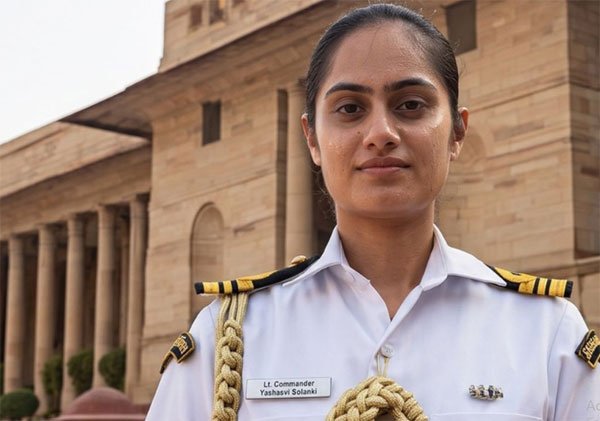
Her historic appointment at Rashtrapati Bhavan marks a significant milestone in the expanding role of women in the Indian Armed Forces
New Delhi, September 2026 : Lieutenant Commander Yashasvi B. Solanki made history in May 2025 by becoming the first woman officer from the Indian Army, Navy or Air Force to be appointed as an Aide-de-Camp (ADC) to the President of India, Droupadi Murmu.
The President is generally assisted by five ADCs — three from the Army and one each from the Navy and Air Force. Solanki’s appointment therefore marked a significant milestone in the participation of women in one of the country’s prominent ceremonial and protocol assignments.
She was formally presented with the ceremonial aiguillette on May 9, 2025, marking the beginning of her tenure. The assignment is expected to last around two and a half to three years.
Solanki has said in interviews that serving as the President’s ADC was not a specific ambition she had pursued, as she had never imagined that such an opportunity would come her way. Her selection involved a demanding process, including an interaction with President Murmu, security clearances and an orientation programme before she formally assumed charge.
Hailing from Maharashtra, Solanki had established herself as a sportsperson before joining the armed forces. She competed in badminton and volleyball at the district level. She has credited her sporting background with helping develop the discipline, focus and determination that later became important aspects of her military career.
Solanki joined the Indian Navy in 2019 as a specialised officer in the Naval Armament Inspection Cadre under the Executive Cadre. She subsequently underwent three years of extensive training related to naval weapons before being posted to Hyderabad, where she worked on defence projects for the Navy.
Officers selected for the President’s ADC appointment generally have several years of consistent service and professional experience. Solanki’s technical and logistical exposure through her naval postings gave her experience in handling responsibilities within the service before she took up the high-profile assignment at Rashtrapati Bhavan.
As an ADC to the President, Solanki is responsible for closely coordinating official engagements, keeping track of visiting dignitaries and forthcoming programmes, and accompanying the President during state functions, investiture ceremonies, diplomatic meetings and other official events.
She has spoken about the level of preparation required for the assignment, noting that ADCs must remain fully informed about the people scheduled to meet the President and the details of each engagement. This is particularly important because the President may seek information about a dignitary or programme at short notice.
Solanki’s appointment came at a time when the Indian Armed Forces were gradually expanding opportunities for women across different operational, technical and leadership roles. The Navy, in particular, has been widening the scope of responsibilities available to women officers, including opportunities related to command and cross-service assignments.
Her achievement was followed by another milestone in July 2026, when Major Navya Shekhawat of the Army Service Corps became the second woman officer overall and the first woman from the Indian Army to serve as an ADC to the President.
Solanki’s journey from competing in district-level sporting events in Maharashtra to serving alongside the President at Rashtrapati Bhavan represents a distinctive chapter in her military career. Her appointment also forms part of the broader evolution of the armed forces, as women officers take on an increasing range of professional, ceremonial and protocol responsibilities.
The two appointments together underline the gradual expansion of opportunities for women officers in prestigious assignments traditionally held by male officers, while highlighting the diverse career paths available within India’s military services.