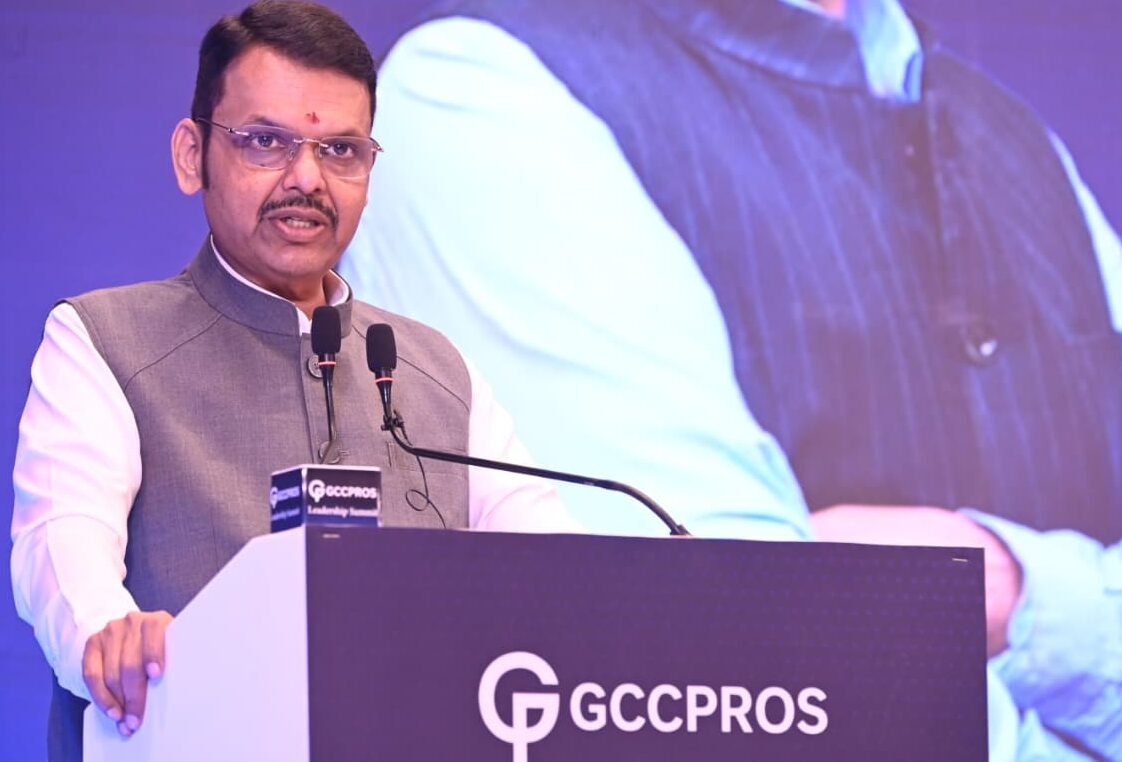
Pune, Aug 2026: Maharashtra Chief Minister Devendra Fadnavis said the state government is determined to make Maharashtra India’s leading and most preferred destination for Global Capability Centres (GCCs). The state has set an ambitious target of attracting 400 new GCCs, generating four lakh high-skilled employment opportunities and securing investments worth ₹50,000 crore.
Speaking at the GCCProJ Leadership Summit held at Hotel Conrad in Pune, Fadnavis said the nature of GCCs in India is rapidly changing. While these centres initially emerged around skilled manpower and cost efficiency, the GCCs of 2030 will increasingly serve as hubs for engineering, artificial intelligence, product development, cybersecurity, financial services, data analytics, research and development, and strategic global decision-making.
The Chief Minister said Maharashtra already possesses a comprehensive ecosystem required to support this transformation. Mumbai has a deep financial and business ecosystem, while Pune has established strengths in engineering, automobiles, manufacturing, technology and skilled manpower. Cities such as Nashik, Nagpur and Chhatrapati Sambhajinagar also have significant potential to develop specialised GCC operations.
“Maharashtra does not have just one good city; it has an entire network of cities, talent and capabilities,” Fadnavis said.
Pune Emerging as a GCC Leader
Fadnavis highlighted Pune’s growing prominence in the GCC sector, noting that the city established its credentials in 2025. Pune became India’s second-largest GCC office market, with the number of centres more than doubling compared with the previous year. He expressed confidence that Pune could emerge as the country’s leading GCC destination by the end of 2026.
He stressed that Maharashtra’s strategy would not rely solely on financial incentives. While subsidies can attract investments, a sustainable GCC ecosystem requires skilled talent, modern infrastructure, ease of doing business, quality of life, research capabilities, universities, connectivity and trust between government and industry.
The state’s GCC policy includes incentives such as wage subsidies, assistance for capital expenditure and rentals, interest subsidies, support for research and development and other financial benefits. The policy also provides for additional Floor Space Index, flexibility in land use, priority access to land, digital infrastructure, reliable utilities and facilities required for round-the-clock operations.
However, Fadnavis said the ultimate objective was capacity building rather than merely offering incentives.
Focus on Future-Ready Skills
The Chief Minister said the biggest challenge facing industries is no longer simply finding employees but ensuring the availability of people with the right skills.
He pointed to rising demand for AI engineers, data analytics professionals, cybersecurity specialists, semiconductor engineers, product managers, advanced manufacturing experts, quantitative finance professionals and life-sciences specialists.
Fadnavis called for closer cooperation between government, industry and educational institutions to create a future-ready workforce. He urged companies to guide universities on the skills that will be required over the next five years rather than focusing only on skills that were in demand five years ago.
Maharashtra to Lead in AI and Advanced Technology
The Chief Minister said Maharashtra intends to remain at the forefront of artificial intelligence and emerging technologies. He noted that an agreement was signed at Davos this year to establish a centre focused on the application, research and innovation of AI technology in Mumbai’s Bandra-Kurla Complex.
Maharashtra already has strong industrial capabilities in semiconductors, fintech, cybersecurity, advanced engineering, pharmaceutical R&D, electric vehicle technology and industrial technology. Fadnavis said the next generation of GCCs should emerge at the intersection of these capabilities.
Expanding GCCs Beyond Mumbai and Pune
Fadnavis said all 400 proposed GCCs need not be concentrated in Mumbai and Pune. While the two cities would remain Maharashtra’s principal global hubs, the government intends to bring tier-II and tier-III cities into the GCC ecosystem.
He suggested potential specialisations for different cities: Mumbai could emerge as a hub for global financial and institutional functions; Pune for engineering and product development; Navi Mumbai for global business and technology; Nagpur for specialised technology and shared services; Nashik for engineering and industrial capabilities; and Chhatrapati Sambhajinagar for advanced manufacturing and automotive activities.
Such geographical diversification, he said, would create a broader and more resilient GCC ecosystem.
Single-Window Government Support
Fadnavis said government functioning must also evolve alongside the GCC sector. Companies should not have to wait weeks or months for routine approvals. Instead, investors should receive certainty, clear responses and an accountable mechanism for resolving problems.
The state government will work towards establishing a single responsible government interface for GCCs, with one designated system handling establishment, expansion and problem resolution.
GCCs Key to $1 Trillion Economy
The Chief Minister said GCCs would play a crucial role in Maharashtra’s ambitious goal of becoming a $1 trillion economy. These centres bring not only capital but also knowledge, global business practices, research and development, leadership capabilities and high-value employment.
Deputy Chief Minister Sunetra Ajit Pawar said Maharashtra’s ambition was to evolve beyond being an operational base for GCCs and become a global centre for innovation, research, product development and advanced technology.
She said Pune’s strong technology ecosystem, skilled workforce and combination of IT and manufacturing capabilities make it well positioned for AI, robotics, cybersecurity, advanced engineering and R&D.
Pawar added that GCCs are creating employment as well as opportunities in research, intellectual property and global business. She said the government is committed to providing investors with infrastructure, connectivity, digital systems and ease of doing business.
“Maharashtra is ready, and Pune is ready,” she said.