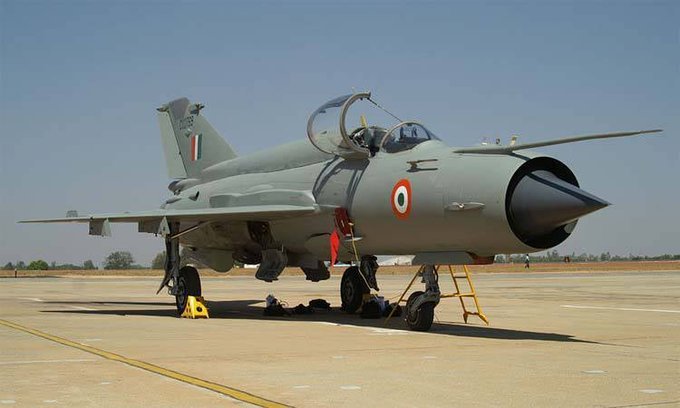
Aug 2026 : The Last Salute offers an emotional farewell to the MiG-21, one of the most iconic and controversial fighter aircraft in the history of the Indian Air Force. After serving the country for more than six decades, the Soviet-origin fighter finally bowed out of operational service in 2025. The documentary revisits that extraordinary journey through the memories of pilots, commanders, technicians and families who were closely associated with the aircraft.
Directed by former Indian Air Force officer Kushal Srivastava, The Last Salute traces the MiG-21's journey from its induction into the IAF in 1963 to its final operational flight and retirement ceremony in Chandigarh in September 2025. The film combines archival footage, cockpit visuals and personal recollections to present an aircraft that inspired both admiration and apprehension.
The documentary's strongest feature is its access to generations of pilots who flew the MiG-21. Their recollections reveal the demanding nature of operating a fast fighter that offered pilots little margin for error. At the same time, the film makes no secret of the affection many aviators developed for the aircraft.
The current Air Force Chief, Air Chief Marshal AP Singh, along with several serving and retired officers, reflects on the MiG-21's contribution to the Indian Air Force and the generations of pilots who trained and operated the fighter.
Air Chief Marshal AP Singh and veterans recall the MiG-21’s legacy
The MiG-21 became an important part of the IAF's operational history after its induction in 1963. Over the decades, more than 700 aircraft of different variants were operated by the service.
Its pilots flew the aircraft during major conflicts and through periods of significant transformation in Indian military aviation. For many aviators, the MiG-21 was not simply another fighter aircraft but the machine in which they learned the fundamentals of combat aviation.
The documentary captures this relationship particularly well. Personal stories from pilots are often more powerful than the film's dramatic presentation because they provide a direct insight into what it meant to enter the cockpit of the aircraft.
The film also attempts to challenge the image of the MiG-21 as a dangerous and outdated fighter. That image has remained one of the most controversial aspects of its Indian service history.
BS Dhanoa recalls his experience flying the MiG-21
Former Air Chief Marshal BS Dhanoa is among the strongest voices defending the aircraft's record.
Recalling his own experience, Dhanoa says:
“I myself flew 1,000 hours on a MiG, which is a hell of a lot. It was accident-free.”
He recalls that the squadron under his command experienced only two accidents involving bird strikes and says neither incident resulted in the loss of a pilot.
“The best part of the story is that when the bird hits took place, both pilots ejected in time, the ejections were safe, and they came back to flying.”
Dhanoa argues that the MiG-21's reputation cannot be assessed simply by counting crashes. He maintains that the aircraft's accident rate needs to be considered against the number of hours it was flown and compared with other fighter aircraft operated by the IAF.
“It is incorrect to say that the MiG-21 had a very bad safety record.”
He also highlights the intensive training given to pilots to deal with emergencies. According to Dhanoa, pilots developed considerable skill in managing situations such as hydraulic failures and other in-flight emergencies.
For him, the MiG-21's story is therefore also a story of pilot training, discipline and experience.
Air Marshal (Retd) NJS Dhillon says the ‘flying coffin’ image needs to be challenged
Air Marshal (Retd) NJS Dhillon also strongly objects to the aircraft's portrayal as a “flying coffin” or “widow maker”.
He says pilots entering the cockpit needed to maintain a balance between caution and confidence.
“You must consider yourself a pessimistic optimist.”
According to Dhillon, pilots had to anticipate emergencies while also having confidence in their training and ability to respond.
He believes it is unfair to judge the MiG-21 solely through the negative image created around its accidents.
“It will be unfair to the MiG-21, to the Air Force and to the thousands of pilots who have flown the MiG-21 if we don’t contest the image that the media has projected of the MiG-21.”
Dhillon also points to the aircraft's extraordinarily long operational career.
The fact that the MiG-21 remained in IAF service for more than six decades, he argues, demonstrates that its operational value extended well beyond the criticism surrounding its accident record.
Air Vice Marshal (Retd) Prashant Mohan says criticism can be demoralising
Air Vice Marshal (Retd) Prashant Mohan takes aim at the tendency to blame an aircraft whenever an accident occurs.
Using road accidents as a comparison, he argues that repeatedly criticising the machine can have an adverse effect on the people who operate and maintain it.
“It becomes very demoralising for people.”
His argument is that aircraft accidents need to be understood in their broader operational context instead of being reduced to a simple judgment about the machine itself.
The documentary uses such views to build its defence of the MiG-21, although this is also where its limitations become apparent.
Squadron Leader Priya Sharma says pilots need to understand the machine
The perspective of younger pilots adds another dimension to the documentary.
Squadron Leader Priya Sharma, associated with the MiG-21's final chapter, says pilots must understand an aircraft before forming an opinion about it.
“You have to deeply understand an aircraft, understand a machine, before you make a statement.”
Her comments reflect the personal attachment many pilots developed to the fighter despite its demanding characteristics and advancing age.
‘It is like clipping somebody’s wings’
Wing Commander Sunil Yadav provides perhaps the most emotional description of the aircraft's retirement.
For pilots who spent years flying the MiG-21, retirement represented more than the withdrawal of an old aircraft. It marked the end of an era and the loss of a machine with which they had developed a profound connection.
“It is like clipping somebody’s wings. It is very sad to say goodbye.”
That emotional connection is one of the documentary's greatest strengths. The pilots do not speak about the MiG-21 merely as a piece of military hardware. They remember it as a machine that shaped their careers and, in many cases, their identities as fighter pilots.
The difficult question of the MiG-21’s safety record
The MiG-21's legacy, however, remains complicated.
The aircraft was involved in the highest number of crashes among IAF fighter aircraft. Government data cited by The Indian Express has recorded more than 500 MiG-21 crashes over six decades, with more than 170 pilots losing their lives. More than 20 aircraft crashed between 2010 and 2022, while 38 crashes were recorded between 2003 and 2013.
The causes varied, including technical problems, human error, bird strikes and spatial disorientation.
These figures explain why the aircraft acquired the notorious labels of “flying coffin” and “widow maker”.
The Last Salute acknowledges this controversy but does not examine it as deeply as it could have. Most of the arguments surrounding the safety record come from officers defending the aircraft. Their experiences are important, but a more balanced documentary would have benefited from examining the concerns raised by critics, accident investigators and families of personnel who lost their lives.
A farewell that is emotional but incomplete
The documentary works best as a tribute rather than as a definitive historical assessment.
Its cockpit footage, archival material and interviews successfully recreate the atmosphere surrounding the MiG-21's long service. The inclusion of families and maintenance personnel is particularly valuable because it demonstrates that the story of a fighter aircraft extends far beyond the pilot sitting inside the cockpit.
The film also captures the extraordinary transformation of Indian military aviation during the MiG-21's lifetime. From its arrival in the 1960s to its final sortie in 2025, the aircraft witnessed wars, technological changes and the emergence of an increasingly modern Indian Air Force.
Yet the film's affectionate approach sometimes becomes overly reverential. The emotional music and presentation reinforce the sense that the documentary is primarily a farewell from those who loved the aircraft.
That is not necessarily a weakness in itself. But a more comprehensive examination of the MiG-21 would have addressed both sides of its legacy with equal seriousness: its contribution, achievements and influence on generations of pilots, alongside its accident history and the human cost associated with its long service.
Ultimately, The Last Salute succeeds in doing what its title promises — giving the MiG-21 a final salute.
It preserves the memories of the pilots who flew it and records the emotions surrounding the end of an extraordinary chapter in Indian aviation.
The MiG-21 was undoubtedly an aircraft that inspired loyalty and affection among generations of Indian Air Force personnel. But its legacy is also inseparable from the controversies surrounding its safety record.
That contradiction is what makes the MiG-21's story so compelling.
As an emotional goodbye from the men and women who knew the aircraft best, The Last Salute is effective and often moving. As a complete examination of the fighter's complicated six-decade legacy, however, it leaves important questions still waiting for answers.
The Last Salute
Director & Writer: Kushal Srivastava
Production House: Matchbox Shots
Producers: Sanjay Routray, Sarita Patil, Mihika Routray, Antara Srivastava
Executive Producers: Pooja Raheja, Lakshya Gupta
Supervising Producer: Ashwani Mishra
Cinematography: Gagandeep, Mohammad Javed, Rishabh Srivastava
Editor: Raunak Phadnis
Poem Recitation: Sharad Kelkar
Platform: Netflix
Genre: Documentary
Featuring
Air Chief Marshal A.P. Singh, Chief of the Air Staff, along with generations of serving and retired Indian Air Force pilots and officers, including Air Chief Marshal (Retd) B.S. Dhanoa, Air Marshal (Retd) NJS Dhillon, Air Vice Marshal (Retd) Prashant Mohan, Air Commodore S.S. Tyagi, Squadron Leader Priya Sharma and Wing Commander Sunil Yadav.
The documentary chronicles the MiG-21's final chapter in the Indian Air Force through the personal experiences of the pilots who flew the legendary fighter.
Maverick Team Rating: ⭐⭐⭐½ 3.5/5
Verdict: An emotional and affectionate farewell to an iconic fighter, elevated by powerful first-hand accounts from IAF veterans, but held back by its largely one-sided treatment of the MiG-21's controversial safety record.
Disclaimer: This review is based on the reviewer’s individual perspective. Audience opinions may vary.