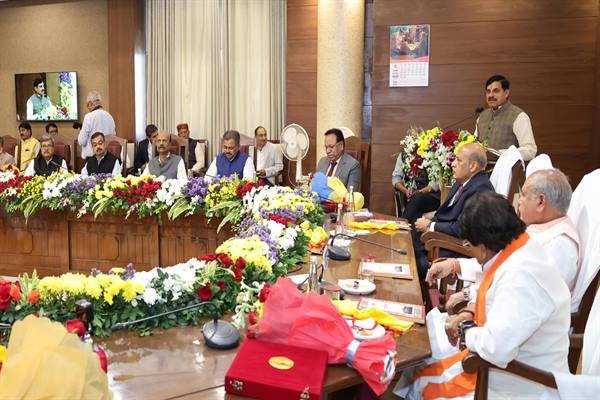
Chief Minister Dr. Mohan Yadav said that Constitution Day Celebrations 2026 reflect our glorious heritage and traditions. Equality and fraternity are the soul of our Constitution, and Madhya Pradesh played a significant role in its making. He said Madhya Pradesh made an important contribution to the decision to name the country ‘Bharat’ instead of ‘India’. Seth Shri Govind Das and Shri Hari Vishnu Kamath, who represented the Madhya Bharat region, strongly advocated the name Bharat in place of India. Madhya Pradesh also played an important role in opposing the suspension of Fundamental Rights.
Chief Minister Dr. Yadav recalled that Dr. Harisingh Gour had emphasised in 1921 the need to establish a Supreme Court within the country to ensure that the highest judicial decisions were delivered in India. In 1928, Pandit Motilal Nehru also supported this view. Former Chief Ministers of Madhya Pradesh, Pandit Ravishankar Shukla and Bhagwant Rao Mandloi, among others, raised issues concerning the contributions of the States and the Centre, as well as the distribution of taxes. In the present era, Prime Minister Shri Narendra Modi has strengthened the system through the implementation of GST, introducing a simplified framework in coordination with the States. The Chief Minister also highlighted Madhya Pradesh’s connection with the national emblem of India, the Ashoka Pillar with its four lions. Late Pandit Dinanath Bhargava played an important role in illustrating the Constitution.
Chief Minister Dr. Yada further said that Madhya Pradesh has passed the Uniform Civil Code (UCC) in the Legislative Assembly. The issue was first raised by Rajkumari Amrit Kaur. Equal civil rights require that matters such as marriage, divorce and succession should not be viewed on religious grounds. In the spirit of ‘One Nation, One Law and One Head’, several State governments have taken steps towards implementing the UCC under the leadership of Prime Minister Shri Modi. One day, Parliament will also pass the Uniform Civil Code. The Chief Minister was addressing the Constitution Day celebrations organised at the Madhya Pradesh Legislative Assembly premises.
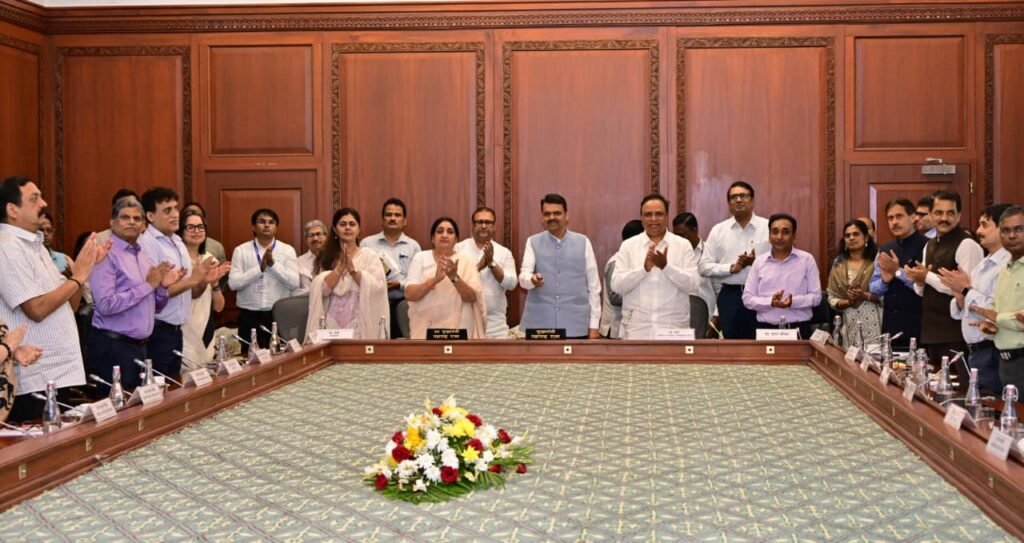
Preamble of the Constitution recited collectively
Chief Minister Dr. Yadav and Speaker of the Legislative Assembly Shri Narendra Singh Tomar garlanded the statue of Dr. B.R. Ambedkar, the architect of the Constitution, on the Assembly premises. Chief Minister Dr. Yadav, Assembly Speaker Shri Narendra Singh Tomar and Parliamentary Affairs Minister Shri Kailash Vijayvargiya released the Constitution Day special edition of the Assembly’s quarterly magazine, Vidhayini.
The Preamble to the Constitution was recited collectively under the leadership of Assembly Speaker Shri Tomar. The programme began with the singing of Vande Mataram and the National Anthem, Jana Gana Mana.
Speaker Shri Tomar announced the launch of the Madhya Pradesh Legislative Assembly’s YouTube channel. An exhibition on the extensive representation of Madhya Pradesh in the Constituent Assembly was also inaugurated in the Assembly’s Central Hall. A gallery showcasing the portraits and contributions of eminent personalities who contributed to the making of the Constitution was opened in the Legislative Council area.
The guests were welcomed with bouquets and mementoes. Chief Minister Dr. Yadav also felicitated the son of Shri Dinanath Bhargava, the artist who illustrated the Constitution. It is noteworthy that Late Shri Bhargava illustrated the Ashoka Pillar on the first page of the Constitution.
Press freedom and freedom of expression curtailed during the Emergency
Chief Minister Dr. Yadav said that the Preamble to the Constitution also mentions the dates according to the Vikram Samvat and Shaka Samvat calendars. The Constitution came into force in 1950, and the then Prime Minister introduced the First Constitutional Amendment in 1951, followed by the Second Amendment in 1954. He said that although Parliament has the constitutional authority to amend the Constitution, amendments were also made without following the proper constitutional process. This reflected the approach of the then government towards the Constitution. The same attitude was evident in the imposition of the Emergency following the Allahabad High Court verdict and in the 39th and 42nd Constitutional Amendments, which altered several constitutional provisions. Attempts were also made to curtail the powers of the judiciary.
During the Emergency, restrictions were imposed on the country's distinguished press and media, as well as on freedom of expression. Former Prime Minister Late Shri Rajiv Gandhi challenged the Supreme Court's verdict in the Shah Bano case. Subsequently, in 1988, the Defamation Bill was introduced to restrict press freedom.
Nation’s Freedom and Constitution Secured through Sacrifices of Countless martyrs—We are proud of our Constitution
Assembly Speaker Shri Narendra Singh Tomar extended greetings on the 77th Constitution Day and said that our forefathers gave the nation a Constitution that would remain relevant in every era. While August 15 and January 26 are celebrated as national festivals, the observance of November 26 as Constitution Day was initiated by Prime Minister Shri Narendra Modi. He said that the programmes organised on this occasion are enhancing public awareness and knowledge. The Constitution provides for both rights and duties, and all citizens must place special emphasis on fulfilling their duties. The country's freedom and Constitution are the result of the dedication and sacrifices of countless immortal martyrs, and every Indian should take pride in the Constitution.
Our forefathers ensured that no section was left out of the constitutional framework. The provision for constitutional amendments has also enabled important changes, including the abrogation of Article 370 and the prohibition of triple talaq. He said that Madhya Pradesh, under the leadership of Chief Minister Dr. Yadav, is also playing an important role in ensuring that every citizen enjoys their rights and that India becomes a developed nation by 2047. Today, India is progressing in every sector and establishing a distinct identity across the world.
PM Shri Modi is Committed to Empowering Poor, Farmers, Women and Tribal Communities
Parliamentary Affairs Minister Shri Kailash Vijayvargiya said that Prime Minister Shri Narendra Modi has resolved to empower the villages, the poor, farmers, women and tribal communities of the country and ensure that they live with dignity. He said that the Prime Minister has strengthened the dignity and security of the poor through initiatives such as the provision of toilets and Jan Dhan bank accounts. The government is also moving forward in the direction of Nari Shakti Vandan. Minister Shri Vijayvargiya recalled that revered former Prime Minister Shri Atal Bihari Vajpayee worked towards securing the Right to Education for the people of the country. Prime Minister Shri Modi’s resolve of ‘Sabka Saath, Sabka Vikas, Sabka Vishwas’ reflects the very spirit of the Preamble to the Constitution.
Minister Shri Vijayvargiya said that Babasaheb Dr. B.R. Ambedkar gave the country one Constitution, yet the nation also witnessed a situation of multiple laws and symbols. The soul of the Constitution lies in democracy, equal rights and the empowerment of weaker sections. Governments are working towards these objectives. He added that the Constitution defines the responsibilities of both the ruling party and the Opposition. The Opposition may disagree on any issue, but no one has been given the right to create anarchy.
The programme was also addressed by Madhya Pradesh Legislative Assembly Principal Secretary Shri Arvind Sharma and Lokayukta Shri Satyendra Kumar Singh. Advisor Shri Pankaj Shukla highlighted the contents of the Constitution Day special edition of the Assembly’s quarterly magazine, Vidhayini.
Chief Secretary Shri Ashok Barnwal, chairpersons of various commissions, vice-chancellors of universities and other senior officers were present at the Constitution Day celebrations.