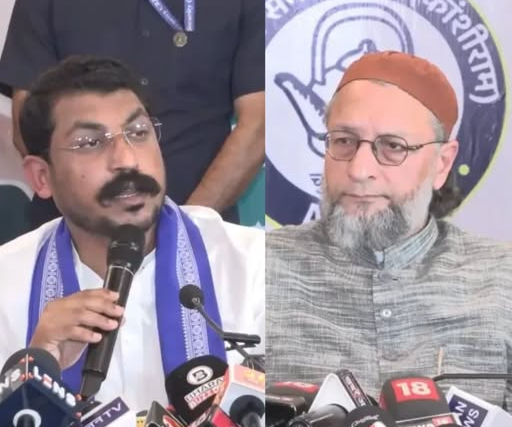
Lucknow, November 2026 : The political contest for the 2027 Uttar Pradesh Assembly elections gained a new dimension on Thursday with All India Majlis-e-Ittehadul Muslimeen (AIMIM) president Asaduddin Owaisi and Azad Samaj Party (Kanshiram) chief Chandrashekhar Azad announcing an electoral alliance under the banner of the Samajik Parivartan Morcha (SPM).
At a press conference in Lucknow, the two leaders formally unveiled the new political formation, with Owaisi declaring Chandrashekhar Azad as the alliance's chief ministerial candidate for the 2027 Uttar Pradesh Assembly polls.
Describing the partnership as an effort to bring about political and social change in the state, Owaisi said the alliance would remain open to other political parties, including the Samajwadi Party (SP) and the Congress, if they were willing to join hands to prevent the Bharatiya Janata Party (BJP) from returning to power.
"On behalf of our party, I would like to state that we are committed to making this Samajik Parivartan Morcha a success. It gives me great pleasure to announce that our brother, Chandrashekhar Azad, will be the chief ministerial candidate," Owaisi said.
He expressed confidence that the alliance would work towards a shared political vision and bring changes benefiting different sections of society. He also indicated that Azad's leadership would be central to implementing the Morcha's objectives.
Chandrashekhar Azad Rejects 'Third Front' Tag
Rejecting the description of the new alliance as a conventional third front, Chandrashekhar Azad said the Samajik Parivartan Morcha would represent deprived, oppressed and marginalised communities.
"People have been calling it a third front, but it is not a third front. It is the Samajik Parivartan Morcha. If you understand its depth, you will realise that it is the first front," Azad said.
He said the alliance aimed to unite weaker sections of society and help them convert their numerical strength into political representation and decision-making power. According to him, communities that lack an independent political voice often struggle to protect their interests, even when they constitute a substantial part of the population.
Invoking the ideals of Dr B R Ambedkar, Azad described political power as the "master key" to resolving people's problems. He referred to Ambedkar's efforts to establish organisations such as the Scheduled Castes Federation, the Indian Labour Party and the Republican Party of India, arguing that these initiatives sought to secure political representation for marginalised communities.
Azad also alleged that successive governments had failed to fulfil promises to bring deprived sections into the mainstream, eliminate poverty and prevent atrocities against them.
SPM May Contest Around 150 Assembly Seats
The newly announced alliance is reportedly considering contesting around 150 constituencies in Uttar Pradesh. However, the final seat-sharing formula and the list of constituencies are yet to be announced.
The alliance announcement followed criticism of the Samajwadi Party by AIMIM's Uttar Pradesh president Shaukat Ali. Ali had claimed that AIMIM approached both the SP and Congress with proposals for an alliance, but the parties rejected them.
He accused the SP leadership of arrogance and said AIMIM would challenge Akhilesh Yadav in Uttar Pradesh in the same way it had challenged RJD leader Tejashwi Yadav in Bihar.
Ali also claimed that his party would restrict the Samajwadi Party to just 27 Assembly seats in the 2027 elections. These remarks underline the political differences between AIMIM and the SP as parties begin preparing for the next electoral contest.
Dalit-Muslim Consolidation at the Centre of Alliance Strategy
The Owaisi-Chandrashekhar Azad partnership is expected to focus on bringing Dalit and Muslim voters under a common political platform. Muslims account for approximately 20 per cent of Uttar Pradesh's population, while Dalits constitute around 21 per cent, according to the figures cited in the source material.
Muslim voters are considered influential in nearly 143 Assembly constituencies, while Dalit voters are significant in around 150 seats. These communities therefore form an important part of the state's electoral landscape.
The new alliance could seek to challenge the Samajwadi Party's traditional support among Muslim voters and the Bahujan Samaj Party's (BSP) established Dalit support base. Its political strategy will depend on its ability to build a shared platform, mobilise voters and establish a presence across constituencies.
With Chandrashekhar Azad named as its chief ministerial candidate, the Samajik Parivartan Morcha has announced its leadership ahead of the 2027 Uttar Pradesh Assembly elections. Its seat-sharing arrangements, possible expansion and ability to consolidate support among marginalised communities will become clearer as the election approaches.
(Disclaimer :The content of this article is sourced from a news agency and has not been edited by the Mavericknews30 team.)