Castel Gandolfo, Aug 2026 : Pope Leo XIV on Saturday called on the faithful to look beyond worldly standards of beauty and discover the transforming power of love, saying that genuine beauty is revealed through charity, faith and selfless service rather than youth, appearance or material possessions.
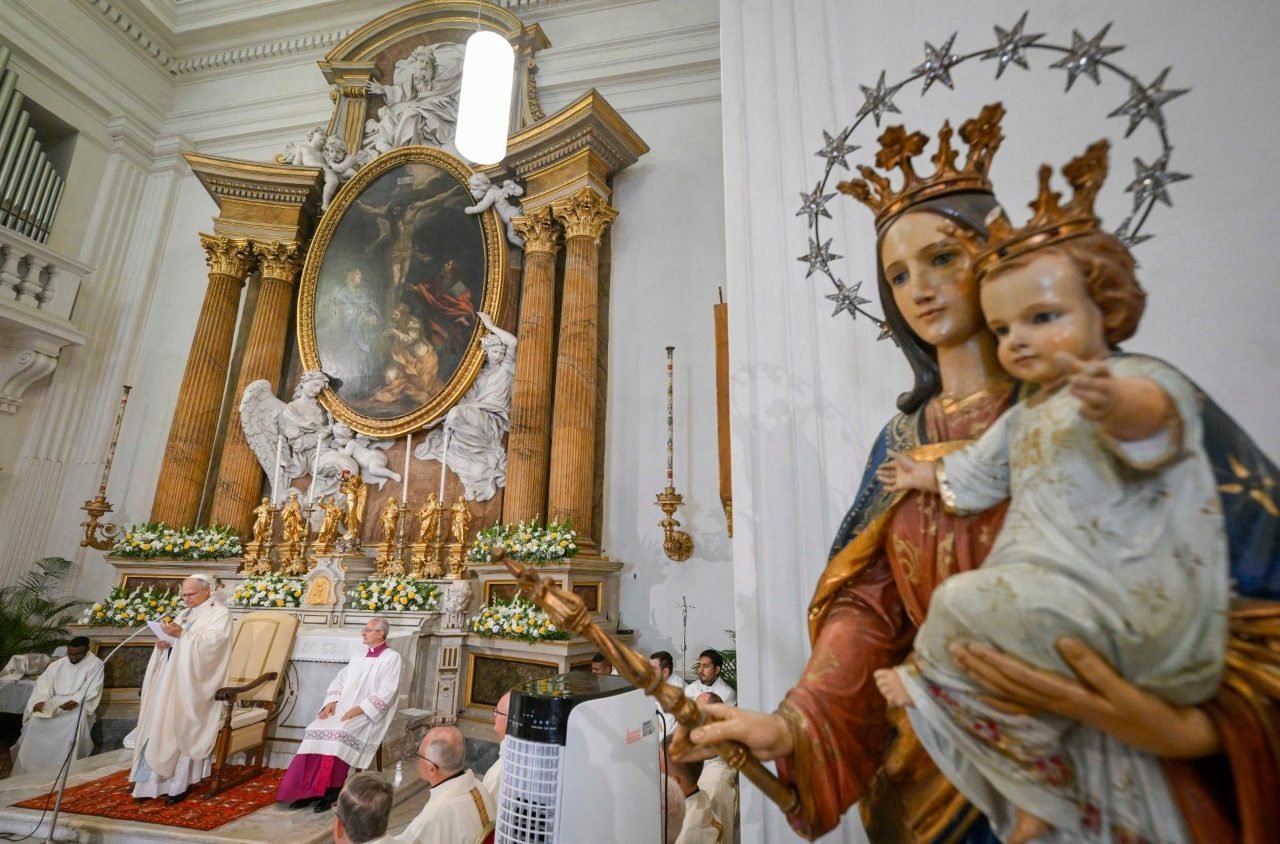
The Pope made the remarks while celebrating Mass for the Solemnity of the Assumption of the Blessed Virgin Mary at the Pontifical Parish of Saint Thomas of Villanova in Castel Gandolfo. Reflecting on Mary’s assumption into heavenly glory, Pope Leo said the feast offers Christians a profound reminder of their own call to holiness and eternal life.
The Holy Father began his homily by expressing his joy at celebrating the Solemnity of the Assumption once again with the parish community. He explained that the Church teaches that Mary, having completed her earthly life, was assumed body and soul into heavenly glory. The mystery, he said, represents the fulfilment of the extraordinary grace bestowed upon her by God from her Immaculate Conception.
Pope Leo pointed to the imagery associated with Mary in Christian art, particularly the vision from the Book of Revelation of a woman “clothed with the sun, with the moon under her feet.” The image, he explained, expresses how heaven and earth, time and eternity, come together in Mary.
Many artistic representations therefore portray Mary as a beautiful young woman rising from the earth toward heaven at the conclusion of her earthly journey. Yet Pope Leo acknowledged that such imagery can appear distant from the physical realities experienced by human beings as they grow older.
“As we age,” he noted, “our bodies do not become more agile, but heavier; our skin does not become fresher, but shows the signs of old age; our hair does not gain colour and lustre, but turns grey and then white.”
The Pope asked what human beings, whose bodies inevitably bear the marks of time, have in common with the youthful figure of Mary depicted in churches.
He said the answer lies in understanding together the mystery of Mary’s incorrupt body and her immaculate heart. It is the purity of the soul, Pope Leo explained, that through God’s grace illuminates and transforms the whole person and ultimately leads to the glory of Heaven.
The Assumption of Mary, he stressed, teaches that true beauty is not about concealing the marks of ageing but about revealing the signs of enduring love. Such love can leave its imprint not only on the soul but also on a person’s life and physical existence.
Pope Leo consequently urged Christians to reconsider contemporary standards of beauty, many of which he described as heavily influenced by hedonism and consumerism. These standards, he warned, can burden people with unrealistic expectations and cause them to devote time and energy to things that ultimately have little lasting value.
Instead, the Pope encouraged the faithful to recognise divine beauty in every stage and circumstance of human life. He said it can be found in the wrinkles of an elderly person as well as in the innocent face of a child, in the maturity of an adult and the enthusiasm of a young person, and in both everyday work clothes and festive celebrations.
Such moments, he said, can provide “small glimpses of heaven” when people learn to recognise the love and dignity contained within them.
“Love is humanity’s most beautiful adornment,” Pope Leo declared, explaining that love “transfigures, transforms, ennobles and lifts us up,” making people lighter, freer and closer to God despite the difficulties and uncertainties of life.
Reflecting further on the Assumption, the Pope referred to an observation by Pope Saint Paul VI that understanding the mystery requires Christians to transform earthly and temporal language into “superlative and absolute” terms so that they can attempt to imagine eternal realities on a human scale.
Pope Leo also recalled Pope Francis’ reflection on the meeting of the infinite and finite in Mary’s life. Mary, he noted, was able to transform a humble stable into a home for Jesus, despite having only poor swaddling clothes, because it was filled with an abundance of love.
For Pope Leo, this captures something essential about the mystery of Mary. The young woman from Nazareth experienced within her innocent heart a meeting of extremes that ultimately led her to heavenly glory. Her own words in the Magnificat bear witness to this extraordinary encounter between human humility and divine greatness.
Through the simple and humble language of her hymn of praise, Mary speaks of profound mysteries, including God becoming man within her to save humanity and the Eternal One entering human history to reopen the path toward eternity.
The Pope also recalled Mary’s identity as the “humble servant” of the Lord. Referring to Pope Saint Paul VI, he said Mary demonstrates the humble dimension through which ordinary people can encounter God.
Pope Leo stressed that Christians do not have to search in distant or extraordinary places to discover the greatness of the mystery celebrated on the Feast of the Assumption. Wherever genuine charity exists, he said, there is an opportunity to encounter something of the divine.
He gave the example of parents returning home after a long and tiring day, exhausted but happy to reunite with their children. He also pointed to grandparents who, despite the physical difficulties and pains associated with old age, find renewed energy and joy while caring for their grandchildren.
Young people striving to live with morality and sincerity, even when doing so requires them to resist social pressures and reject the attitude of simply following what “everyone else does,” also reveal this beauty, he said.
Likewise, Pope Leo highlighted the daily efforts of countless men and women who carry out their work with dedication and faith. Through their ordinary responsibilities, he said, they help bring “a little bit of Heaven to earth” and draw earth closer to Heaven.
Turning again to Mary, the Pope said that the face of Our Lady of the Assumption is unique and transcends every artistic representation. Yet, paradoxically, it is also familiar because traces of that divine beauty can be recognised in people encountered every day.
“Even at this very moment,” Pope Leo said, the faithful can see Mary’s face in the people around them, including brothers and sisters with whom they share the daily offering of their lives through faith.
He explained that in Mary’s holy humanity, believers can recognise their own human nature. Because of this, Christians are also called to live a life transformed by grace and ultimately to share in the glory promised by God.
The Pope then invoked the teaching of St Augustine, who encouraged Christians to make Christ’s Resurrection the compass and centre of their lives. Referring to Augustine’s call to “change course” and follow the light, Pope Leo urged the faithful to embrace the same invitation.
He said Christians must be willing to change direction whenever necessary and allow the light of the Risen Christ to guide their lives. The Christian journey toward Heaven, he suggested, begins in the ordinary circumstances of life, through choices rooted in faith, love, humility and service.
Concluding his homily, Pope Leo invited the faithful to look toward Mary as the model and companion for their own journey. He described her as the woman whom God has crowned with glory in body and soul and entrusted to humanity as Mother, guide, companion and protector.
The Feast of the Assumption, therefore, is not simply a celebration of Mary’s heavenly glory, but also a reminder of the destiny to which all believers are called. Through grace and love, Pope Leo said, human beings can allow their lives to be transformed and lifted toward God.
By directing attention away from fleeting standards of physical perfection and toward enduring signs of love, the Pope presented the Assumption as a message of hope for people of every age. In Mary, he said, Christians see both the fulfilment of God’s grace and a reflection of their own vocation to holiness.
As the faithful look toward the Mother of God, Pope Leo encouraged them to recognise that Heaven is not entirely distant from earthly existence. It can already be glimpsed wherever love, sacrifice, compassion, faith and genuine charity are present.
The Pope’s message ultimately placed love at the heart of the Christian understanding of beauty: a force capable of transforming ordinary lives, overcoming the limitations of time and drawing humanity closer to the eternal presence of God.
(The content of this article is sourced from a news agency and has not been edited by the Mavericknews30 team.)