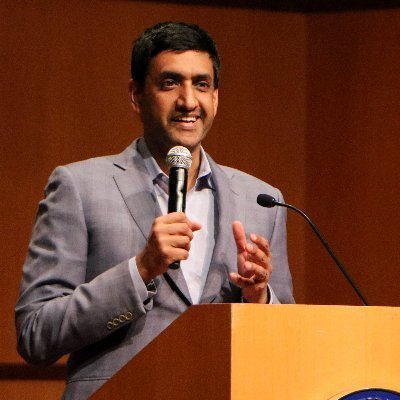
Washington, Aug 2026 : Indian-American Congressman Ro Khanna has called for a new economic agenda for the Democratic Party centred on workers, reindustrialisation and ensuring that the benefits of artificial intelligence reach communities across the United States, while keeping open the possibility of a presidential campaign in 2028.
The California Democrat stopped short of announcing a White House bid but used a television interview on Sunday to outline what he described as “economic patriotism” — a national economic vision aimed at addressing inequality, rebuilding industrial communities and ensuring technological growth benefits ordinary Americans.
“For me, I'm most focused on a national economic vision for this country,” Khanna said. Representing a district that includes parts of Silicon Valley, he argued that the current economic model has generated enormous wealth for a small number of people while leaving many working-class communities behind.
Khanna said Democrats had lost support because they failed to adequately address the concerns of workers and communities affected by deindustrialisation.
“The Democrats' path back out of the wilderness is to have a clear national economic message,” he said, arguing that the party had “left out the working class” and failed communities that had lost their industrial base.
AI Benefits Must Reach Wider Communities
A major part of Khanna’s economic vision focuses on artificial intelligence. He questioned how the country could ensure that AI does not primarily benefit technology billionaires and companies concentrated in Silicon Valley.
“How are we going to make sure AI is not just working for a few billionaires, but is working for communities that were de-industrialised?” he asked.
Khanna also proposed a “data centre bill of rights” to give local communities greater control over where large data centres are constructed. He argued that such facilities should not be built in residential neighbourhoods or on farmland without local approval.
At the same time, he acknowledged that the United States needs more data centres to remain competitive in AI. However, he said their impact on electricity prices, communities and land use must be carefully regulated.
Progressive Agenda
Khanna also reiterated several progressive policy positions, including support for Medicare for All, a tax on billionaires and an end to foreign wars.
He described Medicare for All as “arguably the most important priority” and said the proposal should receive a vote in the House of Representatives, claiming that a majority of House Democrats would support it.
Asked whether he would be a stronger progressive presidential contender in 2028 than Congresswoman Alexandria Ocasio-Cortez, Khanna praised her as a “phenomenal talent” and said the progressive movement would have multiple voices.
Rather than directly comparing himself with Ocasio-Cortez, he focused on the need for a broader economic programme capable of rebuilding support among working-class voters.
Khanna’s comments come as potential Democratic contenders begin positioning themselves ahead of the party’s 2028 presidential race. The son of Indian immigrants, he has emerged as a prominent Democratic voice on technology, economic policy and foreign affairs.
His emphasis on industrial revival, worker-focused policies and responsible AI development could become a central part of the broader debate over how Democrats seek to rebuild their national coalition in the years ahead.
(The content of this article is sourced from a news agency and has not been edited by the Mavericknews30 team.)