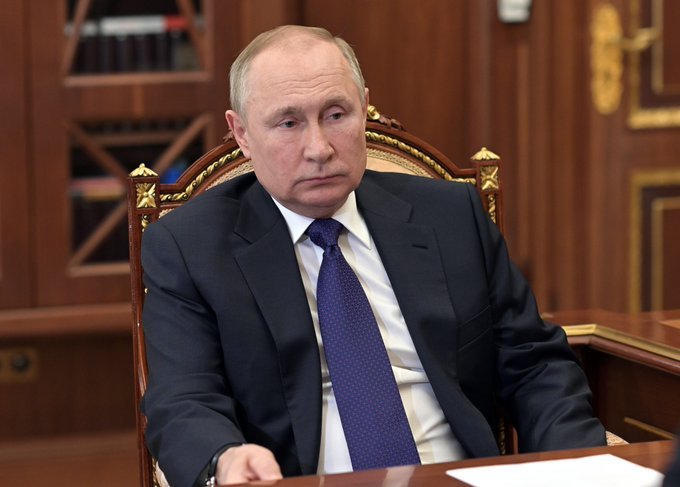
Moscow, Oct 2026: Russian President Vladimir Putin is turning to higher taxes and additional revenue measures to finance government expenditure and sustain the ongoing war in Ukraine, as rising military spending, sluggish economic growth and Western sanctions put increasing pressure on the country's public finances.
Russia's proposed 2027-2029 state budget, scheduled for consideration by parliament on Thursday, comes alongside a series of tax increases announced after the September parliamentary elections. The measures are intended to shore up government revenues as the Kremlin faces mounting budgetary pressures and an economy increasingly dependent on military-related industries.
Unlike last year's broader tax increases, which raised value-added tax (VAT) and expanded the number of small businesses liable to pay it, the latest proposals focus on mining companies, wealthier individuals and certain financial transactions. The changes could nevertheless have wider economic consequences by increasing costs for businesses, investors and consumers.
Russia's Budget Deficit Widens Amid War Spending
Russia's budget deficit has expanded beyond earlier projections as the government continues to spend heavily on its military campaign in Ukraine. Economic growth has remained subdued amid international sanctions, elevated interest rates for civilian businesses, labour shortages and Ukrainian strikes targeting oil refineries and export infrastructure.
According to the Kyiv School of Economics, Russia's budget deficit reached 5.8 trillion rubles, or approximately $72 billion, through August. This was nearly 50 per cent higher than the corresponding figure last year and exceeded the government's already revised deficit target of 4.8 trillion rubles.
The rising deficit has increased pressure on the government to identify additional sources of revenue without relying excessively on borrowing or depleting its remaining financial reserves.
Under the proposed measures, mining companies that have benefited from higher commodity prices will face a windfall profits tax of between 20 and 30 per cent. The levy is expected to affect producers of iron ore, nickel and gold.
The government has also proposed increasing tax rates on income earned from interest, dividends and property sales. Under the existing system, such income is generally taxed at 13 per cent for amounts below 2.4 million rubles, or around $29,800, and 15 per cent above that threshold. The proposed rates would range from 13 to 22 per cent.
Additional measures scheduled to take effect on January 1 include a 100-ruble charge per parcel and a 22 per cent VAT on certain imported goods purchased online that were previously exempt from the tax because their value was below 200 euros. Another proposal introduces a 35 per cent tax on dividends paid into restricted accounts belonging to foreign investors from countries designated by Moscow as "unfriendly".
Together, these steps reflect the Kremlin's effort to mobilise domestic resources as the financial demands of the war continue to compete with civilian economic priorities.
Russians Express Resignation Over Higher Taxes
Public reactions in Moscow reflect a mixture of frustration, resignation and support for the government's stated military objectives.
Denis Bystrov, 39, said the authorities needed to collect more money from ordinary citizens to replenish state coffers.
"What can you do?" said Nelly Godunova, 92, who noted that she had received four university degrees without paying tuition fees. She acknowledged that citizens had contributed to the country over their lifetimes but argued that those who earned money should be prepared to give something back.
Sergei Sukachev, a businessman approaching 70, said he understood that the additional revenue would support what the Russian government calls its "special military operation" in Ukraine. Although he acknowledged experiencing difficulties in his business, he said he believed it was important for Russia to persevere.
Such views illustrate the competing pressures facing Russian society as the government attempts to maintain public support for the war while asking businesses and individuals to shoulder a greater share of its financial burden.
Military Spending Crowds Out Civilian Investment
Chris Weafer, chief executive of consultancy Macro-Advisory Ltd, said Russia had sufficient financing options to cover its budget deficit in 2027 and potentially in 2028. However, he warned that the government would increasingly have to rely on higher taxes and rising costs for households and businesses.
The resulting pressure could leave fewer resources for infrastructure, civilian industries and broader economic development.
According to Weafer, Russia's budget is entering a phase in which military expenditure and the war effort are taking precedence over other priorities. Although the economy continues to register modest growth, that expansion is being driven largely by state spending and industries connected to the government.
Other parts of the economy, particularly businesses that do not benefit directly from defence spending, are struggling under high borrowing costs, labour shortages and the effects of sanctions.
The growing imbalance raises questions about the sustainability of Russia's economic model if military spending remains elevated for an extended period.
Foreign Companies Face Pressure to Contribute
The financial demands of the war have also raised concerns about the treatment of foreign businesses operating in Russia.
A Russian subsidiary of German retailer Metro was seized under legislation allowing temporary state administration of companies associated with countries Moscow considers unfriendly. The subsidiary was subsequently tapped for a contribution of one billion rubles, or approximately $12 million, to a fund supporting the war effort.
Metro AG's headquarters in Germany said it had no role in the donation and that the contribution did not reflect its position or the way it conducted business.
Metro Russia, which is no longer controlled by the German headquarters, said the money would go to the "National Front - Everything for Victory" fund. It said the funds would be used to purchase vehicles, communications equipment and anti-drone systems for Russian soldiers.
Weafer suggested that Russia's takeover of foreign companies could be connected to possible negotiations over Russian assets frozen abroad. However, the forced contribution also raises the possibility that foreign-owned businesses could increasingly be viewed as sources of additional government revenue.
Such measures could further undermine investor confidence and complicate the prospects for foreign companies seeking to operate in Russia.
Financial Buffers Shrink Despite Modest Growth
On the surface, some of Russia's economic indicators appear relatively resilient. The government forecasts gross domestic product (GDP) growth of 0.6 per cent this year, while unemployment remains at a record low and public debt is comparatively modest.
Oil export earnings have also benefited from higher international prices linked to the war in Iran, helping the government support its finances. Finance Minister Anton Siluanov has said the revised budget deficit for this year would be around 3 per cent of GDP.
Although higher than the 1.6 per cent recorded last year, that figure remains below the deficit levels of several other major economies. The United States recorded a deficit equivalent to 5.8 per cent of GDP last year, while the European Union's average stood at approximately 3.1 per cent.
However, these comparisons do not fully capture the constraints facing Moscow. Western sanctions have restricted Russian banks and investors from accessing international financial markets, preventing the government from relying on conventional overseas bond financing.
Domestic financing options are also under pressure. One avenue involves selling government bonds to Russian banks, but those sales encountered difficulties during the summer when banks resisted the relatively low interest rates offered by the government. Issuance resumed after authorities improved the terms.
The government has also relied on the banking system to finance defence companies through loans, shifting some of the financial burden of the war away from the federal budget and onto the balance sheets of banks and state-controlled enterprises, according to the Kyiv School of Economics.
Another source of funding is the National Wealth Fund, established to accumulate reserves from oil and gas export revenues. However, its liquid assets available for spending, including Chinese currency and gold, have declined to the equivalent of just 1.7 per cent of GDP.
Russia's Economic Outlook Remains Vulnerable
The Kyiv School of Economics assesses Russia's public finances as stable for now, but warns that the government's room for manoeuvre is becoming increasingly limited.
A sharp fall in global energy prices or a loss of confidence in the financial system could quickly destabilise the current financial position.
For the Kremlin, higher taxes, domestic borrowing and the use of existing reserves offer ways to sustain military expenditure in the near term. Yet these measures carry economic costs, particularly if civilian investment, household purchasing power and private-sector growth continue to weaken.
Russia's ability to finance the Ukraine war will therefore depend not only on government revenue and energy exports, but also on whether its financial system can withstand prolonged military spending without creating deeper economic imbalances.
As the proposed 2027-2029 budget moves through parliament, the central challenge for Moscow will be balancing the financial demands of the war with the long-term needs of the Russian economy.
(Disclaimer :The content of this article is sourced from a news agency and has not been edited by the Mavericknews30 team.)