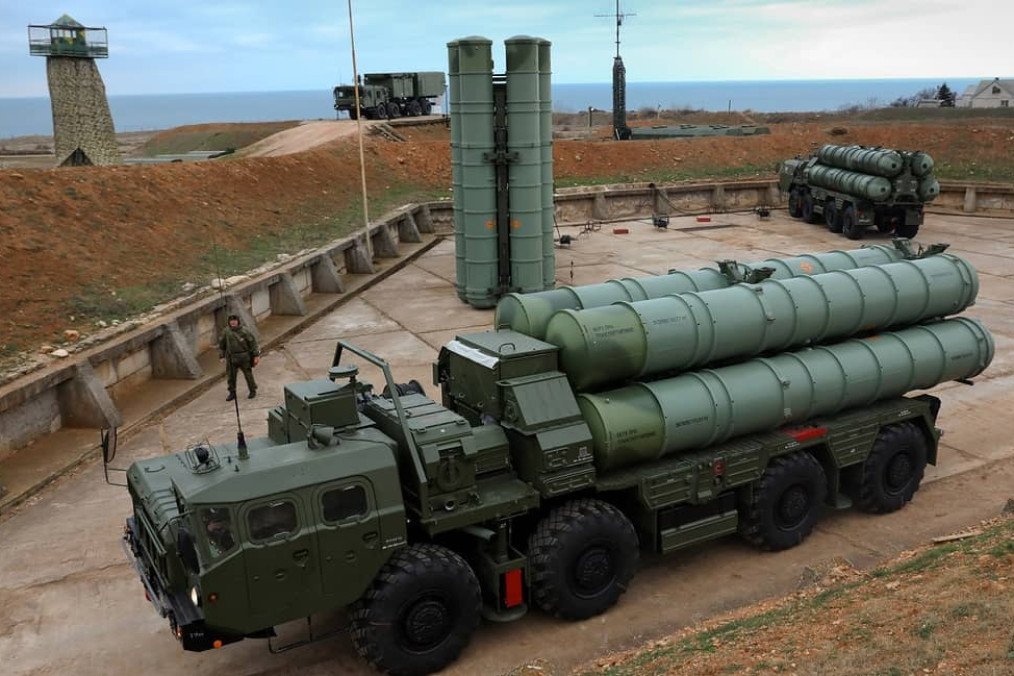
Aug 2026 : Russia is increasingly adapting elements of its advanced air-defence arsenal for offensive operations in Ukraine, reportedly converting S-300 and S-400 interceptors into weapons capable of striking fixed ground targets. Among the systems being employed is the RM-48U, derived from the 48N6 family of interceptors, which has reportedly been used in a ballistic-style role against industrial and logistical infrastructure.
Originally developed to intercept aircraft and missiles, the 48N6-series missiles possess extremely high speeds. In their modified ground-attack configuration, they can reportedly descend at speeds exceeding Mach 6, giving Ukrainian forces limited time to detect, assess and respond to incoming threats.
The RM-48U is understood to be an adaptation of older 48N6-series interceptors. Ukrainian intelligence first reported its battlefield use in January 2026, while subsequent strikes have provided further indications that Russia is incorporating such modified systems into its broader strike arsenal.
Unlike dedicated precision-guided cruise missiles, the repurposed interceptor is reportedly designed to exploit its high velocity and substantial warhead rather than achieve pinpoint accuracy. The missile is said to carry a warhead of roughly 180 kilograms, making it particularly suitable for attacking industrial sites, logistics facilities, warehouses and other large or fixed targets.
The approach provides Russia with an additional option for maintaining pressure on Ukrainian infrastructure. In July 2026, reports indicated that RM-48U missiles were employed in strikes on Kyiv's Sviatoshynskyi District, where the attacks reportedly caused significant fires and damaged facilities associated with Ukraine's defence industry.
Other reports pointed to impacts near the JSC Meridian plant in Kyiv's Solomianskyi District, a facility linked to communications and electronics production. Such strikes indicate that Russia may be seeking to disrupt Ukraine's defence-industrial capabilities and supply networks while preserving more sophisticated and limited missile systems for other missions.
One of the principal advantages of the strategy is economic. Russia has accumulated substantial stocks of older 48N6-series interceptors, including weapons that may have become less suitable for frontline air-defence duties as newer systems enter service. Converting some of these missiles into ground-attack weapons allows Moscow to extract additional value from existing inventories without having to manufacture an entirely new missile type.
The approach could also reduce pressure on Russia's stocks of more expensive precision-strike weapons, including dedicated cruise and ballistic missiles. By relying on modified interceptors for selected targets, Russia can potentially sustain a high tempo of attacks while conserving its most advanced weapons for strategically important missions.
The conversion also creates a difficult challenge for Ukrainian air defences. A high-speed missile launched against a ground target can force Ukraine to deploy expensive defensive interceptors in response. Systems such as Patriot and NASAMS are limited in availability, and repeatedly using them against relatively inexpensive converted missiles can create an unfavourable cost and logistical equation.
The missile's speed further complicates interception. A projectile travelling at several times the speed of sound can significantly shorten the time available for detection and engagement, particularly when approaching along a ballistic trajectory.
However, the repurposed weapons have an important limitation: accuracy. Air-defence interceptors are originally designed to engage moving aerial targets rather than strike predetermined coordinates on the ground. Their guidance architecture is therefore not necessarily comparable with that of dedicated precision ballistic or cruise missiles.
That limitation becomes less significant when the target is a large industrial complex, logistics hub or warehouse network. Even an inaccurate strike can cause considerable damage when the target covers a wide area.
The reported use of RM-48U missiles therefore adds another layer to the already complex threat environment facing Ukraine. Ukrainian forces must contend with drones, cruise missiles, ballistic weapons and now increasingly unconventional adaptations of existing Russian air-defence systems.
The strategy also illustrates Moscow's effort to maximise the military value of available resources. Instead of allowing older interceptors to become obsolete, Russia can potentially convert them into offensive weapons, extending their operational life and creating additional pressure on Ukrainian defences.
For Ukraine, the development means that identifying the type and intended role of an incoming missile is becoming increasingly difficult. Air-defence planners must account for weapons that may have originated as defensive systems but are now being used offensively.
Russia's reported adaptation of the S-300 and S-400 interceptor family ultimately reflects a pragmatic approach to sustaining its strike campaign. By repurposing existing missile stocks, Moscow can expand its range of attack options, conserve high-value precision weapons and force Ukraine to commit scarce air-defence resources. As the conflict continues, such adaptations could remain an important feature of the evolving missile war.
(Disclaimer :The content of this article is sourced from a news agency and has not been edited by the Mavericknews30 team.)