
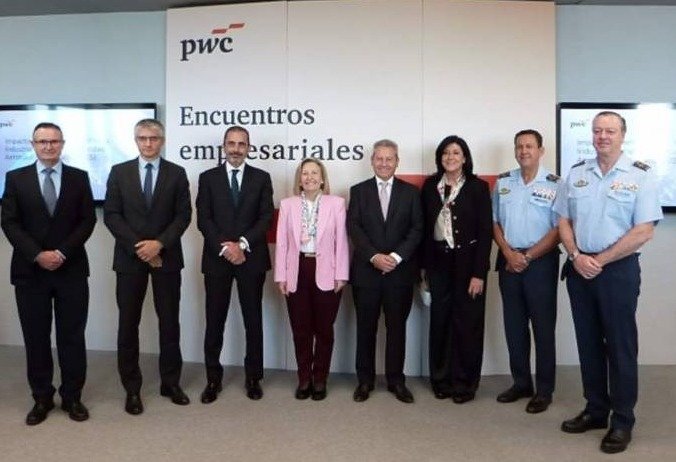
Madrid; October 2026: PwC (PricewaterhouseCoopers), a global professional services network has issued a report - "Economic and Social Impact of the Defence, Security, Aerospace, and Space Industry”, in which it has been asserted that Spain's defence, security, aerospace, and space industries consolidated their economic and industrial expansion in 2025, with a combined revenue of €18,034 billion, an 11.6% increase over the previous year. The sector contributed €24.425 billion to the national GDP, supported 289,938 jobs, and achieved exports worth €10.821 billion.
The report identifies these activities as one of the country's main industrial drivers within a context of strengthening European defence capabilities, reconfiguring supply chains, and a growing interest in reducing external technological dependencies. The total contribution of the industries integrated into TEDAE (the Spanish Association of Defence, Security, Aeronautics and Space Technology Companies) is equivalent to 1.45% of Spain's GDP and 13.7% of its industrial GDP, having grown by 11.4% compared to 2024, representing an additional €2.5 billion in one year.
The report further highlights the significant impact of the defence, security, aerospace, and aerospace industries on the rest of the economy. For 01 euro of direct GDP generated by these companies, 2.3 euros are mobilised throughout the Spanish economy, including indirect effects on suppliers and those induced by employment-related consumption.
The importance of this activity therefore extends beyond the main manufacturers. The ecosystem includes companies in engineering, electronics, software, communications, advanced materials, maintenance, logistics, aeronautical components, and space systems, among other sectors. This network of suppliers helps to extend the industrial impact to various autonomous communities, with a particularly strong presence in Madrid, Andalusia, the Basque Country, Castile-La Mancha, and Galicia.
Turnover grew in all four sectors analysed by TEDAE. Aeronautics maintained the highest business volume, with €12.08 billion, 6.2% more than in 2014. Within this sector, defence aeronautics advanced by 7.7%, while civil aeronautics increased by 4.8%.
Defence and security revenues reached €10,877 billion, a year-on-year increase of 16.2%. The highest growth rates were recorded in naval defence, with a rise of 46.4%, and land defence, with an increase of 22.2%. The space industry generated €1,416 billion in revenue, 9.5% more than the previous year.
The activity of these industries supported 289,938 jobs, including direct, indirect, and induced employment, which is equivalent to 1.3% of national employment and 12.1% of Spanish industrial employment. This figure represents more than 30,000 additional jobs compared to 2024 and a total growth of 11.5%.
Direct employment in the sector grew by 10.6%, a rate 4X higher than that observed in the Spanish labour market as a whole, according to PwC and TEDAE. The report estimates that each direct job linked to these activities generates another 3.5 jobs in the national economy. Economic sources have specified that the sector had 83,453 direct jobs and more than 206,000 indirect and induced jobs by 2025.
The technological profile and complexity of the activities largely explain this capacity to generate skilled employment. The industry demands professionals in engineering, advanced manufacturing, cybersecurity, artificial intelligence, electronics, mission systems, secure communications, data analysis, and space operations, among others.
International reach is another key indicator. Exports totalled €10,821 billion in 2025, equivalent to 60% of the consolidated revenue of the industries analysed. Over the last four years, export volume has doubled. Furthermore, the products of these sectors are 4.8 times more complex than the average Spanish export, a characteristic that reinforces their strategic value and their ability to compete in high-tech markets.
Innovation remains one of the sector's distinguishing features. The total impact associated with R&D&I investment reached €2.812 billion in 2025, an amount equivalent to 30.6% of all Spanish industrial R&D&I. Defence, security, aerospace, and space companies allocate nearly 09 euros out of every 100 euros of revenue to research, development, and innovation — a rate 6X higher than the national industry average. This investment translates into technologies with dual applications, meaning they can be used in both the military and civilian sectors: satellites, encrypted communications, sensors, navigation, lightweight materials, cybersecurity, and autonomous systems.
The Secretary of State for Defence, Amparo Valcarce, stated during the presentation of the report that a “solid, autonomous and technologically competitive” industrial base is essential to strengthen technological sovereignty and provide the country with the necessary capabilities to face current challenges.
The study also estimates the total tax contribution of these industries at €8.107 billion, equivalent to 2.5% of Spanish tax revenue. For every euro of direct tax revenue from this activity, €2.30 of revenue is generated across the economy as a whole, according to PwC's analysis.
The sector's growth coincides with the rollout of the Special Modernisation Plans (PEM), which are shaping a significant portion of the Armed Forces' capabilities modernisation and the future workload for domestic industry. TEDAE estimates that these programs will mobilise at least €61.9 billion, with industrial return targets aiming to direct 80% of the spending to Spanish companies and 90% to European industry.
Currently, the Ministry of Defence manages 79 modernisation programs, 35 of which correspond to the PEMs promoted through the 2025 plan. The forecast announced by the department is to incorporate 15 new PEMs in 2026 and a national LEO capability program in 2027, with the aim of raising the number of programs underway to 95.
The challenge for the industry will be to transform this investment cycle into sustainable, long-term capabilities: increasing technological autonomy, maintaining a competitive national supply chain, training specialised professionals, and ensuring predictable public planning. For TEDAE, the sector's current size confirms that defence, security, aeronautics, and space are no longer isolated fields, but rather a national industrial and technological infrastructure.
Team Maverick.