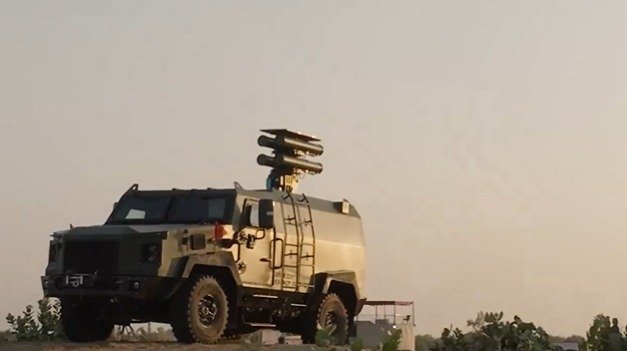
Pokhran, November 2026 : Adani Defence & Aerospace has demonstrated its Bagheera-AT1 vehicle-mounted anti-tank guided missile (ATGM) system at the Pokhran Field Firing Ranges in Rajasthan, showcasing its capabilities to senior representatives of the Indian Army, Department of Military Affairs (DMA) and Ministry of Defence (MoD).
The demonstration was conducted under a No Cost No Commitment (NCNC) evaluation, allowing the defence establishment to assess the system's operational performance without an immediate procurement commitment.
The trials included day and night engagements, a two-missile tandem firing against a target simulating an armoured vehicle, and an engagement against an aerial target at extended range. The programme concluded with a static display of the complete combat system.
Developed in approximately 18 months, Bagheera-AT1 has been designed around Indian terrain, climatic conditions and operational requirements. It combines a guided missile, an automated launcher and integrated day-and-night targeting equipment mounted on a high-mobility 4x4 armoured vehicle designed by Adani Defence.
The system uses laser beam-riding guidance, a feature intended to improve its performance in electronically contested battlefield environments. Unlike missiles that depend on radio-frequency command links, Bagheera-AT1 follows a laser beam directed towards the target. This makes it highly resistant to conventional electronic jamming and could improve its survivability against electronic warfare measures.
The missile can engage armoured targets at ranges of up to 8 km, offering greater reach than many legacy land-based anti-tank missile systems. The company has also indicated that the broader missile architecture could support guided engagements at longer distances.
A key feature demonstrated was the ability to launch two missiles in rapid succession along the same laser beam towards a single target. According to the company, the first missile is intended to trigger the target tank's Active Protection System (APS), while the second follows to penetrate its defences. The approach is designed to improve the chances of defeating modern armoured vehicles equipped with active protection technologies.
Each Bagheera-AT1 vehicle carries 12 missiles, comprising four ready-to-fire rounds on the launcher and eight reloads stored onboard. Its targeting suite includes day television and thermal-imaging sights, along with automated target-tracking capabilities for operations in different visibility conditions.
The system can also engage aerial targets at extended ranges, expanding its potential role beyond conventional anti-armour missions. Its shoot-and-move capability is intended to allow crews to fire from protected positions and relocate quickly, reducing their exposure to retaliatory fire.
The demonstration comes amid the Indian Army's efforts to modernise its anti-tank missile inventory. Existing holdings include ageing Milan-2T and Konkurs-M systems, while Spike missiles were inducted to meet immediate operational requirements. India is also pursuing advanced anti-tank capabilities while encouraging domestic defence manufacturing and reducing dependence on imports.
Adani Defence said recent conflicts had highlighted the importance of range and mobility in armoured engagements. It described Bagheera-AT1 as an additional long-range mobile ground capability that could complement man-portable and helicopter-launched missile systems.
The platform appears broadly comparable in design and operational role to Russia's Kornet-EM, although its capabilities and performance will require detailed evaluation by the armed forces.
If selected for induction, Bagheera-AT1 could provide the Indian Army with another domestically developed private-sector option for mobile, long-range anti-armour operations. Its eventual adoption will depend on the outcome of technical assessments, operational trials and the Army's procurement requirements.