- OSDMA’s vision ; DISASTER -RESILIENT ODISHA.
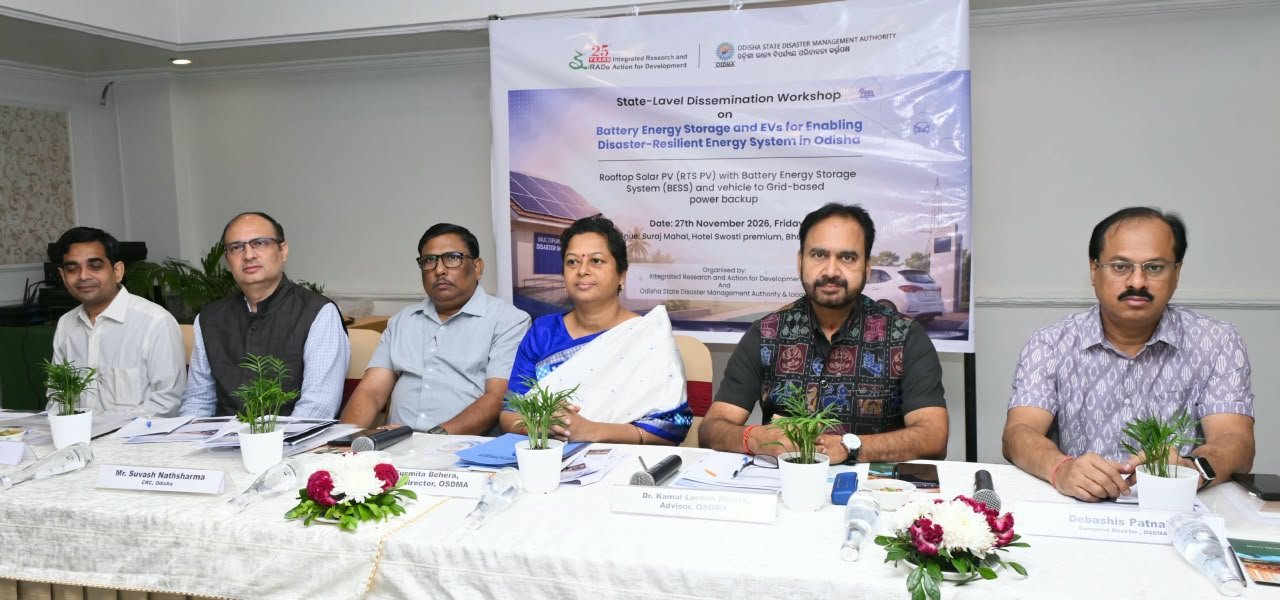
Bhubaneswar, November 2026 : Odisha State Disaster Management Authority (OSDMA) in collaboration with Integrated Research and Action for Development (IRADe) organised State Level Dissemination Workshop on “Battery Energy Storage and EVs for Enabling Disaster-Resilient Energy Systems in Odisha.”
As a disaster-prone coastal state, Odisha faces recurring cyclones, floods and extreme weather events that can disrupt electricity supply for extended periods. Multipurpose Disaster Shelters play a critical role in protecting vulnerable communities and supporting emergency response. Reliable electricity is essential for maintaining lighting, communications, water supply and other basic services in these shelters during disasters.
Under the project, IRADe undertook a techno-economic feasibility assessment and implemented pilot demonstrations for Solar PV and BESS supported power backups at two Multipurpose Disaster Shelters: Narsinghpatana in Brahmagiri block and Keutajanga in Astaranga block of Puri district. Two solar hybrid power systems, each with a capacity of 3 kWp and integrated with Battery Energy Storage Systems (BESS), have been installed at the pilot locations. The initiative received on-ground support from OSDMA, the District Disaster Management Authority (DDMA), Puri and the respective block administrations.
The project aims to strengthen the energy resilience of Multipurpose Disaster Shelters (MDSs) through solar power, battery storage and complementary energy solutions, ensuring continuity of power back during disasters.
Dr. Probal Ghosh, Deputy Director, IRADe presented the study on techno economic feasibility of power back up solutions. The assessment indicates that appropriately designed solar PV and battery storage systems can help reduce dependence on grid electricity and diesel-based backup while ensuring a more reliable power supply. Selected configurations integrating stationary battery storage backup have the potential to support critical shelter loads for more than 24 hours during prolonged grid outages, subject to system design, battery capacity, critical load requirements and vehicle availability.
The findings also highlight the potential for these systems to deliver benefits during normal operations by reducing grid electricity consumption and associated costs, while strengthening preparedness for emergencies. The assessment provides an evidence base for evaluating investment options and identifying suitable configurations for different shelter requirements.
The initiative supports OSDMA’s vision of building a disaster-resilient Odisha by strengthening the preparedness and operational readiness of critical community infrastructure. Reliable and decentralised energy systems can help ensure that essential services at disaster shelters remain functional when conventional electricity supply is disrupted.
Solar power and battery storage can serve a dual purpose ; supporting the day-to-day functioning of shelters and providing dependable backup during emergencies.
With more than 800 Multipurpose Disaster Shelters and school-cum-shelters across the state, the project offers an opportunity to explore the phased adoption of resilient energy solutions, particularly in cyclone- and flood-prone coastal districts. The pilot experience informed the development of technical standards, risk-informed energy system designs, critical-load requirements, financing arrangements and operational and maintenance protocols for wider implementation.
Smt Sushmita Behra, Executive Director, OSDMA thanked IRADe for its collaboration and support in setting up this first of its kind Solar PV and Battery Energy Storage for disaster shelters. She also shared that this initiative has potential to scale for other disaster shelters in Odisha. The learnings from the pilots would help in furthering this initiative.
Speaking on the occasion, Dr. Kamal Lochan Mishra, Advisor, OSDMA said that the project marks an important step towards integrating clean energy solutions into disaster risk management and strengthening the resilience of essential community infrastructure. By combining renewable energy, battery storage and appropriate backup arrangements, Odisha can move towards more energy-secure, operationally resilient and future-ready disaster shelters, contributing to the broader vision of a disaster-resilient Odisha.
Mr Rohit Magotra, Director, IRADe highlighted need for combining conventional and emerging technologies for enhancing energy and disaster resilience in Multipurpose Disaster Shelters. He shared that learnings from the pilots shall help to design integrated clean energy systems which can be managed by the community.
The workshop also provided a platform for stakeholders from Energy Department, Renewable Energy Agencies, DISCOMS, Village level Disaster Shelter Management Committees, Solar PV developers, Battery manufacturers, Think Tanks and Civil society to deliberate on the technical, financial, institutional and policy measures required to scale up such solutions. Strengthening coordination among relevant government departments and agencies, aligning existing schemes and financing mechanism and building local capacity for system operation and maintenance will be important for sustaining the benefits of the initiative.
Anshuman Sahoo