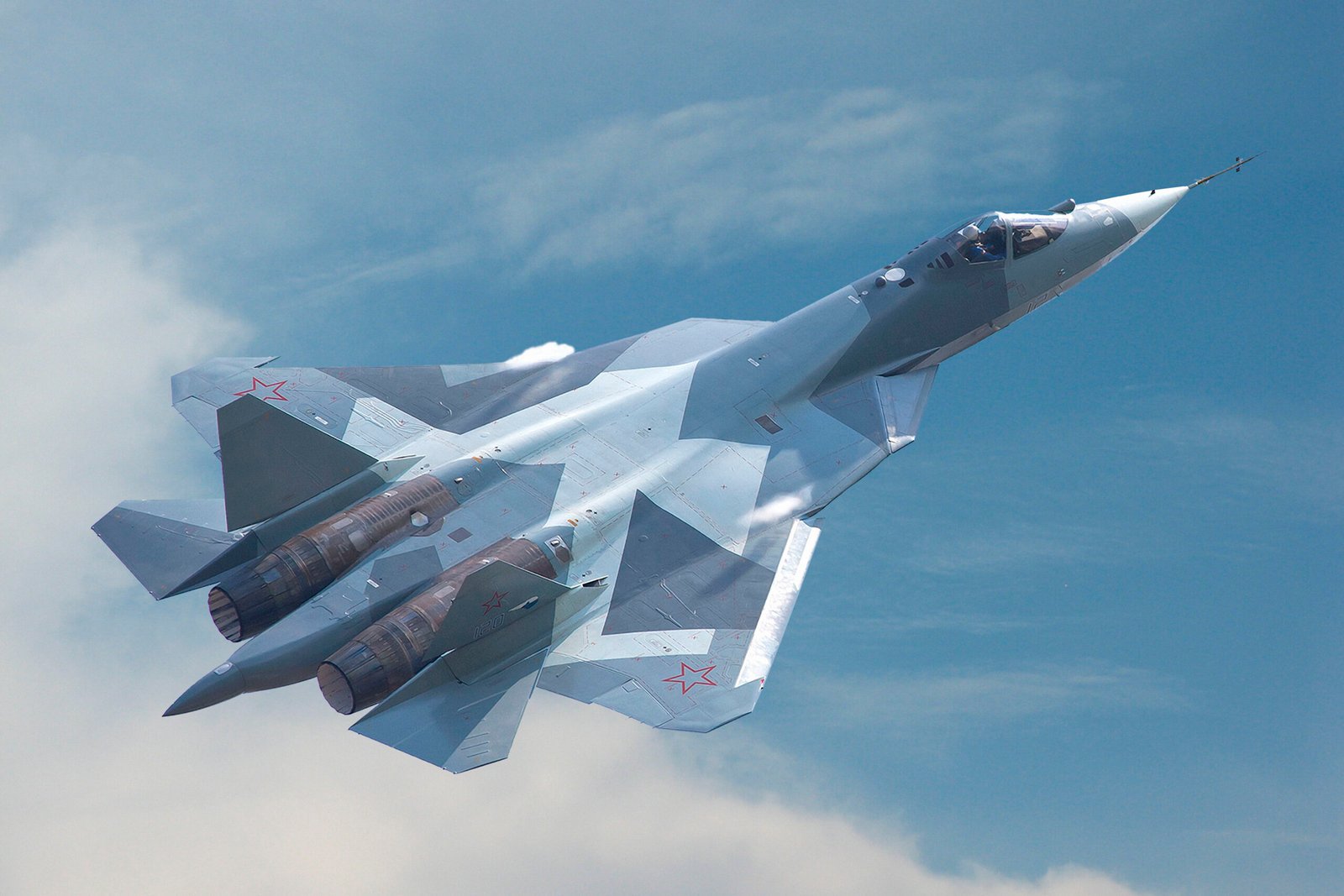
Moscow, Sep 2026 : Russia’s state-owned defence technology corporation Rostec has highlighted the extreme thermal endurance of the Su-57 fifth-generation fighter, claiming that its powerplant can withstand internal temperatures approaching 2,000 degrees Celsius during demanding combat manoeuvres.
In a statement issued on September 1, Rostec said the aircraft’s engine and associated systems are designed to operate under exceptionally high thermal loads, underscoring the engineering and structural resilience required for the fighter’s highly agile flight profile.
The capability has been showcased during demonstrations by renowned Russian test pilot Sergey Bogdan, including his performance at the Aero India airshow. Flying at an altitude of around 600 metres, Bogdan carried out a series of complex aerobatic manoeuvres, including a high-angle manoeuvre that brought the aircraft close to a temporary standstill in the air.
Such manoeuvres place considerable demands on a fighter’s propulsion and control systems. When an aircraft dramatically reduces its forward speed while maintaining altitude, sustained thrust and precise control become critical to prevent loss of stability. According to Rostec, the Su-57’s powerplant is capable of handling the intense thermal stresses generated during such demanding flight conditions.
Russia also argues that the aircraft’s extreme manoeuvrability has operational significance beyond airshow demonstrations. The ability to rapidly change speed, direction and flight trajectory can complicate an adversary’s targeting solution and potentially help a fighter evade incoming missiles.
This emphasis on super-maneuverability forms an important part of Russia’s presentation of the Su-57 as a fifth-generation combat aircraft. While stealth, sensors and long-range weapons are central to modern aerial warfare, the ability to perform aggressive changes in flight path remains an additional element of survivability, particularly during close or dynamic engagements.
The Su-57 currently operates with the AL-41F-1 engine, also known as “Product 117”. The powerplant is an advanced, thrust-vectoring derivative of the Soviet-era AL-31F engine family and provides the fighter with the propulsion and manoeuvrability required for its current operational configuration.
However, the AL-41F-1 is regarded as an interim or first-stage powerplant. Russia has long been developing a new-generation engine intended specifically for the Su-57. Known as the AL-51F, or “Product 30”, the engine was conceived as a clean-sheet design intended to provide improved performance and efficiency compared with the existing powerplant.
Development of the next-generation engine has taken longer than initially expected. It is now projected to enter service around 2030, when it is expected to be incorporated into an upgraded version of the aircraft referred to as the Su-57M1.
The transition to the new engine is expected to improve the aircraft’s overall performance, while potentially enhancing its range, acceleration, fuel efficiency and high-altitude capabilities. Until then, the AL-41F-1 remains central to the Su-57’s operational and demonstration profile.
Rostec’s latest comments also come as Russia seeks to expand international interest in the Su-57. Moscow has increasingly promoted the fighter’s combination of advanced aerodynamics, manoeuvrability, weapons capability and claimed combat experience as it competes for a position in the global fifth-generation fighter market.
The international competition remains intense. The United States operates the F135 powerplant on its F-35 fleet, while China has continued development and deployment of the WS-15 engine for its J-20 stealth fighter.
Against this backdrop, Russia’s progress on the AL-51F will remain closely watched. Until the new engine becomes operational, the Su-57’s ability to withstand extreme thermal stresses while performing demanding manoeuvres remains a key feature Moscow is using to demonstrate the fighter’s engineering capabilities and combat potential.
(Disclaimer :The content of this article is sourced from a news agency and has not been edited by the Mavericknews30 team.)