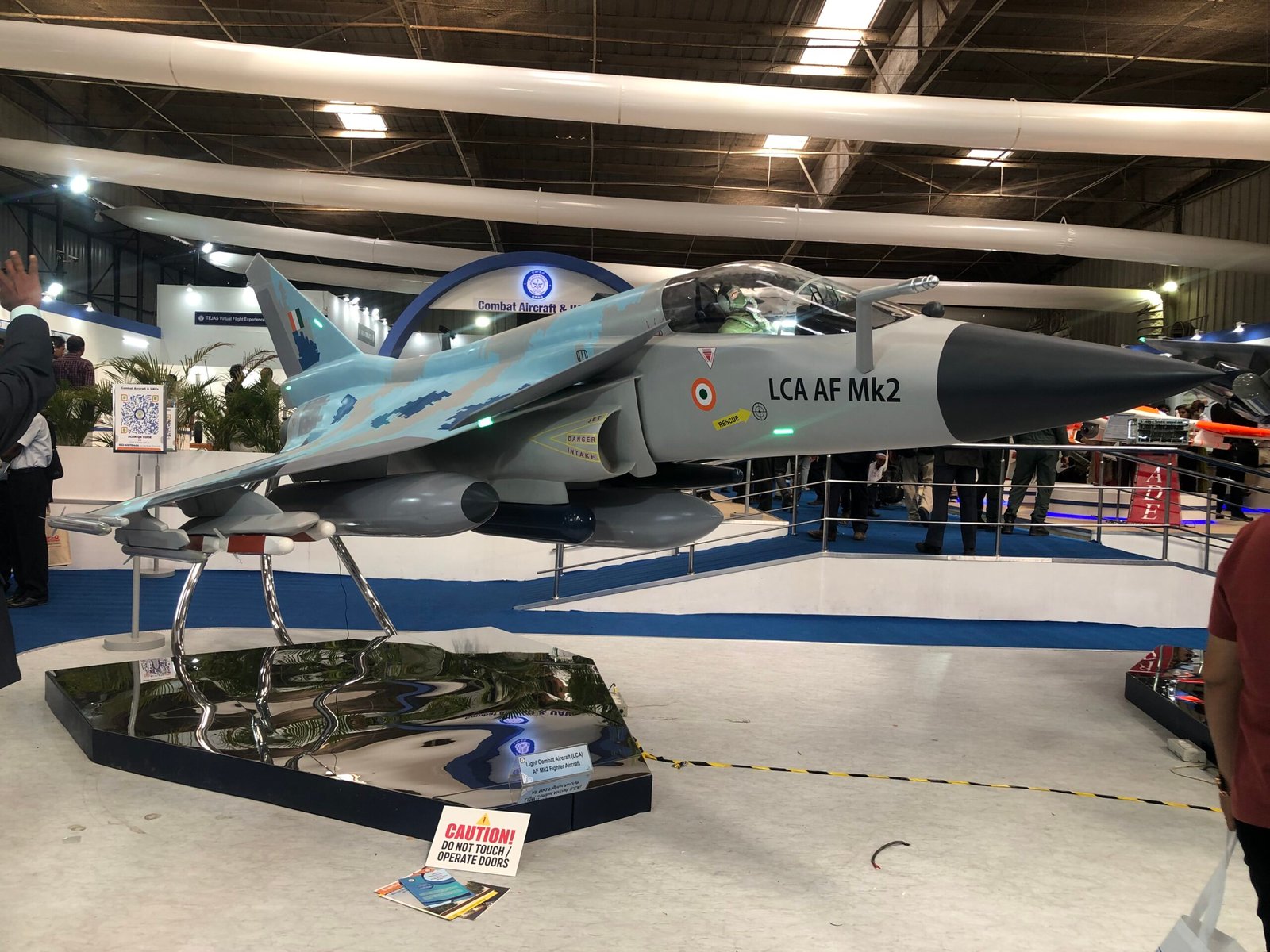
India has set new timelines for two of its most important indigenous fighter aircraft programmes, with the Tejas Mk-2 prototype expected to fly by September 2027 and the Advanced Medium Combat Aircraft (AMCA) prototype targeted for its maiden flight in September 2028. Defence Secretary Rajesh Kumar Singh announced the timelines at the NDTV Defence Summit, while also outlining the status of Tejas Mk-1A deliveries and the private-sector-led development model for AMCA.
New Delhi, September 2026 : India’s indigenous fighter aircraft development programme has received fresh timelines, with Defence Secretary Rajesh Kumar Singh stating that the Tejas Mk-2 prototype is expected to make its first flight by September 2027, while the first prototype of the fifth-generation Advanced Medium Combat Aircraft (AMCA) is targeted to fly in September 2028.
Singh made the announcement at the NDTV Defence Summit in New Delhi on September 27, where he also said Hindustan Aeronautics Ltd (HAL) is expected to deliver one squadron of Tejas Mk-1A aircraft by the end of 2026. He indicated that Tejas Mk-2 testing is planned between June and September next year, although some slippage could occur.
The timelines are significant for India’s effort to expand its indigenous fighter fleet and address gaps arising from the gradual retirement of older aircraft.
Tejas Mk-2 to replace ageing fighter fleets
The Tejas Mk-2, also known as the Medium Weight Fighter, is being developed by the Aeronautical Development Agency (ADA) with HAL. It is planned as a larger and more capable evolution of the Tejas Mk-1A and is intended to eventually replace aircraft such as the Jaguar, Mirage-2000 and MiG-29 in Indian Air Force service.
The aircraft is designed around the General Electric F414 engine and is expected to have a maximum take-off weight of around 17.5 tonnes. Its design incorporates close-coupled canards, an indigenous Uttam active electronically scanned array radar and an infrared search-and-track system.
The fighter is also planned to carry a range of Indian weapons, including Astra air-to-air missiles and Rudram anti-radiation missiles, while offering multiple hardpoints for weapons and external stores. Its intended mission profile includes air superiority, deep strike and suppression of enemy air-defence operations.
The first-flight target comes as India continues to expand production of the Tejas Mk-1A. Singh said one squadron is expected to be delivered by the end of this year, providing an additional boost to the IAF’s indigenous fighter fleet.
AMCA programme enters critical phase
The AMCA represents a more ambitious technological step. Conceived as a fifth-generation stealth fighter, the twin-engine aircraft is expected to incorporate low-observable design features, an internal weapons bay, advanced sensors, sensor fusion and electronic warfare capabilities.
The initial AMCA Mk-1 is planned to use General Electric F414 engines, while India intends to develop a more powerful indigenous engine for a future Mk-2 variant.
The aircraft is being designed for air-dominance missions, long-range precision strikes and network-centric warfare. Its internal weapons carriage is intended to preserve stealth, while external weapon stations could be used for missions where low observability is less critical.
The AMCA programme received a major institutional boost in 2024 when the Cabinet Committee on Security approved the Full Scale Engineering Development phase at an estimated cost of around Rs 15,000 crore.
Private industry gets a larger role
A significant feature of the AMCA programme is the expanded role for private industry. The Defence Ministry has opened prototype development to private-sector participation, with the selected company expected to work alongside ADA.
Three consortia have qualified for the prototype-development phase, including Tata Advanced Systems, an L&T-BEL-Dynamatic consortium and a Bharat Forge-BEML-Data Patterns consortium. HAL did not qualify on technical grounds, according to the Defence Secretary.
The selected private partner will build five flying prototypes and one structural test aircraft. The programme envisages the first flight within 30 months of contract signing, followed by an extensive testing programme involving 1,800 sorties over 84 months.
Singh’s September 2028 target therefore represents an important milestone, but the subsequent testing and certification process means operational induction would come considerably later.
India looks beyond fifth-generation fighters
The AMCA and Tejas Mk-2 programmes are being pursued alongside broader efforts to strengthen India’s future combat-air capability.
At the same summit, Defence Minister Rajnath Singh said India was already looking towards sixth-generation fighter technology and preparing for the nature of warfare expected over the next two decades. He also stressed that future battlefields would increasingly be driven by advanced technologies.
The timelines also come against a rapidly evolving regional fighter landscape. South Korea’s KF-21 programme has progressed into production, highlighting the pace at which other countries are moving towards advanced indigenous combat aircraft.
For India, the immediate priority remains translating development programmes into flying prototypes, completing testing and establishing reliable production capacity.
The September 2027 target for Tejas Mk-2 and September 2028 target for AMCA therefore mark important milestones, but their significance will ultimately depend on the ability to maintain development schedules, complete testing and transition from prototypes to sustained series production.