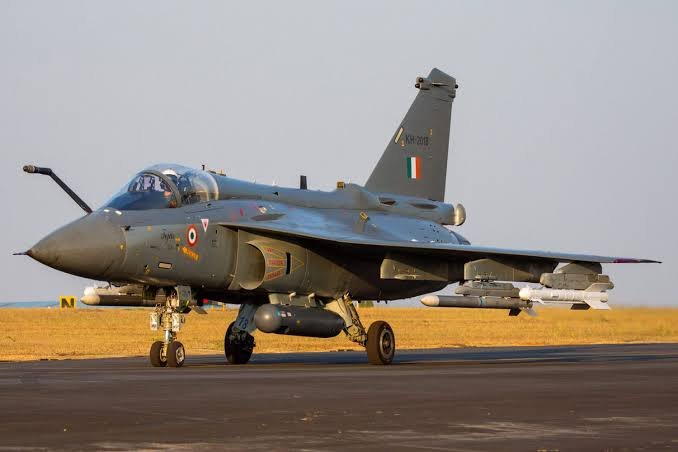
New Delhi, August 2026 : India’s indigenous TEJAS MK-2 Medium Weight Fighter (MWF) program is progressing steadily, with the first prototype now expected to make its maiden flight between March and July 2027, marking a significant milestone in the country’s efforts to strengthen its domestic fighter aircraft capabilities.
Hindustan Aeronautics Limited (HAL) and the Aeronautical Development Agency (ADA) have been advancing structural assembly, engine integration and ground testing of the aircraft. However, delays associated with the General Electric F414-INS6 engine, along with the government’s decision to increase indigenous content requirements, have pushed the project timeline further.
The TEJAS MK-2 is being developed as a 4.5-generation medium-weight fighter and is intended to eventually replace ageing aircraft in the Indian Air Force, including the Mirage-2000, Jaguar and MiG-29 fleets. Compared with earlier TEJAS variants, the MK-2 features a substantially larger airframe, close-coupled canards, larger air intakes and a more powerful propulsion system designed to support its increased weight and weapons load.
At the heart of the aircraft is the GE F414-INS6 turbofan engine, which is expected to provide around 98 kN of thrust. The engine will give the fighter a projected maximum speed of Mach 1.8 and a service ceiling of approximately 50,000 feet, representing a considerable improvement over the GE F404 engines powering earlier TEJAS variants.
HAL has outlined a phased prototype development plan. The first prototype is scheduled for rollout in March 2027, with its maiden flight targeted for the middle of the year. A second prototype is expected by late 2027 or early 2028, followed by the third and fourth prototypes in 2029 and 2030 respectively.
The planned production schedule reflects a deliberately phased approach to flight testing and certification. The first two prototypes will primarily be used for flight evaluation and systems testing, while more extensive weapons trials are expected to begin with the third prototype around 2030. Full production clearance is currently not anticipated before 2031, following which the Indian Air Force could begin the induction process.
The program has experienced several revisions to its original schedule. Earlier projections had envisaged the aircraft being rolled out in 2022, but the target was subsequently shifted to 2023, 2025 and later 2026. Increased indigenisation requirements and delays in securing development funding contributed to the repeated extensions.
The government’s decision to raise the indigenous content target from 65 per cent to 80 per cent has added to the development workload but is also aimed at reducing dependence on foreign suppliers and strengthening India’s domestic aerospace manufacturing capabilities.
Engine integration and certification remain among the most critical stages of the project. HAL officials have indicated that propulsion validation will take precedence over fixed rollout or flight dates, given the importance of ensuring the engine, aircraft systems and flight-control architecture operate reliably together.
Ground trials are already focusing on several critical systems, including avionics, hydraulic and electrical networks, flight-control computers and engine interfaces. Structural evaluations and software verification are also being carried out to establish the aircraft’s redundancy, reliability and safety standards.
Engine ground runs will subsequently be used to validate the propulsion system, fuel systems, hydraulics, electrical networks and avionics integration. These tests will have to be completed successfully before the aircraft progresses to taxi trials and eventually its maiden flight. The aircraft will also require certification and clearance from the Centre for Military Airworthiness & Certification (CEMILAC) before taking to the skies.
The TEJAS MK-2 is a major component of India’s broader defence self-reliance strategy. The Indian Air Force is expected to require around 110-120 aircraft, with the fighter designed to carry a payload of approximately 6.5 tonnes.
The aircraft is planned to incorporate several indigenous technologies, including the Uttam AESA radar, advanced digital flight-control systems and compatibility with modern air-to-air and air-to-ground weapons. HAL is also working with private-sector companies and start-ups, particularly in Bengaluru, to expand India’s domestic aerospace ecosystem and encourage greater participation from non-government players.
Despite the delays, the TEJAS MK-2 remains one of India’s most significant indigenous combat-aircraft programmes. Its larger airframe, advanced avionics, indigenous systems and powerful propulsion are intended to position it between lighter fighter aircraft and heavier imported platforms such as the Rafale.
The four-prototype development roadmap is designed to provide a structured path from ground testing to flight evaluation, weapons integration and eventual production. If the upcoming milestones are achieved as planned, the TEJAS MK-2 could become an important element of the Indian Air Force’s future fighter fleet while strengthening India’s long-term ambition of building a self-reliant aerospace industry.
(Disclaimer :The content of this article is sourced from a news agency and has not been edited by the Mavericknews30 team.)