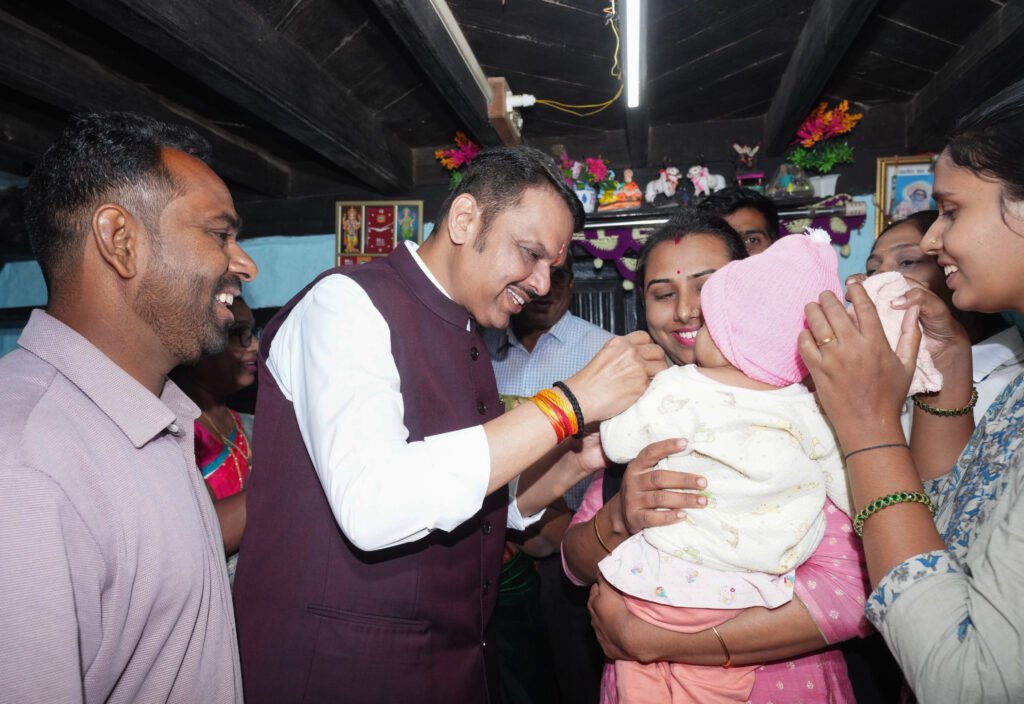
November 2026 : Diwali is a festival of joy, enthusiasm and auspiciousness. However, this year, the joy of the festival has been somewhat diminished for many farming families in Maharashtra due to the crisis of drought. Amid irregular rainfall, crop damage, water scarcity and financial difficulties, farming families in rural areas are celebrating the festival. At such a time, the State Government has not restricted its role merely to financial assistance and administrative decisions but has attempted to reach farmers' homes personally and share in their joys and sorrows. While financial assistance is being deposited into farmers' bank accounts on one hand, the Chief Minister, Deputy Chief Minister and other members of the Cabinet are visiting rural areas and celebrating Diwali with farming families on the other. Both these actions of the government highlight the sensitive and human face of administration.
Visits by ministers are a regular administrative activity. However, this time, their visits to rural areas are not limited merely to reviewing development works or holding meetings with officials. Going beyond official protocol and formalities, these visits reflect sensitivity and concern. During a crisis, the feeling that someone is standing by you and enquiring about your well-being itself provides great relief to an ordinary person. The Chief Minister and members of the Cabinet have attempted to strengthen this feeling by reaching out to various rural areas of Maharashtra.
Significantly, these visits are not limited to assurances alone. To provide immediate relief to drought-affected farmers, the State Government decided to provide advance assistance of Rs 5,000 each to eligible farmers. This amount is being deposited into farmers' accounts through Direct Benefit Transfer. As of November 5, assistance amounting to Rs 4,372 crore and 83 lakh had been deposited into the accounts of 87,45,669 farmers across the state.
This relief has been significant for farming families facing financial difficulties during a joyful festival like Diwali. In the life of an ordinary person, Diwali is a festival of happiness, family gatherings and recreation. At such a time, along with financial assistance, the government has also demonstrated sensitivity.
Along with the State Government, the 24th instalment of the Centre's Pradhan Mantri Kisan Samman Nidhi scheme was also disbursed on October 30. Under this instalment, more than Rs 18,690 crore was directly transferred to the bank accounts of 9.34 crore eligible farmer families across the country. Through this financial assistance from the Central and State governments, efforts are being made to provide economic support to farmers.
In addition, various measures are being implemented for farmers in drought-affected areas, including restructuring of crop loans, suspension of loan recovery, concessions in educational fees, ensuring the availability of drinking water, and arrangements for fodder and water for livestock. Eligible farmers are also being provided benefits under the Punyashlok Ahilyadevi Holkar Farmer Loan Waiver Scheme. Efforts are underway to provide relief to farming families through financial assistance, various concessions and measures at the local level. These decisions are creating confidence among farmers that the government is firmly standing by them.
The sensitive approach was reflected in Chief Minister Devendra Fadnavis's visit to Nagpur district. The Chief Minister celebrated Diwali at the home of farmer Rambhau Balpande in Lohari Savanga village of Narkhed taluka. Significantly, instead of merely paying a goodwill visit and leaving, he spent time with the Balpande family and also stayed overnight at their home. During his interaction with the family, he learnt about the agricultural situation, difficulties in rural areas and water-related issues. Arunatai Balpande performed the traditional welcome ritual for the Chief Minister. He enjoyed a home-cooked meal and shared the joy of Diwali with the family.
For an ordinary family, it is a unique experience when the head of the state visits their home, understands their difficulties and interacts warmly with their family members. Such visits add a personal touch to the interaction between the government and citizens. The importance of this visit is not limited merely to a formal courtesy call; it is also significant in terms of understanding the ground realities of rural areas.
The Chief Minister gave this visit the character of the concept of 'Administration at Your Doorstep'. On this occasion, an announcement was made about relaxing restrictions on digging borewells in agricultural fields until December 15. This relaxation will be subject to the necessary permissions and administrative supervision for orchards in specific areas. Discussions were also held on local issues related to water conservation, irrigation and infrastructure. The Chief Minister's stay with the farming family proved to be an experience of personal warmth and trust for people in rural areas.
Deputy Chief Minister Eknath Shinde also visited the home of drought-affected farmer Ambadas Tangade in Bhilpuri village of Jalna taluka and celebrated Diwali with his family. He understood the circumstances of the family, whose livelihood depends on just one acre of agricultural land. Through his interaction with the family members, he learnt about their financial difficulties and the condition of their farming activities. On this occasion, he accepted a simple home-cooked meal in the rural setting and shared the joy of Diwali with the family. He also assured them that farmers would not be left to fend for themselves under any circumstances.
Like the Chief Minister and Deputy Chief Minister, other members of the Cabinet also attempted to reach farmers and needy families in various districts. Guardian ministers also visited remote areas of their respective districts and interacted with citizens through Diwali visits. Through this initiative, an effort was made to convey the confidence that the government stands with the people and is committed to protecting the interests of ordinary citizens, right down to the grassroots level.
The significance of all these visits is not limited merely to celebrating a festival. When a person holding the highest position in the government visits an ordinary farmer's home, interacts with family members, understands their difficulties and accepts their hospitality, it adds a personal touch to the interaction between the government and ordinary citizens. The simplicity of the ministers, their interaction with family members and their efforts to connect with rural life give the families concerned, as well as people in the surrounding areas, a sense of confidence and satisfaction. Such initiatives create an opportunity not only to communicate information about government schemes and decisions to citizens but also to understand their actual difficulties.
Drought is not merely an issue affecting agricultural production; its consequences also affect education, health, employment, marriages and the rural economy of farming families. Therefore, during such a crisis, providing social and emotional support along with financial assistance is equally important. Of course, the confidence expressed through these visits needs to be strengthened further through the consistent implementation of actual assistance. Ensuring that aid reaches eligible beneficiaries on time, maintaining the availability of drinking water and fodder for livestock, and implementing effective measures for the revival of agriculture are equally important responsibilities.
Depositing financial assistance into farmers' accounts, taking decisions on their problems and, at the same time, reaching their homes to share in their joys and sorrows clearly reflect the government's approach. Creating the confidence that farmers are not alone during a crisis and that the government stands by them is the important outcome of these initiatives.
Along with this, visits to rural areas have also provided an opportunity to determine future development priorities. It is important for the highest levels of government leadership to gain first-hand understanding of which infrastructure facilities have remained inadequate for years and what improvements are required in water storage, irrigation, water conservation, agriculture-related businesses and rural employment. It is necessary to formulate sustainable measures keeping in mind the uncertainties arising from climate change. These visits can provide direction towards creating a robust system in which rural life will not be disrupted, even if the state faces a severe drought in the future. Thus, these initiatives have a dual benefit. On one hand, families affected by the crisis receive emotional support, while on the other, the government gains an understanding of ground realities for planning future development.
This is an effort to create a ray of hope in the lives of drought-affected families amid the lights of Diwali. By combining financial assistance with humanity, the government has attempted to establish a connection with the lives of ordinary people. Funds are reaching farmers' bank accounts to keep the lamps burning in their homes, while representatives of the government are also reaching their doorsteps. This is the human face of sensitive governance during drought!