Washington, Aug 2026 : US President Donald Trump has recommended replacing the combined measles, mumps and rubella (MMR) vaccine with three separate shots as part of a sweeping restructuring of the country’s childhood immunisation policy.
The recommendation will come into effect once individual vaccines for measles, mumps and rubella become domestically available. Until then, the combined MMR vaccine will continue to be accessible, according to the administration.
Trump’s executive order also recommends that childhood vaccines be administered during separate medical visits “to the maximum extent feasible”. The White House said the approach was intended to provide parents with greater control over the timing and frequency of their children’s vaccinations.
Under the order, the Health and Human Services (HHS) secretary has been directed to develop options for administering core childhood vaccines individually rather than primarily through combination products. The MMR vaccine will be the first to undergo this process.
HHS has been given 90 days to submit its plans to the President through the White House domestic policy adviser. The department may work with private-sector manufacturers as well as foreign governments and organisations to ensure individual vaccines become available in the US.
The administration has stressed that combination vaccines will not be withdrawn from the market. Vaccinations that are recommended through shared clinical decision-making will also remain available, allowing parents and healthcare professionals to determine whether particular immunisations are appropriate for individual children.
The MMR recommendation is part of the administration’s new “Gold Standard Childhood Vaccine Recommendations”, which significantly changes the number of diseases for which vaccination is routinely recommended for all American children.
Under the framework, the number of diseases covered by universal childhood immunisation recommendations has been reduced from 18 under the Centers for Disease Control and Prevention’s 2024 schedule to 11.
Measles, mumps and rubella remain among the diseases for which the administration recommends vaccination for every child. The other eight are diphtheria, tetanus, pertussis, polio, Haemophilus influenzae type B, pneumococcal disease, human papillomavirus (HPV) and chickenpox, or varicella.
Other vaccines have been moved into categories covering children considered to be at higher risk or situations in which vaccination decisions would be made jointly by parents and clinicians.
The high-risk category includes respiratory syncytial virus (RSV) monoclonal antibodies and vaccines against hepatitis A, hepatitis B, meningococcal B, meningococcal ACWY and dengue.
Meanwhile, influenza and COVID-19 vaccines are among those placed under shared clinical decision-making. Hepatitis A, hepatitis B, rotavirus and meningococcal disease have also been included in this category, depending on individual circumstances.
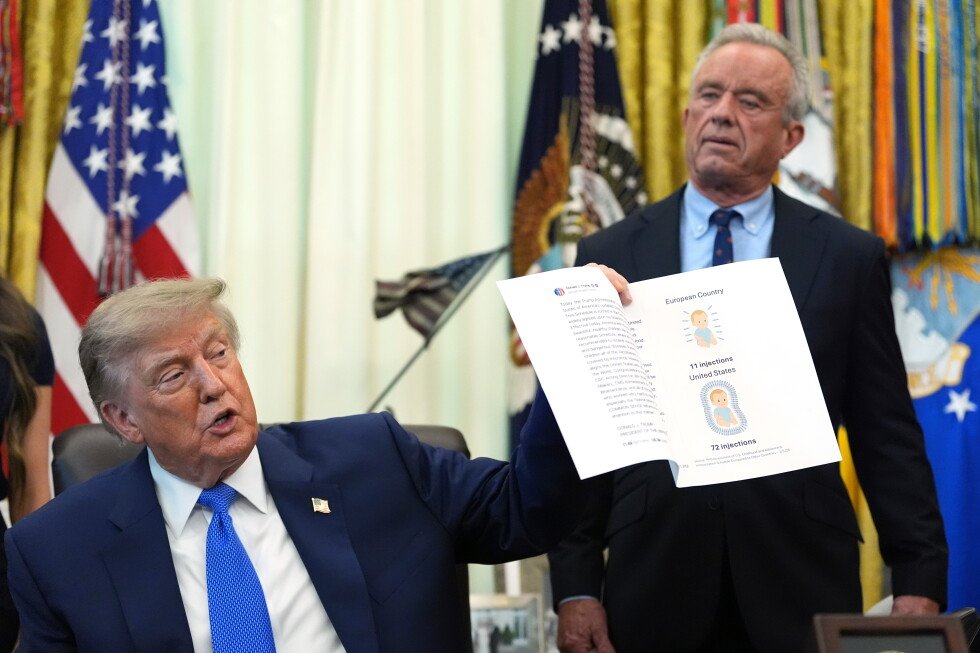
The White House said the revised approach was based on a scientific assessment completed by HHS in January 2026 that compared US childhood immunisation recommendations with those of other developed countries.
According to the administration, the assessment concluded that the US recommends more childhood vaccines than any peer country and, in some cases, more than twice as many doses as certain European nations. It identified 11 vaccines that were consistently recommended across the countries included in the comparison.
Beyond separating combination vaccines, HHS has been instructed to review the timing and sequencing of all core childhood immunisations. The department could subsequently recommend changes to the federal childhood and adolescent vaccination schedule.
The order also calls for the development of alternatives to aluminium-based adjuvants used in some vaccines, comparative safety and efficacy studies, continuous assessment of vaccine risks and benefits using US and international data, and improvements in vaccine safety monitoring, research and transparency.
Federal departments and agencies have been directed to review the new recommendations and take appropriate steps to implement or advance them within their respective areas of authority.
States and territories have also been encouraged to consider whether their laws governing vaccination requirements for school enrolment and attendance should be updated in light of the administration’s revised recommendations.
(The content of this article is sourced from a news agency and has not been edited by the Mavericknews30 team.)