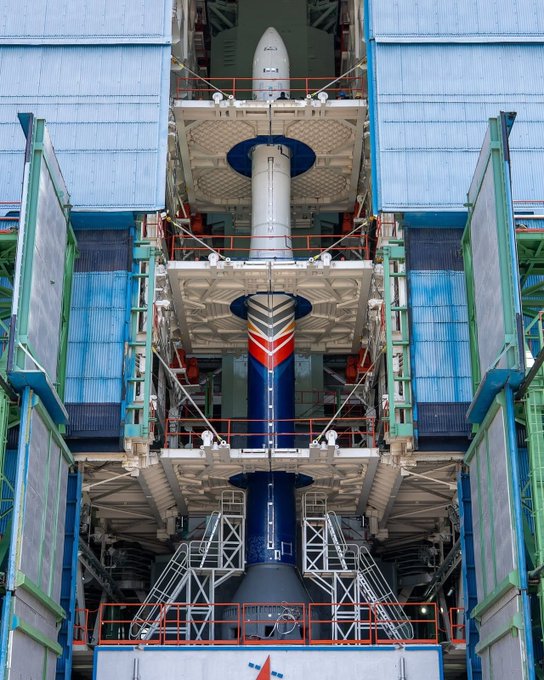
India Enters New Era in Space as Skyroot’s Vikram-1 Becomes First Private Orbital Rocket to Reach Orbit

New Delhi, July 2026 : India achieved a defining milestone in its space exploration journey on Saturday as Hyderabad-based startup Skyroot Aerospace successfully launched Vikram-1, the country’s first privately developed orbital launch vehicle, under its landmark Mission Aagaman. The achievement places India among a select group of nations where private companies have independently demonstrated orbital launch capability, joining the ranks of the United States and China.
The historic mission lifted off from the First Launch Pad at the Satish Dhawan Space Centre (SDSC-SHAR) in Sriharikota, Andhra Pradesh, marking a watershed moment for India’s fast-growing private space industry. The flawless launch underscores the success of India’s space sector reforms and highlights the increasing role of private enterprises in the country’s ambitious space programme.
Announcing the successful launch, Skyroot Aerospace shared its excitement on social media, stating, “LIFT-OFF! Vikram-1 has left the pad at Sriharikota. India’s first privately developed orbital rocket is flying. History is being made.” Moments later, the company confirmed that the rocket had achieved safe tower clearance, clearing one of the mission’s critical early milestones.
Named in honour of Dr. Vikram Sarabhai, the visionary regarded as the father of India’s space programme, Vikram-1 has been designed as a four-stage launch vehicle capable of delivering small satellites into orbit with speed, flexibility and cost efficiency. The rocket is intended to cater to the rapidly expanding global demand for dedicated satellite launches, particularly for commercial customers seeking quick and customised access to space.
Standing nearly seven storeys tall, Vikram-1 is targeting a Low Earth Orbit (LEO) at an altitude of approximately 450 kilometres. The successful orbital mission significantly enhances India’s credentials in the competitive global commercial launch market, where demand for launching small satellites has grown rapidly in recent years due to advances in communication, Earth observation, navigation and scientific research.
Skyroot Aerospace envisions transforming access to space through what it describes as a “cab service to space.” Under this model, satellite operators can book dedicated launches tailored to their orbital requirements instead of waiting for shared launch opportunities. The company believes this approach will make space missions more flexible, efficient and commercially viable for customers worldwide.
Mission Aagaman represents Skyroot’s second major space mission after its successful Vikram-S suborbital flight under Operation Prarambh in November 2022. That mission created history by becoming the first privately built rocket to reach space from Indian soil and laid the foundation for India’s emerging private launch ecosystem. Vikram-1 now builds on that achievement by taking the next crucial step—placing a privately developed launch vehicle into orbit.
The successful mission also reflects the growing collaboration between the Indian Space Research Organisation (ISRO), the Indian National Space Promotion and Authorization Centre (IN-SPACe), and India’s expanding private aerospace sector. Government reforms over the past few years have opened the space industry to private participation, encouraging innovation, investment and entrepreneurship.
Ahead of the launch, Prime Minister Narendra Modi described Mission Aagaman as “a historic new frontier for India’s space journey.” Extending his best wishes to the Skyroot team, the Prime Minister said the mission symbolised the talent, determination and entrepreneurial spirit of India’s young innovators.
He noted that India’s policy reforms in the space sector have created unprecedented opportunities for startups and private companies to contribute to national development while positioning the country as a major player in the global space economy.
The successful launch of Vikram-1 is expected to boost investor confidence in India’s private aerospace industry, attract international commercial launch contracts and strengthen the country’s ambitions of becoming a leading global hub for affordable satellite launches. Beyond its technological significance, Mission Aagaman marks the beginning of a new chapter in India’s space story—one in which private innovation will play an increasingly central role alongside the nation’s established space programme.






India Post Invites Citizens to Design Official Mascot, Announces Rs 2 Lakh Prize Pool
New Delhi, July 2026 : The Department of Posts has launched the ‘India Post Mascot D…

India Post Invites Citizens to Design Official Mascot, Announces Rs 2 Lakh Prize Pool
New Delhi, July 2026 : The Department of Posts has launched the ‘India Post …