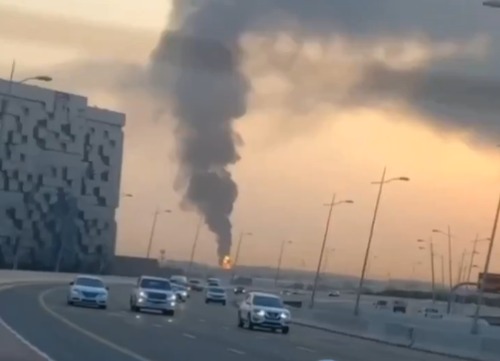
Drone Attack Sparks Fire Near Fuel Tank at Dubai Airport, Flights Briefly Suspended Amid Rising West Asia Tensions

Dubai, March 2026 : A suspected drone strike near a fuel storage area triggered a massive fire close to Dubai International Airport on Monday, forcing authorities to temporarily halt flight operations at one of the world’s busiest aviation hubs. The incident occurred on the 17th day of the escalating conflict involving the United States, Israel, and Iran, adding to already heightened tensions across the West Asia region.
Officials said the blaze broke out near a fuel tank after the drone attack, sending large flames into the air and raising safety concerns at the airport. Emergency teams from Dubai Civil Defence quickly responded to the scene and managed to bring the fire under control within a short time. Authorities confirmed that no injuries were reported.
According to the Dubai Civil Aviation Authority, the temporary suspension of flights was taken as a precautionary measure to ensure the safety of passengers and airport staff. Several departures and arrivals were briefly delayed while emergency services worked to contain the situation and assess the damage.
Videos circulating on social media appeared to show large flames rising near the airport complex, indicating the scale of the fire. However, officials emphasised that the situation was swiftly brought under control and airport operations were gradually restored.
The incident comes amid intensifying hostilities in the region, particularly around the strategically crucial Strait of Hormuz, through which a significant portion of the world’s oil supply passes.
Amid the escalating tensions, Donald Trump said that military operations against Iran were “going very well,” according to media reports. He also warned that the United States was not receiving oil through the Strait of Hormuz and urged countries that benefit from the vital shipping route to take greater responsibility for protecting it.
Trump reportedly suggested that a planned summit with Xi Jinping could be postponed due to disruptions in global shipping caused by the ongoing conflict.
Meanwhile, Iran warned of serious consequences if its energy infrastructure is targeted. Abbas Araghchi said Tehran would retaliate against any attack on its energy facilities. He also dismissed claims that Iran was seeking negotiations for a ceasefire, reiterating that the country would continue to defend itself.
Araghchi condemned recent Israeli strikes on fuel depots in Tehran, calling them a violation of international law and warning of long-term environmental damage caused by attacks on energy facilities.
At the same time, a senior commander of the naval wing of the Islamic Revolutionary Guard Corps warned that any attack on Kharg Island could significantly disrupt global energy markets and create a “new and complex equation” for oil supply and pricing worldwide.
Elsewhere in the region, the Israel Defense Forces launched fresh airstrikes targeting areas in southern Lebanon and the southern suburbs of Beirut. Cities such as Khiam and Bint Jbeil were among the reported targets.
According to Lebanon’s Health Ministry, at least five people were killed and seven others injured in strikes on the towns of Majdal Selm and Ayta ash-Shaab.
Iran also continued launching missiles toward Israel, triggering air-raid sirens across central regions of the country. Israeli media reported that the projectiles landed in open areas without causing significant damage.
Across the Gulf region, air defence systems were activated as several countries intercepted drones and missiles during the conflict. Saudi Arabia’s Defence Ministry said its air defence units intercepted drones in the Eastern Province, while the Bahrain Defence Force reported neutralising 125 missiles and 212 drones since the outbreak of hostilities.
In Iraq, rockets and drones targeted Baghdad International Airport, where a United States diplomatic mission is located, further highlighting the widening scope of the confrontation.
Amid the rising tensions, diplomatic efforts are continuing to prevent further escalation. Mohammed bin Abdulrahman Al Thani and Faisal bin Farhan held a phone conversation during which both countries condemned what they described as “irresponsible” attacks by Iran and emphasised the need to reduce tensions and return to dialogue.
India also reported that diplomatic engagement with Tehran helped ensure the safe passage of two Indian-flagged gas tankers through the Strait of Hormuz amid the ongoing hostilities.
The conflict has already spread across at least a dozen countries, with rising casualties highlighting the widening impact of the confrontation in the region.
Meanwhile, the ripple effects of the security incident in Dubai were felt as far away as India. An Emirates flight bound for Dubai was forced to return to Cochin International Airport on Monday morning due to the temporary suspension of operations at Dubai airport.
Flight EK533, which departed Kochi at around 4:30 a.m., turned back mid-air after Dubai authorities announced the suspension of airport operations due to security concerns. The aircraft, carrying around 350 passengers, landed safely in Kochi at approximately 8:30 a.m.
Initially, airport authorities indicated that passengers might be allowed to disembark and return home. However, they were later advised to remain on board temporarily as officials assessed the situation in Dubai and evaluated whether the flight could resume its journey.
Later in the morning, officials decided to allow passengers to disembark at Kochi while awaiting further instructions regarding the continuation of the flight.
(The content of this article is sourced from a news agency and has not been edited by the Mavericknews30 team.)







Maharashtra Shuts Schools Across Several Districts as Heavy Rain Alert Triggers Safety Measures
Mumbai, July 2026: Authorities across several districts in Maharashtra have declared a hol…

Maharashtra Shuts Schools Across Several Districts as Heavy Rain Alert Triggers Safety Measures
Mumbai, July 2026: Authorities across several districts in Maharashtra have declared a holiday for …