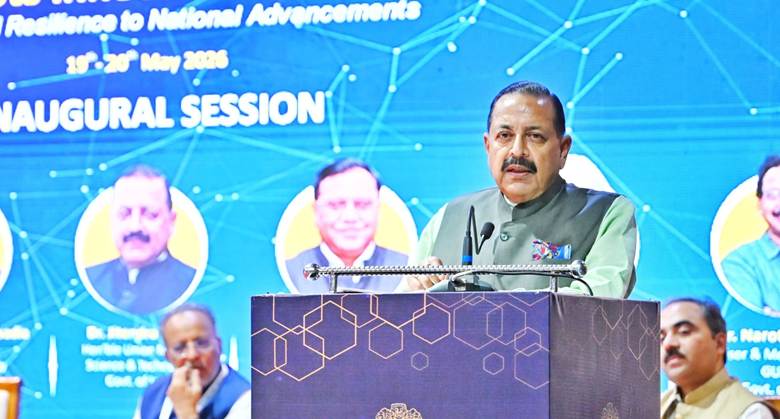
Promoting ‘Grassroots Innovators’ can Strengthen Rural Economy, reduce regional imbalance: Dr. Jitendra Singh

Union Minister of State (Independent Charge) for Science & Technology, Earth Sciences and Minister of State for PMO, Personnel, Public Grievances & Pensions, Department of Atomic Energy and Department of Space, Dr. Jitendra Singh today said that promoting ‘Grassroots Innovators’ can strengthen India’s rural economy and reduce regional imbalance through inclusive, innovation-led growth.
The Minister said, said grassroots innovators must become active stakeholders in India’s economic transformation, as their traditional knowledge, local skills and practical innovations hold immense potential for livelihood generation, decentralized growth and national development.
Addressing the inaugural session of the two-day National Workshop on “Grassroots Innovation Pathways: From Local Resilience to National Advancements” at Science City, Ahmedabad, Gujarat, Dr. Jitendra Singh described grassroots innovators as India’s “silent nation builders” whose contributions often remain outside formal institutional systems despite their significant societal and economic value. He said innovation in India should not remain confined to metropolitan centres, laboratories or elite institutions, but must expand across villages, smaller towns and community ecosystems.
The workshop has been organized by NITI Aayog in collaboration with the National Innovation Foundation (NIF) and Gujarat Council of Science & Technology (GUJCOST). The inaugural session was attended by Gujarat Minister for Science & Technology Shri Arjun Modhwadia former DRDO Chairman and former NITI Aayog Member Dr. V.K. Saraswat, Senior Adviser (Science & Technology), NITI Aayog Prof. Vivek Kumar Singh, Secretary DST Gujarat Ms. P. Bharathi, National Innovation Foundation Director Dr. Arvind Ranade and several scientists, policymakers and innovators from across the country.
Dr. Jitendra Singh said India possesses a unique ability to innovate under resource constraints and that many transformative ideas emerge directly from lived experiences and local challenges. Referring to the early years of India’s space programme, he recalled how Dr. Vikram Sarabhai and other pioneers worked with minimal infrastructure but extraordinary commitment, demonstrating the inherent innovation capacity of India’s human resource.
The Minister said many grassroots innovators may not possess formal academic qualifications, yet display remarkable creativity and technical aptitude rooted in practical experience. He noted that a large number of startups are now emerging from Tier-2 and Tier-3 cities, reflecting the growing innovation potential of smaller towns and rural India.
Dr. Jitendra Singh said grassroots innovation is fundamentally a bottom-up process and stressed the need to connect local innovators with scientific institutions, modern technology, validation systems and market opportunities. He said the challenge is not merely to identify innovators, but to create pathways for scaling their innovations into viable products and community solutions.
He emphasized that grassroots innovation must also be viewed as an economic and developmental priority. India, he said, cannot emerge as a leading global economy unless rural economies are strengthened and growth becomes regionally balanced. He added that grassroots innovation can play a major role in employment generation, community entrepreneurship and reducing developmental disparities.
Dr. Jitendra Singh called for stronger convergence between grassroots innovators and formal innovation ecosystems, including research institutions, incubators and industry. He said many government schemes and scientific programmes often fail to adequately reach local innovators because they remain disconnected from ground realities.
Highlighting the importance of technology integration, the Minister said combining traditional knowledge systems with modern technologies such as Artificial Intelligence and food processing technologies can significantly increase the value and market potential of local products and skills. He cited successful interventions involving millet-based products and traditional regional food items where scientific support helped improve commercialization and income opportunities for local communities.
The Minister said Prime Minister Narendra Modi has consistently encouraged grassroots innovation and community participation through initiatives such as “Mann Ki Baat” and PM Vishwakarma, which are helping preserve traditional skills while linking them with technology, entrepreneurship and economic opportunity.
The workshop includes technical sessions on Institutional Enablers to Support Grassroots Innovation, Learning from Grassroots Innovators, Community Driven Innovation Initiatives and Regional & State Innovation Initiatives. Discussions during the workshop are expected to focus on policy frameworks, institutional coordination, incubation support and scalable models for expanding grassroots innovation across the country.
Dr. Jitendra Singh expressed confidence that such initiatives would help build a stronger and more connected innovation ecosystem where innovators from villages and remote regions become equal participants in India’s development journey and contribute meaningfully towards Viksit Bharat @2047.




BJP Workers Are Full-Time Politicians, Rahul Gandhi Is Part-Time: Nitin Nabin in Telangana
Hyderabad, June 2026 : Bharatiya Janata Party (BJP) national president Nitin Nabin on Mond…
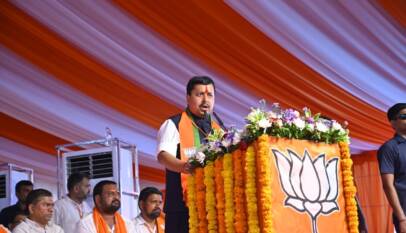
BJP Workers Are Full-Time Politicians, Rahul Gandhi Is Part-Time: Nitin Nabin in Telangana
Hyderabad, June 2026 : Bharatiya Janata Party (BJP) national president Nitin Nabin on Monday …