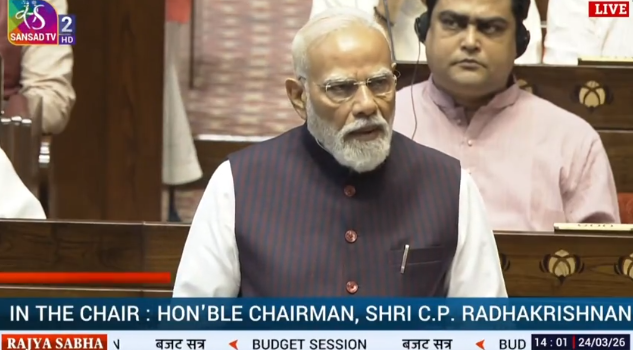
PM Modi addresses the Rajya Sabha on the ongoing conflict in West Asia

Many ships from around the world are stranded in the Strait of Hormuz, a very large number of Indian crew members are among them,This is also a major cause of concern for India: PM
In such a critical situation, it is essential that a united voice of peace and dialogue goes out to the entire world from this Upper House of India’s Parliament: PM
Around one crore Indians live and work in the Gulf countries, The safety of their lives and livelihoods is also a very big concern for India: PM
More than three weeks have passed since this war began in West Asia , This war has created a serious energy crisis across the entire world: PM
Attacks on commercial ships and disruption of international waterways like the Strait of Hormuz is unacceptable: PM
India has condemned attacks on civilians, on civil infrastructure, and on energy and transport-related infrastructure: PM
Since the start of the war, I have held two rounds of phone conversations with the heads of state of most countries in West Asia: PM
We are in constant touch with all the Gulf countries, We are also in contact with Iran, Israel, and the United States: PM
Our goal is to restore peace in the region through dialogue and diplomacy: PM
We have also discussed de-escalation and the reopening of the Strait of Hormuz with them: PM
India is making continuous efforts, through diplomacy, to ensure the safe passage of Indian ships even in this atmosphere of war: PM
Since the war began, the movement of ships through the Strait of Hormuz has become very challenging, But despite these adverse circumstances, our government is trying to find way forward through dialogue and diplomacy: PM
The effort is to ensure that oil and gas supplies reach India from wherever possible, The country is witnessing the results of every such effort: PM
In the past few days, ships carrying crude oil and LPG have arrived in India from many countries around the world, Our efforts in this direction will continue in the coming days: PM
The fundamentals of our economy are strong,the government is closely monitoring the rapidly changing situation: PM
The government is working with a strategy to address every impact in the short term, medium term, and long term: PM
The government has made the necessary preparations to ensure an adequate supply of fertilizers: PM
The government is making continuous efforts to ensure that farmers do not bear the burden of any crisis: PM
I would like to reassure the farmers of the country once again that the government stands with them to resolve every challenge: PM
The Prime Minister Shri Narendra Modi addressed the Rajya Sabha today, presenting the Government’s position on the situation arising from the ongoing conflict in West Asia. Noting that the war, which has been raging for over three weeks, has precipitated a severe global energy crisis with deeply worrying implications for India, PM Modi pointed out that the conflict is disrupting India’s trade routes and affecting the routine supply of essential commodities such as petrol, diesel, gas, and fertilizers. With nearly one crore Indians living and working in Gulf countries, their safety and livelihoods remain a matter of profound concern, the Prime Minister observed, while also drawing attention to the large number of Indian crew members stranded aboard ships in the Strait of Hormuz. “In such dire circumstances, it is imperative that a united voice of peace and dialogue goes out to the entire world from this august Upper House of the Indian Parliament,” affirmed Shri Modi.
Detailing India’s vigorous diplomatic outreach since the outbreak of hostilities, the Prime Minister informed the House that he has personally conducted two rounds of telephonic conversations with heads of state of most West Asian nations and that India remains in continuous contact with all Gulf countries, as well as with Iran, Israel, and the United States. The objective, he stated, is the restoration of peace in the region through dialogue and diplomacy, and discussions on de-escalation and reopening of the Strait of Hormuz have been specifically taken up. Emphasising India’s firm stance, he declared that attacks on commercial vessels and obstruction of international waterways like the Strait of Hormuz are unacceptable, and that India has categorically opposed all attacks on civilians, civil infrastructure, and energy and transport-related infrastructure. “Any threat to human life in this war is against the interests of humanity, and therefore India’s sustained endeavour is to encourage all parties towards a peaceful resolution at the earliest,” remarked Shri Modi.
Underscoring the Government’s unwavering priority of safeguarding Indians at home and abroad during times of crisis, the Prime Minister shared that over 3,75,000 Indians have been safely brought back to India since the war began, including more than 1,000 from Iran alone, among them over 700 young medical students. While all countries have assured full security for Indians present on their soil, the Prime Minister expressed deep sorrow over the loss of Indian lives and injuries sustained due to the attacks, assuring that the Government is working with complete sensitivity during this period of crisis. “All necessary assistance is being extended to the affected families, and the best possible medical treatment is being ensured for the injured,” stated PM Modi.
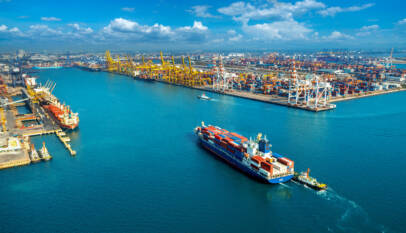
Highlighting the strategic significance of the Strait of Hormuz as one of the world’s largest trade routes, particularly for the transportation of crude oil, gas, and fertilizers, the Prime Minister acknowledged that the movement of ships through the strait has become extremely challenging since the onset of the war. However, despite the adverse circumstances, the Government has endeavoured to forge alternative pathways through dialogue and diplomacy, with the singular focus of ensuring that oil and gas supplies reach India from wherever possible. “The country is witnessing the results of every such effort, over the past few days, ships laden with crude oil and LPG from numerous countries across the world have arrived in India, and our efforts in this direction will continue unabated in the days ahead,” said the Prime Minister.
Drawing attention to the long-term risks, the Prime Minister noted that while India’s endeavour is to ensure the safe arrival of ships carrying every essential commodity, be it oil, gas, or fertilizers, the prolonged persistence of the global disruptions caused by this war would inevitably lead to serious consequences. “India is therefore accelerating all the resilience-building measures that have been undertaken over the past years,” asserted Shri Modi.
Speaking on India’s decade-long strategic preparedness, Prime Minister Modi observed that every crisis tests both a nation’s resolve and its efforts, and that consistent and far-sighted decisions have been taken over the past eleven years to ensure the country can withstand such challenges. Detailing the diversification of energy imports , from 27 countries earlier to 41 countries today for crude oil, LNG, and LPG, he informed the House that India has prioritised building crude oil reserves for precisely such times of crisis, with oil companies maintaining substantial stocks of petrol and diesel. Strategic Petroleum Reserves exceeding 53 lakh metric tonnes have been developed over the past eleven years, with work underway to establish reserves exceeding 65 lakh metric tonnes, alongside a significant enhancement of India’s refining capacity. “I wish to assure this House and the nation that India possesses adequate crude oil storage and robust arrangements for continuous and uninterrupted supply,” affirmed the Prime Minister.
Elaborating on the Government’s strategy to reduce overdependence on any single fuel source, the Prime Minister highlighted the emphasis being placed on Piped Natural Gas (PNG) alongside LPG for domestic gas supply. Unprecedented work has been carried out on PNG connections over the past decade, and this effort has been further intensified in recent days. “Simultaneously, large-scale efforts are being made to significantly increase the domestic production of LPG as well,” remarked Shri Modi.
Championing India’s vision of self-reliance, the Prime Minister stressed that the Government’s sustained effort over the past several years has been to minimise dependence on other countries across every sector, noting that over 90 per cent of India’s oil is currently transported on foreign-flagged vessels , a situation that compounds the nation’s vulnerability during any global crisis. To address this, the Government has launched a mission worth approximately ₹70,000 crore to build Made-in-India ships, while rapidly developing capacities in ship building, ship breaking, and maintenance and overhauling. He further highlighted that India’s defence sector has been made more resilient, with the country now manufacturing most of its required weaponry domestically, and significant strides have been made in building a domestic API ecosystem for life-saving medicines and in reducing dependence on imports of rare earth minerals. “Greater self-reliance across every critical sector is the only path forward, and major steps are being taken on each of these fronts,” stated PM Modi.
Assessing the economic impact of the current crisis, the Prime Minister acknowledged that the conflict has shaken economies across the world and that recovery from the damage inflicted in West Asia will take considerable time. Continuous efforts, he said, are being made to minimise the adverse impact on India, with the nation’s strong economic fundamentals and the Government’s round-the-clock monitoring of the rapidly evolving situation serving as a bulwark. Informing the House about the constitution of an Inter-Ministerial Group that meets regularly to assess and address challenges related to imports and exports, and the formation of seven new Empowered Groups , on the lines of those constituted during the COVID-19 pandemic , to undertake swift and far-reaching action on supply chains, petrol-diesel, fertilizers, gas, and inflation, the Prime Minister expressed his confidence in the collective approach. “I am fully confident that through these shared and coordinated efforts, we will be able to navigate these circumstances more effectively,” said the Prime Minister.
Turning to the agricultural sector, Prime Minister Modi assured the nation that the Government is making every effort to ensure that farmers receive adequate supply of fertilizers during the upcoming sowing season, with all necessary preparations already in place. “I wish to once again assure the farmers of this country that the Government stands firmly with them in finding solutions to every challenge, and it remains our unwavering commitment that no burden of any crisis falls upon their shoulders,” affirmed Shri Modi.
Addressing the House in its capacity as the Council of States, the Prime Minister noted that the coming period will pose a significant test for the nation, and the cooperation of States will be indispensable for success. He urged all State Governments to ensure that the benefits of the PM Garib Kalyan Anna Yojana continue to reach beneficiaries on time, as crises disproportionately affect the poor, labourers, and migrant workers. Calling for proactive steps to address the difficulties faced by migrant workers and special monitoring mechanisms by State Governments, he also warned that black-marketeers and hoarders tend to become highly active during such times and urged swift action wherever such complaints arise. “The uninterrupted supply of essential commodities must be the topmost priority for every State, and I earnestly appeal to all State Governments to put special arrangements in place to ensure this,” remarked Prime Minister Modi.
Invoking the spirit of cooperative federalism, the Prime Minister called upon all State Governments to ensure that India’s robust growth trajectory is maintained regardless of the scale of the crisis, and that every necessary step and every necessary reform is implemented with speed. Recalling the exemplary Team India spirit demonstrated during the COVID-19 pandemic , when the Centre and States, despite being governed by different political parties, collaborated seamlessly on testing, vaccination, and the supply of essential goods , the Prime Minister said this same spirit must guide the nation now. “With the combined efforts of all State Governments and the Central Government, the country will be able to effectively confront this grave global crisis, we must carry forward the same Team India spirit,” asserted Shri Modi.
Characterising the unique nature of the challenge, the Prime Minister observed that this crisis is of a distinct kind and requires solutions of a correspondingly distinct character. “We must confront every challenge with patience, restraint, and a calm mind,” stated PM Modi.
Concluding his address on a note of resolve, the Prime Minister acknowledged that the situation is changing by the moment and called upon the citizens of India to remain prepared for every eventuality. While cautioning that the adverse effects of this war are very likely to persist for an extended period, he offered a firm assurance to the nation. “The Government is vigilant, it is ready, and it is formulating its strategy and taking every decision with utmost seriousness, the welfare of the people of this country is paramount for us; this is our identity, and this is our strength,” affirmed Prime Minister Shri Narendra Modi.

Telangana’s Abhi Chandra Clinches Two Medals at Special Olympics Nationals
Dehradun, July 2026 : Determination, discipline and an unyielding passion for sport define…

Telangana’s Abhi Chandra Clinches Two Medals at Special Olympics Nationals
Dehradun, July 2026 : Determination, discipline and an unyielding passion for sport defined the …