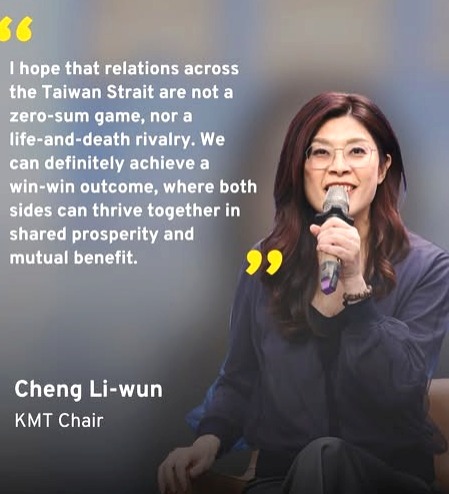
Taiwanese Cheng Li-Wun To Visit China As PRC Attempts To Co-Opt With TPP.

Taipei, Taiwan; April 2026: Taiwanese Kuomintang (KMT) chairwoman Cheng Li-Wun accepted an invitation from China Communist Party (CCP) General Secretary & President Of China Xi Jinping to visit the People’s Republic Of China (PRC) during April 07th to 12th.
CCP Taiwan Affairs Office (TAO) director Song Tao announced Xi’s invitation dated March 30 for Cheng to lead a KMT delegation to Jiangsu, Shanghai, and Beijing, though he did not explicitly state whether Xi would meet with Cheng himself. In her statement, Cheng said the trip would likely demonstrate that the two sides of the Taiwan Strait are “not destined for war”. Cheng has repeatedly expressed her desire to meet with Xi Jinping since her election as KMT Chairwoman in October 2025.
Meanwhile, the KMT legislative caucus and other KMT figures portrayed the upcoming meeting as an important mechanism for stabilising cross-strait relations. Taiwan’s Mainland Affairs Council (MAC), by contrast, urged Cheng to avoid falling into the trap of advancing the CCP’s agenda to divide Taiwan. The CCP seeks to legitimize the KMT as an interlocutor on behalf of Taiwan in place of the DPP, the current ruling party. The PRC cut off official exchanges with Taiwan after the DPP’s Tsai Ing-Wen became president of Taiwan in 2016 because it views the DPP as “separatists”. CCP officials have repeatedly met with KMT officials and invited them to PRC-hosted events during this time, however.
MAC has alleged that PRC based social media accounts are spreading propaganda claiming that Taiwan will soon run out of liquefied natural gas (LNG) due to Iran’s closure of the Strait of Hormuz. PRC psychological warfare against Taiwan aims to undermine Taiwanese people’s confidence in their government and weaken Taiwan’s resolve to resist PRC annexation. The said allegations were cross verified and it was identified that numerous PRC-based accounts on Douyin, TikTok, and YouTube posting videos apparently based on the same script. The videos claim that due to Iran’s closure of the Strait of Hormuz, Taiwan’s LNG supply will run out within 11 days and Taiwan will face electricity blackouts. LNG fueled around half of Taiwan’s power generation in 2025, according to the Taiwanese Energy Administration. Some videos also promoted “peaceful unification” with the PRC as a solution to Taiwan’s alleged energy shortfalls, echoing comments by the PRC’s Taiwan Affairs Office on March 18.
While refuting the purported allegations, Taiwan’s Minister of Economic Affairs Kung Ming-Hsin stated that LNG imported from Qatar through the Strait of Hormuz only accounted for around one third of Taiwan’s LNG supply, and that Taiwan is not in danger of running out of LNG.
The PRC is likely attempting to cause fear among Taiwan’s population about a potential energy crisis and increase the appeal of Taiwan acquiescing to PRC rule. The PRC may also be attempting to set conditions for a potential blockade around Taiwan to force “unification”. By conditioning Taiwan’s population to fear being cut off from imported fuel, the PRC may seek to amplify the psychological impact of future threats or moves to blockade Taiwan and force it to surrender its sovereignty. Taiwanese officials noted that online PRC disinformation features a “consistent narrative” focusing on Taiwan’s vulnerability to a blockade.
During 2025, the People’s Liberation Army (PLA) have carried out a total of 121 aerial incursions into Taiwan’s Air Defense Identification Zone (ADIZ) in March alone, setting a new monthly low since Taiwanese President William Lai Ching-te took office in May 2024. The PLA normalised an average of over 300 ADIZ incursions per month beginning in May 2024, but the monthly total fell below 200 in January 2025 and continued to decline through March 2025.
The persistent decline in monthly PLA sorties around Taiwan may indicate that the PRC is adjusting its coercion strategy toward Taiwan. A high volume of ADIZ incursions previously allowed the PRC to degrade Taiwan’s threat awareness by desensitising it to repeated aerial intrusions and to signal the PRC’s displeasure with Taiwanese political developments such as Lai’s election. Reducing the number of PLA sorties around Taiwan each month may free up PLA resources to focus on other priorities, such as enhancing joint combat operations, and restore the utility of ADIZ incursions as a means of short-term political signaling. The PLA may also have reduced the number of sorties to perform maintenance on its air fleet after an extended period of heavy use.
Taiwanese authorities indicted PRC born spouse and activist Xu Chunying in March 2026 for engaging in espionage and election interference on behalf of the PRC. Xu campaigned for TPP candidates, including Ko Wen-Je, under PRC direction but turned down the TPP’s offer to take one of the party’s at-large legislative seats. Xu’s indictment alleged that her PRC handler, Sun Xian, an official of a minor PRC political party belonging to the CCP led United Front, asked Xu if another PRC-born Taiwanese spouse named Li Chen-Hsiu could “take the baton”.
Taiwanese Mainland Affairs Council Deputy Minister Liang Wen-Chieh interpreted the phrase to mean that Li would take the seat Xu declined. Li Chen-Hsiu became the first PRC-born naturalised Taiwanese legislator when she assumed office in February 2026. The Ministry of the Interior did not receive documentation to verify that she renounced her PRC citizenship, however, and Cabinet officials have demanded that she vacate her seat until she does so. Li said that she herself have attempted to renounce her citizenship but PRC authorities rejected her application. Sun’s inquiry does not prove that Li herself is working with the PRC, but it does establish that PRC officials were interested having a PRC-born legislator in the LY.
The PRC appears to be increasing operations to infiltrate and co-opt the TPP even though the TPP does not officially support cross-strait unification and instead maintains an ambiguous stance. Taiwanese authorities previously convicted former TPP Taoyuan chapter spokesperson and independent LY candidate Ma Chih-Wei in October 2025 for receiving electoral funds from the PRC to run for office and providing her PRC handlers a list of contact information for Taiwanese central government agencies and national security personnel.
The PRC’s promotion of TPP candidates and attempts to infiltrate Taiwanese politics through the TPP show a pragmatic approach to election interference that is not limited to supporting parties that accept some form of cross-strait unity, such as the KMT’s 1992 Consensus or more radical pro-unification stances. The PRC likely sees the TPP as a significant player in Taiwanese politics to obstruct the DPP or remove it from power, even though the TPP is a centrist third party that does not officially align with the CCP’s cross-strait views. The CCP has also recruited people within the DPP itself to collect intelligence.
In a step towards demonstrating their resentment – Taiwan refused to attend the recently concluded disoriented & result-less World Trade Organization (WTO) Ministerial Conference for the first time because the conference host, Cameroon, issued travel documents that labeled Taiwan as “Taiwan, Province of China”. US lawmakers have accused the PRC of manipulating international organisations to exclude Taiwan. The WTO’s 14th Ministerial Conference was held in Yaoundé, Cameroon, on March 26-29.
Taiwan’s Ministry of Foreign Affairs (MOFA) condemned Cameroon on March 20 for its “subservience to China” and for undermining Taiwan’s right to participate in the WTO as a full member. The WTO is one of the few international organisations that Taiwan participates in. Taiwan joined it in 2002 under the name “Separate Customs Territory of Taiwan, Penghu, Kinmen and Matsu”.
Cameroon while responding to Taiwan’s complain by offering documents to exempt Taiwanese delegates from visa requirements, but MOFA said those documents were full of errors that could have led to “greater risk of being obstructed or humiliated upon arrival”. US Congress members John Moolenaar and Ro Khanna criticised Cameroon’s “decision to effectively exclude Taiwan” as an example of PRC efforts to manipulate international institutions. The PRC often pressures other countries to downgrade or sever their relations with Taiwan or to downgrade or obstruct Taiwan’s participation in international organizations. The PRC owns about a fifth of Cameroon’s external debt, is financing major infrastructure including Cameroon’s first deepwater seaport and a hydroelectric dam, and upgraded bilateral relations to a “comprehensive strategic partnership” in 2024.
Suvro Sanyal – Team Maverick


NCC Holds Cyclothon 2026 to Mark 79th Independence Anniversary
The National Cadet Corps (NCC) organised Cyclothon 2026 on August 02, 2026 in New Delhi to…

NCC Holds Cyclothon 2026 to Mark 79th Independence Anniversary
The National Cadet Corps (NCC) organised Cyclothon 2026 on August 02, 2026 in New …