Chinese Oil Refinery Has Been Sanctioned By The United States.

Beijing; April 2026: The US Treasury Department has announced that it is imposing sanctions on the Hengli Petrochemical Refinery, near Dalian in northeast China. In their official X handle they have said:
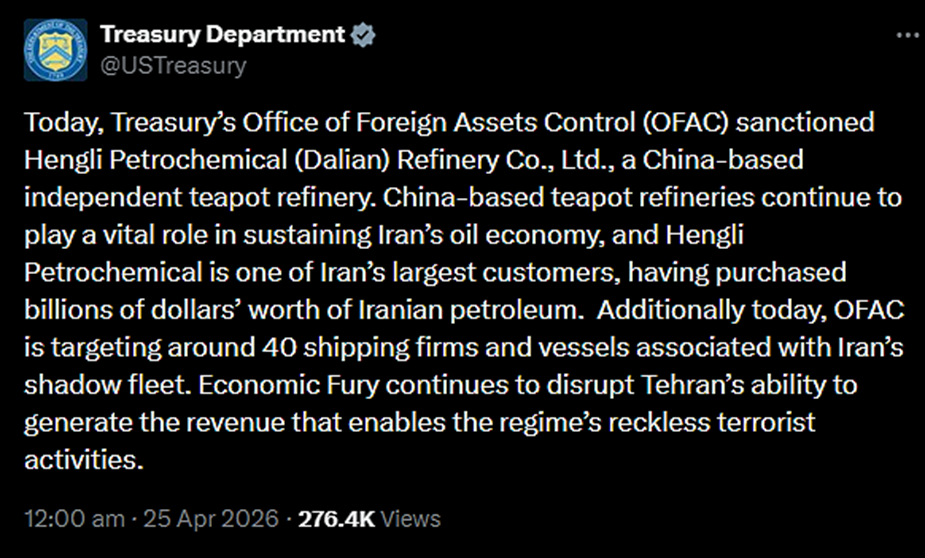
The Treasury said that the refinery was among the independent so-called “teapot refineries” that “continue to play a vital role in sustaining Iran’s oil economy”.
It was almost a month after the US-Israel attack on Iran, Members of the International Energy Agency have agreed to release 400 million barrels of oil from strategic reserves. Many countries started tapping the strategic oil reserves in a bid to ease the effects of an economic crisis, but it was China who appeared to have largely insulated itself from the oil crisis, even though the country is heavily reliant on Iran for oil.
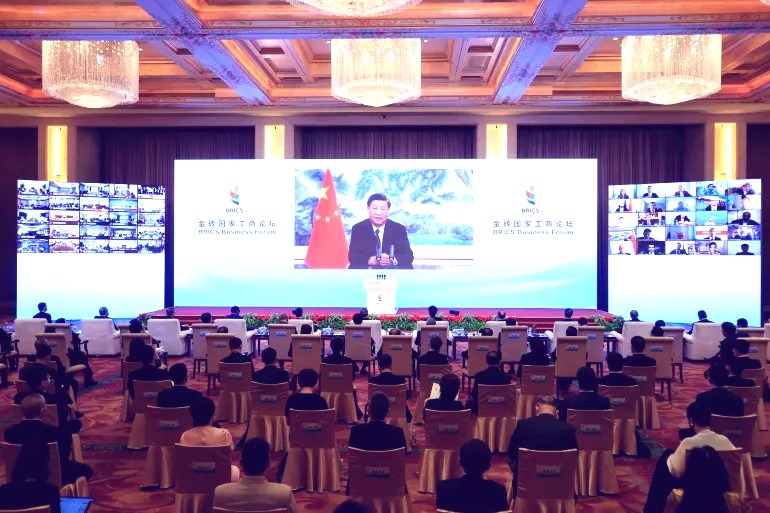
According to data from Kpler, China bought more than 80% of Iran’s shipped oil in 2025. China’s imports of Iranian crude were 1.4 million barrels of oil per day (mbd) in 2025, out of a total 10.4 mbd seaborne crude imports. Beijing was already prepared to cope with an energy crisis, as it had been preparing for years. In 2021, while visiting an oilfield in the country, Chinese President Xi Jinping stated that the country would take its energy supply matters “into its own hands”.
Since then, one of the key tactics the country has used to secure its oil supply is through “teapot refineries” – smaller, independent facilities which have capitalised on oil made cheap by international sanctions, stockpiling oil reserves and increasing imports from countries such as Iran, Russia and Venezuela. Indeed, until the US launched its strike on Venezuela in January, and capturing the President Nicolas Maduro, and effectively seizing control of the Venezuelan oil industry, China was the largest buyer of oil from the country.
Muyu Xu, a senior crude oil analyst at Kpler have said, “while China’s continued buying of Russian and Iranian crude has provided some buffer in this oil crisis, it will not be sufficient to offset the loss of non-Iranian supplies from the Middle East”, adding further, “while our data shows that Iranian oil on water outside the Persian Gulf remains close to 165 mbd, which is equivalent to about four months of China’s Iranian imports. This does not mean China will rely on Iranian crude as a primary solution to ease the supply crunch”, Muyu said.
While a large quantity of sanctioned Russian oil is being shipped to China on shadow fleets flying false flags, this is also likely to diminish as a result of the war after Trump relaxed US sanctions. Several Russian oil-laden tankers have already changed course on the open ocean to head for India instead.
Furthermore, teapot refiners cannot buy endless amounts of oil if prices rise substantially, Muyu said. “State-owned refiners remain concerned about compliance and operational risks, while teapot refiners are also holding back from new purchases due to high prices and thin margin”.
CHINA’S TEA POT REFINERS –
They are small, privately owned oil refineries primarily based in China’s Shandong province, which are used by Beijing to import discounted Iranian and Russian oil to circumvent sanctions imposed by the US and other countries. “To avoid the reputational and financial risk from importing sanctioned Iranian oil, this oil was mainly bought by small, private ‘teapot’ refineries, rather than major Chinese state-owned oil companies”.
Moreover, China has facilitated the payments of Iranian oil in renminbi through China’s new Cross-border Interbank Payment System (CIPS). These refineries are known as “teapots” because of their compact teapot-like shape. They account for one-quarter of China’s processing capacity, but they operate on very narrow margins, meaning they are very sensitive to fluctuations in the price of oil.
According to the Oxford Institute for Energy Studies, these refineries came to be known globally in July 2015, when Chinese crude buying surged. In normal times, the teapots boost fuel supply and margins. During crises, they act as a flexible buffer for bargain barrels. However, when discounts dry up and prices surge, their thin profit margins get squeezed, forcing some to cut operations.
The US has previously imposed sanctions on some of these teapot refineries – such as the Hebei Xinhai Chemical Group refinery in the Shandong province in May last year, for importing Iranian oil.
The Chinese embassy in Washington has not commented on this subject, although asserted that China opposes illegal unilateral sanctions against countries and has called for talks to end the war in the Middle East.
Suvro Sanyal – Team Maverick.






End of an Era: Cristiano Ronaldo Bids Farewell to the FIFA World Cup After a Record-Breaking International Career
Dallas, July 2026 : One of football’s greatest chapters came to a close on Tuesday a…

End of an Era: Cristiano Ronaldo Bids Farewell to the FIFA World Cup After a Record-Breaking International Career
Dallas, July 2026 : One of football’s greatest chapters came to a close on …