Reform Linked MoUs signed with Mizoram and Ladakh under Jal Jeevan Mission 2.0

Continuing the nationwide rollout of reform linked implementation under Jal Jeevan Mission 2.0; Mizoram and Ladakh signed MoUs with the Union Government today, committing to a structured reform framework for sustainable, transparent and community-led rural drinking water service delivery.
The reform‑linked MoU mandates a Gram Panchayat‑led, service‑based and community‑centred model of rural water governance, aligned with the objectives of Jal Jeevan Mission 2.0.
The reform‑linked MoU seeks to ensure that every rural household has access to drinking water supply in adequate quantity and of prescribed quality on a regular basis, through strengthened community participation (Jan Bhagidari) and bringing in structural reforms for sustainable operation and maintenance of rural water supply systems, thereby enhancing the living standards of rural communities contributing to long‑term water security aligned with the national vision of Viksit Bharat @2047.
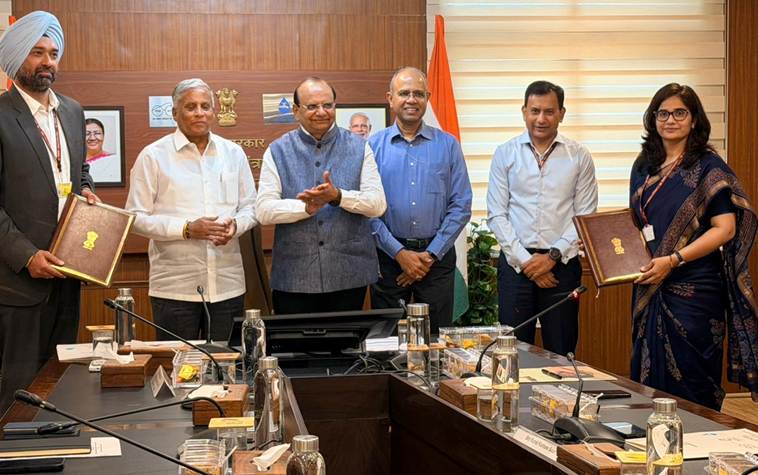
The MoUs were signed in the virtual presence of the Union Minister of Jal Shakti, Shri C. R. Patil. Minister of State for Jal Shakti Shri V. Somanna was also present during the MoU signing at the DDWS office.
Senior officials from the Department of Drinking Water and Sanitation (DDWS), including Shri Ashok K. K. Meena, Secretary, DDWS, Shri Kamal Kishore Soan, Additional Secretary & Mission Director, National Jal Jeevan Mission (NJJM) were also present during the MoU signing.
The MoU with Mizoram signed in the presence of the Chief Minister of Mizoram, Shri Lalduhoma who joined the event virtually along with senior officials from the state.
The MoU was signed and exchanged between Smt. Swati Meena Naik, Joint Secretary (Water), DDWS, and Smt. Zodingpuii, Secretary PHED, Government of Mizoram & MD JJM, Mizoram.
Marking a key step in Centre-UT collaboration, the MoU with Ladakh was formally signed on the presence of Lieutenant Governor of Ladakh, Shri Vinai Kumar Saxena; Smt. Shashanka Ala, IAS, Secretary, UT, Ladakh; Dr. Mohammad Usman Khan, JKAS, Add. Secretary, PHE/I&FC department, Ladakh and other senior officials from the State.
The MoU was signed and exchanged between Smt. Swati Meena Naik, Joint Secretary (Water), DDWS, and Shri Shurbir Singh, IAS, Commissioner/Secretary, PHE/I&FC Department, UT, Ladakh.
Addressing the gathering, Union Minister of Jal Shakti, Shri C. R. Patil highlighted that the reform-linked MoUs mark a pivotal step in achieving ‘Har Ghar Jal’ for all rural households by 2028. He commended Mizoram’s near-100% reported physical progress under JJM and urged timely reforms in operation, maintenance, and community participation to ensure and claim Har Ghar Jal (HGJ) certified status. The Minister assured full central support, including expedited fund releases, to maintain implementation momentum for the state.
In his address Ladakh, Shri C. R. Patil congratulated Shri Vinai Kumar Saxena for his commendable efforts in ensuring 98.18% FHTC in the UT. He also urged for a rapid execution of the mission as per the JJM 2.0 guidelines to get a 100% HGJ certified UT.
He also stated that JJM 2.0, under the leadership of Prime Minister Shri Narendra Modi, focuses on accountability, water quality, and long-term sustainability. In order to fulfill this, he urged the officials to conduct District Water and Sanitation Mission (DWSM) meetings on timely basis and adhere to the MoU. He also urged both Mizoram and Ladakh to prioritize Jal Sanchay Jan Bhagidari through convergence with schemes like MGNREGA to ensure the long-term viability of the water supply systems.
Shri Patil informed that in September 2025, the Secretary of the Department of Drinking Water and Sanitation (DDWS) wrote a D.O. letter to the Secretary of the Ministry of Home Affairs (MHA) regarding issues related to Operation & Maintenance (O&M) in the Union Territories. In this regard he requested Lieutenant Governor of Ladakh to coordinate with MHA and work for O&M.
He also mentioned the suggestions given by the Additional Secretary & Mission Director (AS&MD), NJJM after discussion with the Chief Secretary of Ladakh during his visit to the UT in September 2025 and asked to take actions in this regard.
Chief Minister of Mizoram, Shri Lalduhoma, in his address termed the MoU a potential game changer for the State and highlighted Mizoram’s strong performance under JJM. He informed that 1,33,060 rural households in the State have been provided with FHTCs, with 99% physical progress achieved across sanctioned schemes. He further noted that all rural schools and Anganwadi centers have been covered with tap water supply.
The Chief Minister also highlighted the State’s emphasis on water quality, with 28 water testing laboratories established, including NABL-accredited facilities. He underlined the role of community participation through constitution of VWSCs in all villages and the formation of district technical teams to ensure sustainability of water supply systems. He also mentioned that the state has planned Comprehensive Implementation and Reform Plan (CIRP) and will be uploading it on Jal Jeevan Mission-Integrated Management Information System (JJM-IMIS).
While appreciating the continued support of the Union Government, he emphasised the importance of timely financial support for sustaining implementation momentum and reaffirmed the State government’s commitment to successful execution of the mission.
In his address, the Lieutenant Governor of Ladakh, Shri Vinai Kumar Saxena highlighted the significance of Jal Jeevan Mission in ensuring access to safe drinking water in the challenging terrain of Ladakh. He termed the signing of MoU as a historic occasion.
He pointed out that substantial progress has been achieved, with works completed in a significant number of villages, and emphasized that JJM is translating the vision of providing tap water to every household into reality. He highlighted the unique feature of JJM as it has community-led verification, wherein local villagers certify the functionality and delivery of water supply systems, thereby ensuring accountability and effectiveness on the ground. Aligning to the mission’s key points, Shri Saxena expressed confidence that the reform-linked framework will further strengthen implementation and assured full cooperation of the UT administration in achieving the objectives of Jal Jeevan Mission.
In his opening remarks, Shri Ashok K. K. Meena, Secretary, DDWS underscored that the MoU prioritises not just infrastructure setup of pipelines, but sustainable services managed at the grassroots level. He emphasised on decentralization and community ownership, with Gram Panchayats and Village Water & Sanitation Committees (VWSCs) being empowered to manage and operate in-village water supply systems. While stating the importance of the MoU signing with the state and UT, Shri Meena highlighted that the MoU is a shared commitment between the State/UT which ensures the upholding of JJM 2.0 guidelines in order to provide safe, secure and sustainable drinking water to the rural households. He also mentioned that this step is an initiative which aligns with the fulfillment of Prime Minister Shri Narendra Modi’s Har Ghar Jal vision.



Jagan Accuses Chandrababu of Taking Credit for Bhogapuram Airport, Says YSRCP Laid the Foundation for the Project
Amaravati, July 2026 : With the Bhogapuram Greenfield International Airport set to be inau…

Jagan Accuses Chandrababu of Taking Credit for Bhogapuram Airport, Says YSRCP Laid the Foundation for the Project
Amaravati, July 2026 : With the Bhogapuram Greenfield International Airport set to be inaugurated …