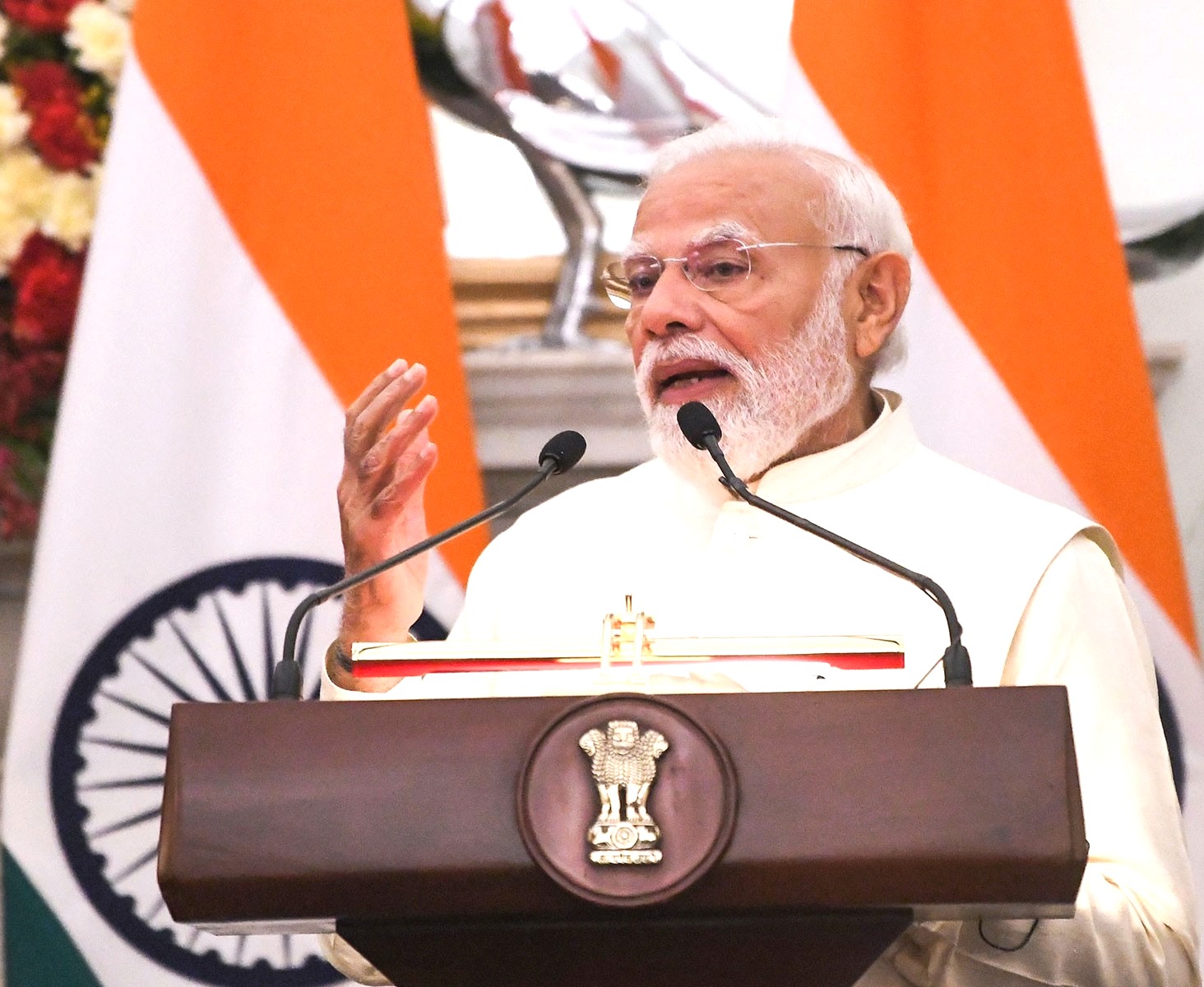
PM Modi Hails 1998 Pokhran Tests On National Technology Day; Says ‘Tech Key Pillar Of Self-Reliant India’.

New Delhi; May 2026: Prime Minister Narendra Modi today on 11th May 2026 has lauded the country’s scientific community on National Technology Day, calling the 1998 Pokhran nuclear tests a “landmark moment” that showcased India’s scientific excellence and unwavering commitment.
In a post on X, the Prime Minister said, “Greetings on National Technology Day. We recall with pride the hard work and dedication of our scientists, which led to the successful tests in Pokhran in 1998. That landmark moment reflected India’s scientific excellence and unwavering commitment”.
Calling technology, a key pillar of a self-reliant India, the Prime Minister said innovation continues to drive growth, widen opportunities and strengthen multiple sectors of the economy. He added that the government remains focused on supporting talent, encouraging research and developing solutions that contribute to the country’s progress and fulfil people’s aspirations.
“Technology has become a key pillar in building a self-reliant India. It is accelerating innovation, expanding opportunities and contributing to the nation’s growth across sectors. Our continued focus remains on empowering talent, encouraging research and creating solutions that serve both national progress and the aspirations of our people”, he added.
The celebration of National Technology Day was started by former Prime Minister Atal Bihari Vajpayee in 1999 to honour Indian scientists, engineers and technologists, who worked for India’s scientific and technological advancement and ensured the successful conduct of Pokhran tests in May 1998. Since then, National Technology Day is observed every year on May 11th. India conducted Pokhran-II tests, a series of 05 nuclear explosions, in May 1998 at the Indian Army’s Pokhran Test Range in Rajasthan. It was overseen by the then Prime Minister Atal Bihari Vajpayee. The test was also led by scientific figures, including R Chidambaram and APJ Abdul Kalam.
In a press statement, the Department of Atomic Energy said the first three detonations were carried out simultaneously at 15:45 hours IST on May 11. These included a 45-kiloton thermonuclear device, a 15-kiloton fission device and a 0.2 kiloton sub-kiloton device. 02 more nuclear devices, detonated simultaneously on May 13th, were also in the sub kiloton range, with yields of 0.5 kilotons and 0.3 kilotons.
The department said the tests marked the culmination of decades of sustained efforts towards self-reliance in India’s nuclear weapons development programme. It noted that the programme drew on expertise across several disciplines, including explosive ballistics, shock wave physics, condensed matter physics, materials science, nuclear and neutron physics, radiation hydrodynamics and advanced electronics engineering. The statement added that the development of complex computer simulation software and specialised production and fabrication technologies had also played a critical role in accurately predicting weapon yields. According to the department, India has developed world-class expertise in several of these fields, including shock wave physics and high-pressure equation-of-state research.
Earlier yesterday (10th May 2026), ahead of the National Technology Day today, industry leaders and academic experts said that responsible and inclusive innovation will define India’s next phase of technological growth. Experts have highlighted that while Artificial Intelligence (AI), digital infrastructure and advanced technologies are accelerating India’s transformation into a global innovation hub, issues such as cybersecurity, ethical governance, sustainability and accessibility must remain central to technological progress. Academic leaders also stressed the need for ethical and socially responsible technology education.
C P Gurnani, Co-Founder and Vice Chairman of AIonOS, said responsible innovation should focus on both technology and trust. “The true measure of technology lies in its impact on humanity. Responsible innovation today is about building trust as much as it is about building technology”, Gurnani said. He added that enterprises must prioritize “secure, ethical and inclusive digital transformation” as digital ecosystems continue to expand.
Anku Jain, Managing Director of MediaTek India, said India is rapidly emerging as a global innovation hub, with IT spending expected to exceed USD 176 billion. “India’s technology landscape is rapidly transitioning from a cost-efficient IT services base to a high-value global innovation hub”, Jain said, adding that responsible innovation must ensure advanced technologies remain “accessible and sustainable”. According to Jain, democratising affordable and energy efficient technologies across urban and rural India will play a key role in powering inclusive growth.
Agendra Kumar, Managing Director of Esri India, said technologies such as geospatial intelligence are helping governments and organisations make informed decisions across urban development, climate resilience and infrastructure planning. “Technology has the potential to drive meaningful and lasting progress when it is designed with inclusivity, sustainability and resilience at its core”, Kumar said.

Pankaj Malik, CEO and Whole-time Director of Invenia-STL Networks, said India’s next digital growth phase will require AI-ready infrastructure with intelligent power management and green data centres. “The future of technology will depend on how sustainably we power the intelligence we are creating”, Malik said.
Meanwhile, Gadhadar Reddy, Co-Founder and CEO of NoPo Nanotechnologies, said advanced materials such as carbon nanotubes will play a major role in industrial transformation. “Advanced materials will define the next era of industrial transformation, with carbon nanotubes unlocking new levels of performance across energy, electronics, and manufacturing”, Reddy said.
Shrikrishna Dikshit, Partner – Risk Advisory at Baker Tilly ASA India, said India’s AI-led growth must be backed by strong cybersecurity and governance frameworks. “As we race towards a USD 5 trillion digital economy, the true leaders won’t just be those who deploy AI the fastest, but those who build on a foundation of resilience”, Dikshit said.
Visalakshi Talakokula, Associate Dean at Mahindra University, said institutions should help students understand the societal implications of AI and emerging technologies through ethics driven education and interdisciplinary learning.
Sanjay Gupta, Vice Chancellor of World University of Design, said responsible innovation should focus on inclusivity and societal impact alongside technological advancement. “Responsible innovation is not about slowing progress, but about shaping it with purpose”, Gupta said.
Team Maverick.





US Launches Third Round of Strikes on Iran After Attack on Commercial Ship in Strait of Hormuz
Washington, July 2026 : The United States launched a third round of military strikes again…

US Launches Third Round of Strikes on Iran After Attack on Commercial Ship in Strait of Hormuz
Washington, July 2026 : The United States launched a third round of military strikes …