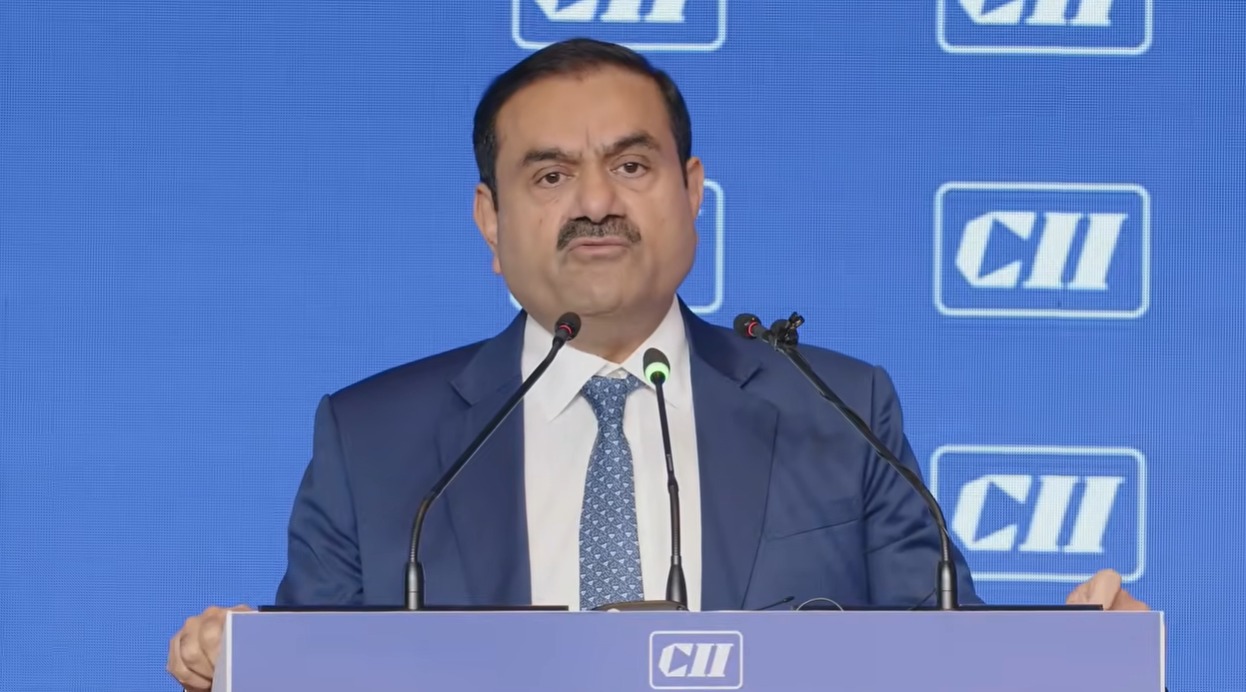
Gautam Adani Says Energy, AI and Compute Will Define Future Global Power Structure

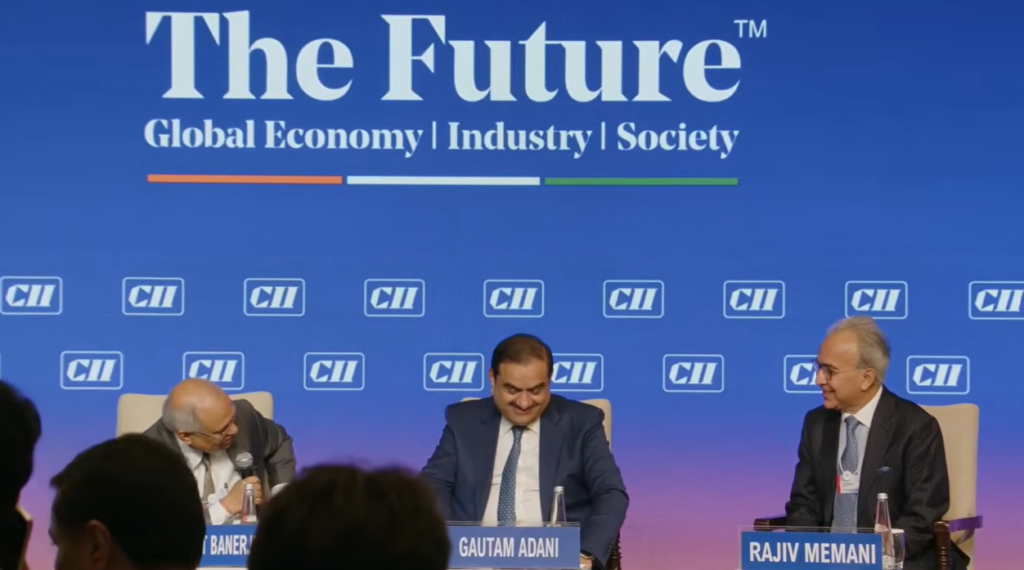
New Delhi, May 2026 : Namaskar, It is a privilege to be present at the 2026 CII Annual Business Summit and to share my thoughts on a world that is changing more rapidly than at any point in recent history.
This year’s summit theme asks us to reflect on the future of the global economy, industry, and society. But before we speak about the future, we must first question one of the biggest assumptions of the past three decades.
For years, the world believed globalization would continue uninterrupted. Nations assumed supply chains would always remain open, technology would move freely across borders, capital would flow without restrictions, and digital infrastructure would remain neutral. The world convinced itself that geography no longer mattered and that the future belonged to an interconnected global order.
But recent events have shown that assumption was incomplete.

The world that is emerging today is no longer flat. It is increasingly fractured and strategically divided. Supply chains are now being redesigned around national priorities. Energy has returned to the centre of geopolitical discussions. Semiconductors are no longer viewed merely as industrial products but as instruments of strategic influence. Data is being treated as a sovereign national resource, while Artificial Intelligence is increasingly being developed behind protected digital and physical infrastructure.
The recent conflicts in the Middle East and attacks on critical infrastructure have reinforced one unmistakable reality: energy security and digital security are no longer separate domains. Together, they form the twin pillars of national power in the twenty-first century.
It is becoming increasingly clear that the nation that controls its energy will power its industrial future. The nation that controls its compute infrastructure will shape the intelligence economy of tomorrow. And the nation that controls both will define the balance of global influence in the decades ahead.
This is the new geometry of power.
If 1947 represented India’s political freedom, then true independence in the modern era will mean owning the energy that powers our homes, industries, and transportation systems, while also controlling the intelligence and digital infrastructure that guides our future.
The world’s two largest economies — the United States and China — have already understood this deeply.
The United States realized the importance of energy sovereignty following the oil embargo of 1973-74, when oil prices surged dramatically and exposed how even a superpower could be vulnerable if its energy lifelines depended on external control. America responded through decades of technological innovation, policy support, and persistence, eventually transforming itself through the shale oil and gas revolution into one of the world’s largest energy producers.
Today, the United States produces nearly 14 million barrels of crude oil every day, while natural gas powers a major portion of its electricity generation. But America did not stop there. It is now investing aggressively in advanced nuclear technologies, geothermal energy, renewables, battery storage, and next-generation energy systems.
Simultaneously, compute infrastructure has emerged as the next strategic frontier. Chips, AI models, cloud infrastructure, and data centres are no longer simply commercial assets. They are now instruments of national capability. Discussions between governments and technology companies increasingly revolve around control of future technological infrastructure.
China arrived at the same conclusion through a different path.
Without America’s shale advantage, China built a unique architecture of self-reliance. Coal remained the backbone of its industrial and energy system, while the country simultaneously executed one of the largest renewable energy expansions in human history.
Despite coal still accounting for a large share of electricity generation, China added an unprecedented 440 gigawatts of solar and wind capacity in 2025 alone — representing nearly two-thirds of global renewable additions during that period.
On the digital front, China recognized early that leadership in Artificial Intelligence could not depend indefinitely on foreign chips, foreign operating systems, or foreign platforms. Even under export restrictions, it continued building domestic capabilities and treating AI as a national strategic objective.
The conclusion is now unavoidable.
America seeks compute dominance through energy abundance. China seeks AI sovereignty through industrial scale. Energy and intelligence have become inseparable pillars of strategic power. Nations that fail to build these capabilities during times of stability risk becoming vulnerable during periods of crisis.
Against this backdrop, India’s journey will neither mirror America’s path nor China’s model. India’s strength lies in something uniquely its own.
India is not building for an abstract future. India is building for a rising, aspirational, and rapidly transforming society. We are building for expanding cities, electrified transportation, industrial growth, digital consumption, and millions of entrepreneurs waiting to scale their ambitions.
India’s greatest advantage is simple: demand already exists.

Everything India builds today already has consumers, businesses, and industries waiting to use it. The challenge before us is not creating demand, but building capacity quickly enough to meet it.
The progress India has made on the energy front is extraordinary.
As of March 2026, India has crossed 500 gigawatts of installed power capacity. More than half of this capacity has been added in the past decade alone. India is now preparing to scale toward nearly 2,000 gigawatts by 2047.
This is not symbolic progress. This is nation-scale transformation happening in real time — industrializing, digitizing, urbanizing, and decarbonizing simultaneously.
India’s economic trajectory reflects this momentum. It took the country nearly 67 years after Independence to become a two-trillion-dollar economy. Yet it required only about 12 additional years to double that figure.
India is no longer growing through incremental expansion. India is now growing through compounding acceleration.
Every new road strengthens industrial corridors. Every airport expands trade opportunities. Every port improves logistics efficiency. Every power asset supports manufacturing growth. Every data centre strengthens digital infrastructure.
At this pace, India could effectively add the equivalent of a new European economy to its GDP every decade.
We have witnessed this kind of transformation before.
A decade ago, few imagined the scale of India’s mobile data revolution. But once smartphones became affordable, telecom networks expanded, and data prices declined, digital consumption exploded across the country.
Artificial Intelligence could create an even larger transformation — but one that will require far greater energy and infrastructure capacity.
India’s data centre capacity, projected at roughly 5 gigawatts by 2030, could potentially rise to nearly 75 gigawatts by 2047. This demands preparation at an unprecedented scale.
There is, however, one narrative surrounding AI that deserves to be challenged.
Across many global boardrooms, AI is often discussed as a force that will eliminate jobs, replace human judgment, and reduce workforce participation. That narrative does not fit India’s reality.
India must not import fear from elsewhere.
India must build AI not as a technology that removes opportunity, but as one that expands productivity, creates employment, empowers small businesses, and allows Indians to compete globally with confidence.
The story of UPI demonstrates this clearly.
UPI was never merely a payment system. It fundamentally transformed economic trust and digital participation. It gave street vendors digital visibility, enabled small merchants to participate in the formal economy, and transformed smartphones into economic instruments.
Once payments became frictionless, commerce accelerated. Once ordinary citizens entered the digital economy, entirely new industries emerged.
From that digital foundation rose companies such as Flipkart, Paytm, Ola, Swiggy, Meesho, Zepto and PhonePe.
AI has the potential to trigger a similar transformation, but on a much larger scale.
It will create industries that do not yet exist, business models that have not yet been imagined, and markets that remain invisible today.
To understand this future, India must recognize the three foundational layers of AI.
The first layer is power.
AI begins with reliable, affordable, and scalable energy. Without electricity, there can be no processing, storage, or networking.
The second layer is compute infrastructure.
This includes chips, GPUs, servers, data centres, cooling systems, and high-capacity networks — the physical factories of the intelligence age.
The third layer is the application layer.
This is where AI touches farmers, doctors, teachers, manufacturers, logistics companies, banks, students, consumers, and citizens.
Power creates compute.
Compute creates intelligence.
Intelligence creates new businesses.
This is the new AI stack.
India must therefore understand that AI is not merely software. AI is infrastructure. AI is energy. AI is cooling systems, chips, data, networks, governance, and talent.
For too long, the digital world was treated as borderless. But in this fractured era, data and compute must have a home. Intelligence must have geography.
If a nation’s data is processed entirely elsewhere, then its future risks being shaped elsewhere as well.
This represents the sharpest collision between the old technology world and the emerging intelligence economy.
India’s IT services industry achieved something extraordinary. It generated employment, confidence, global credibility, and economic growth. It placed India at the centre of the global technology ecosystem.
But the earlier model largely focused on building software and services for platforms owned elsewhere.
The AI age rewards ownership differently.
It rewards those who own the data, the compute infrastructure, the foundational models, and the platforms on which future economies will operate.
Every generation must build beyond the achievements of the previous one. This is not criticism of India’s IT sector. It is recognition of a changing technological reality.
At the Adani Group, we view this as a defining national mission.
We are builders. And in the intelligence age, building means creating the physical backbone of India’s digital future.
The first foundation is energy.
Without power, there can be no AI. Without AI infrastructure, there can be no digital leadership.
At Khavda in Gujarat, we have already commissioned a major portion of what will become the world’s largest single-site renewable energy project — a 30-gigawatt renewable energy complex that could reshape India’s energy landscape.
Our total commitment toward the energy transition currently stands at approximately 100 billion dollars, making it among the world’s largest clean-energy investment programmes.
The second foundation is data centres.
Across India, we are developing integrated data centre campuses. In partnership with Google, we are building a massive gigawatt-scale data centre campus in Visakhapatnam. This represents a multi-billion-dollar commitment toward sovereign compute infrastructure on Indian soil.
Microsoft is also a key partner in our digital infrastructure initiatives, while companies including Flipkart and Uber are anchoring significant data requirements with the group.
Recently, we also announced another 100-billion-dollar commitment toward the data centre sector.
This reflects a larger national belief.
India must not rent the infrastructure of its intelligence future. India must build it, power it, and own it domestically.
But beyond infrastructure, the most important foundation remains people.
The intelligence age will not be built only by algorithms and servers. It will also be built by technicians, electricians, safety officers, grid operators, cooling engineers, data centre professionals, and millions of skilled Indians maintaining the physical systems that support the digital economy.
Through the Adani Foundation, we have committed Rs 60,000 crore toward healthcare, education, skilling, and community development. A growing portion of this investment is now focused on AI-integrated skilling initiatives.
Because the true measure of AI will not be how many jobs it eliminates. The true measure will be how many Indians it empowers.
Throughout my life, I have believed in building where others saw impossibility — ports where there were marshlands, infrastructure where there was darkness, and opportunity where others saw limitations.
One lesson stands above all others:
The future does not arrive on its own. The future is built.
And so, India must build.
We must build for the farmer who understands his land but needs technology to maximize productivity.
We must build for the nurse who possesses instinct and dedication but requires better tools.
We must build for the teacher in a remote classroom who may soon gain access to the world’s knowledge through digital infrastructure.
We must build for the small manufacturer who has the skill to compete globally but requires intelligence systems to scale.
We must build for the welder, the technician, the electrician, the operator, and the millions of invisible hands that hold this nation together every day.
These are the people of Bharat that AI must be built to serve.
The next freedom struggle will not be fought only at our borders.
It will be fought in our grids, our data centres, our factories, our classrooms, our laboratories and our minds.
And this time, freedom will mean capability.
Capability to power ourselves.
Capability to compute for ourselves.
Capability to dream for ourselves.
It begins here. It begins now. And it begins with us. Jai Hind.
Team Maverick.
(The content of this article is sourced from a news agency and has not been edited by the Mavericknews30 team.)








Alvarez, Lautaro Fire Argentina Past 10-Man Switzerland in Extra Time, Set Up Blockbuster World Cup Semi-final Against England
Score: Argentina 3 (Alexis Mac Allister 10′, Julian Alvarez 112′, Lautaro Mart…

Alvarez, Lautaro Fire Argentina Past 10-Man Switzerland in Extra Time, Set Up Blockbuster World Cup Semi-final Against England
Score: Argentina 3 (Alexis Mac Allister 10′, Julian Alvarez 112′, Lautaro Martinez 120+1′) beat …