India-Netherlands Partnership Revives Momentum for Gujarat’s Ambitious Kalpasar Project

Gandhinagar, May 2026 : The renewed collaboration between India and Netherlands on the long-pending Kalpasar project is being viewed as a major boost for Gujarat’s future water security, irrigation expansion and renewable energy ambitions.
The latest push for the ambitious infrastructure proposal came during Prime Minister Narendra Modi’s recent visit to the Netherlands, where a Letter of Intent (LoI) was signed between India’s Ministry of Jal Shakti and the Dutch Ministry of Infrastructure and Water Management.
The agreement aims to deepen technical cooperation and facilitate knowledge-sharing for the planning and execution of the Kalpasar project, one of Gujarat’s most ambitious and technically challenging water management proposals.
The project has remained under discussion for decades because of its massive engineering requirements, environmental considerations and financial scale. However, the renewed Indo-Dutch engagement has revived optimism around the proposal.
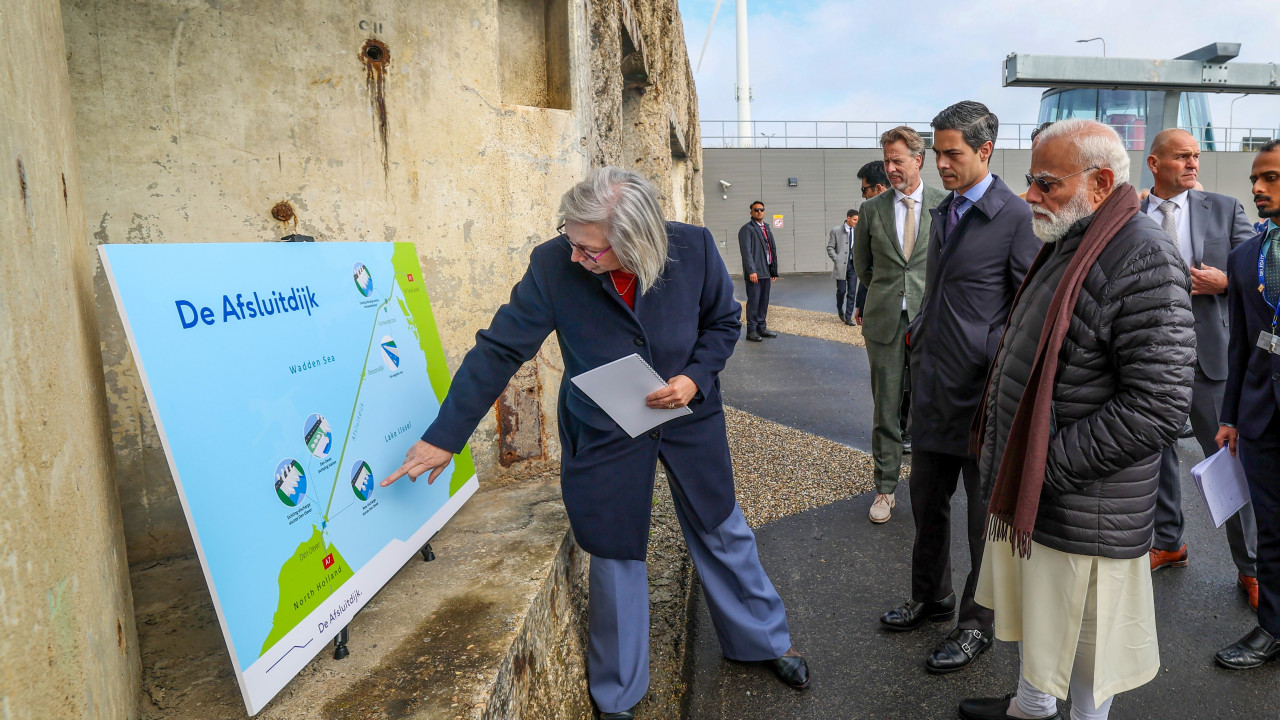
During the visit, Prime Minister Modi also toured the renowned Afsluitdijk dam in the Netherlands. The 32-kilometre-long barrier dam, completed nearly 80 years ago, is considered one of the world’s most successful examples of large-scale coastal engineering and water management.
The structure separates the North Sea from inland freshwater systems and has played a crucial role in flood protection, land reclamation and freshwater conservation in the Netherlands. Dutch authorities highlighted the project as an important reference point for engineering strategies relevant to Kalpasar.
The Kalpasar project proposes constructing a massive dam across the Gulf of Khambhat in Gujarat to store freshwater from seven rivers that currently flow into the Arabian Sea. The stored water would be used for irrigation, drinking water supply and industrial purposes across several drought-prone regions of the state.
Officials believe the project could transform water distribution in Gujarat if implemented successfully.
According to estimates, the project has the potential to provide irrigation benefits to nearly 10 lakh hectares of land spread across 42 talukas in nine districts of the Saurashtra region. This is expected to significantly strengthen agricultural productivity in areas frequently affected by water scarcity and erratic rainfall.
Apart from water storage, Kalpasar is also designed as a multi-purpose infrastructure project. It includes plans for large-scale renewable energy generation, with an estimated capacity of around 1,500 MW of wind energy and 1,000 MW of solar power.
The proposal also envisions development opportunities in fisheries, tourism, transport infrastructure and regional economic connectivity.
One of the major projected benefits of the project is the reduction in travel distance between South Gujarat and Saurashtra. Currently, the route between the two regions spans around 240 kilometres, but the Kalpasar dam corridor could reduce this distance to nearly 60 kilometres, creating faster transport and trade connectivity.
Gujarat has historically struggled with recurring droughts and uneven rainfall distribution. While the Sardar Sarovar Dam has significantly improved water availability in several regions, state planners have argued that dependence on a single major reservoir system may not be sufficient to ensure long-term water resilience.
The Kalpasar proposal was first conceptualised during Narendra Modi’s tenure as Chief Minister of Gujarat. In 2004, marine surveys were initiated near Bhavnagar to study the technical feasibility of the project.
Since then, multiple technical assessments and environmental studies have been conducted to evaluate engineering requirements and ecological impact.
International consultancy Royal HaskoningDHV has also contributed to parts of the project’s detailed planning, particularly regarding marine engineering design and closure methodologies.
Recent discussions between Indian and Dutch officials have focused on strengthening institutional partnerships and forming joint expert groups to support project evaluation and implementation planning.
These issues were also discussed earlier this year during a meeting in Gandhinagar between Gujarat Chief Minister Bhupendra Patel and Dutch Ambassador Marisa Gerards.
The talks centred on technical cooperation, sustainable infrastructure development and long-term institutional collaboration under the broader India-Netherlands Strategic Partnership on Water.
The strategic partnership between the two countries focuses on water management, climate adaptation, flood control and sustainable urban development — sectors in which the Netherlands possesses globally recognised expertise.
For Gujarat, the latest developments signal a renewed commitment to integrating international engineering expertise with long-term domestic planning for Kalpasar.
If implemented successfully, the project is expected to become one of India’s largest integrated water infrastructure initiatives, reshaping irrigation systems, strengthening water security, expanding renewable energy capacity and transforming regional connectivity across Gujarat.



Jaishankar, Rubio Push for Defence Pacts and Near-Final Trade Deal at Manila Meeting
Manila, July 2026 : India and the United States on Wednesday gave fresh momentum to their …
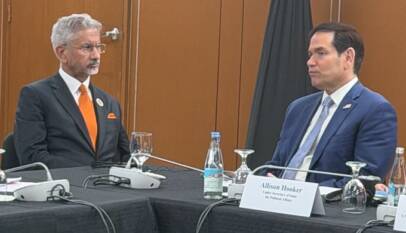
Jaishankar, Rubio Push for Defence Pacts and Near-Final Trade Deal at Manila Meeting
Manila, July 2026 : India and the United States on Wednesday gave fresh momentum …