PM Modi Calls for Deeper India-Europe Strategic and Economic Partnership at European Industry Round Table in Sweden

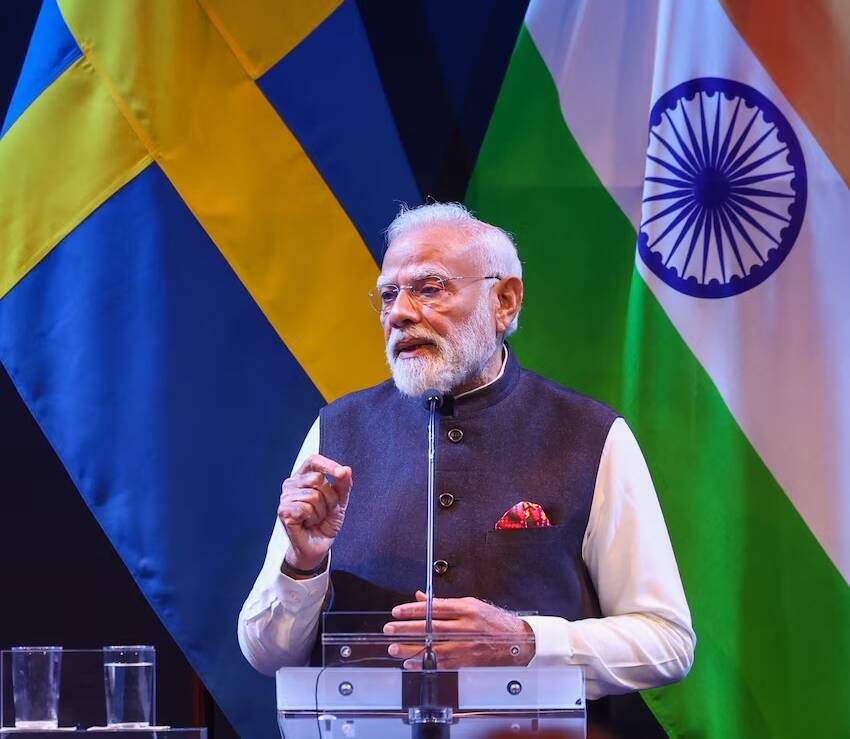
Gothenburg, May 2026 : Prime Minister Narendra Modi on Sunday made a strong pitch for expanding India-Europe strategic and economic cooperation while addressing the prestigious European Round Table for Industry (ERT) in Gothenburg, Sweden. Emphasising that India-Europe relations are founded not only on trade and commerce but also on shared democratic values, trust and diversity, the Prime Minister called for stronger partnerships in technology, manufacturing, energy, innovation and resilient global supply chains.
The interaction was hosted by the Volvo Group and attended by Swedish Prime Minister Ulf Kristersson, European Commission President Ursula von der Leyen, senior European industrial leaders, policymakers and representatives from several leading Indian and European companies.
Addressing the gathering, Prime Minister Modi highlighted the growing strategic convergence between India and Europe at a time when the world is witnessing geopolitical uncertainty, supply chain disruptions and rapid technological transformation.
“The partnership between India and Europe is not limited to economic figures only. It is a partnership of common values. It is a partnership of democracy and diversity. It is a partnership of trust and transparency,” PM Modi said during his keynote speech.
The Prime Minister thanked Swedish Prime Minister Kristersson for inviting him to the round table and described the interaction as an important platform for shaping future economic cooperation between India and Europe.
“Addressing a prestigious forum such as the European Roundtable for Industry is a matter of honour for me. I have met some of you before, and I am meeting some for the first time today. But one thing is certain — all of you are connected to India in one way or another,” he remarked.
PM Modi also held discussions with Prime Minister Kristersson and Ursula von der Leyen on strengthening India-Europe collaboration across multiple sectors. According to the Press Information Bureau (PIB), the leaders exchanged views on trade, investment, innovation, clean energy, technology cooperation and global economic resilience.
A major focus of the Prime Minister’s address was the recently concluded negotiations on the India-European Union Free Trade Agreement. PM Modi described the agreement as a transformational step in India-Europe economic relations and said it would unlock vast opportunities in trade, technology, manufacturing and services.
“India and Europe stand at a new turning point in their relationship. At the level of governments, we have set an ambitious and strategic agenda. An agreement on the India-EU Free Trade Agreement has been reached,” he said.
Referring to European Commission President Ursula von der Leyen’s earlier description of the deal, the Prime Minister added: “As EU Chief Ursula von der Leyen has said, this is truly the ‘mother of all deals’. Our effort is to conclude it as soon as possible.”
According to the PIB statement, PM Modi said the agreement would create a transformative economic partnership and deepen trade, investment and technology linkages between India and Europe.
The Prime Minister stressed that India today represents one of the world’s most attractive destinations for global investment and manufacturing. He highlighted India’s rapid economic growth, expanding digital infrastructure, policy reforms and large-scale infrastructure development as key strengths attracting international investors.
“India is moving forward with new self-confidence in the form of the fastest-growing major economy,” he said.
PM Modi reiterated his government’s vision of “Design for India, Make in India and Export from India” and invited European companies to become long-term partners in India’s growth journey.
He also underlined the importance of building resilient and diversified global supply chains and said India and Europe can play a critical role in creating trusted industrial ecosystems.
The Prime Minister highlighted India’s ambitious investments in transport, logistics, renewable energy, green hydrogen and advanced manufacturing, saying these sectors offer enormous opportunities for European participation.
“In an uncertain global environment, India is focusing on strengthening energy security and clean energy capacity,” PM Modi said, inviting European businesses to scale up investments in India’s renewable energy and green technology sectors.
He identified several areas where India-Europe collaboration could significantly expand, including telecom and digital infrastructure, artificial intelligence, semiconductors, electronics manufacturing, mobility, aerospace, defence, healthcare and climate technology.
Speaking about India’s digital transformation, PM Modi said the country has emerged as a global leader in digital public infrastructure.
“Digital India has made public services more transparent, efficient and accessible,” he noted.
The Prime Minister said India is now the third-largest startup ecosystem in the world, with Indian startups delivering innovative global solutions in AI, fintech, biotechnology, climate technology, drones, mobility and space.
“India has talent, scale, demand and stability,” he said.
PM Modi specifically invited leading European technology companies to become partners in India’s rapidly growing deep-tech and semiconductor ecosystem. He mentioned companies such as ASML, NXP Semiconductors, SAP and Capgemini as examples of firms already actively connected to India’s technology landscape.
“In this topic, I would like to give you five suggestions. India can become a major partner in 5G to 6G, AI-enabled networks, secure connectivity and digital inclusion,” he said.
The Prime Minister also highlighted India’s policy reforms aimed at improving the business environment for foreign investors.
“FDI reforms have opened many sectors for global capital. PLI schemes have created manufacturing momentum in sectors like electronics, pharma, telecom, solar modules, textiles and auto components,” he stated.
“We have made ease of doing business a part of governance.”
PM Modi also laid special emphasis on healthcare and life sciences cooperation between India and Europe.
“Philips, Nestlé and Unilever have an old relationship with India. Now we should take this partnership to the next level,” he said.
He identified vaccines, cancer care, digital health, medical devices and nutrition as sectors with enormous scope for collaboration.
The Prime Minister further highlighted opportunities in sustainable infrastructure, mentioning areas such as green steel, sustainable cement, logistics, urban mobility, aerospace and defence manufacturing.
“Sustainable cement, green steel, mobility, logistics, aerospace and defence — India and Europe’s partnership can provide world-class outcomes in these areas,” he said.
PM Modi also underlined the importance of talent mobility and educational partnerships. He said India’s young and skilled workforce can become a major contributor to future global economic growth and innovation.
“The government can only provide framework support and policy direction. Real change on the ground level will be possible only through your efforts,” the Prime Minister told industry leaders.
He urged European businesses to actively collaborate with India in shaping future technologies and sustainable economic systems.
To institutionalise cooperation, PM Modi proposed holding an India-Europe CEO Round Table annually and suggested the creation of an “India Desk” within the European Round Table for Industry to facilitate regular engagement.
“We can organise the India-Europe CEO Round-table once a year. Industry bodies of India and Europe can be joined together. Sector-specific working groups can also be formed,” he said.
He also assured business leaders that the Indian government would support major collaborative projects and create mechanisms for regular project review and implementation.
“The Indian government will help you complete all these projects in a timely manner. We can also create an institutional system for reviewing all these projects,” he added.
The interaction concluded with a strong reaffirmation of the shared commitment between India and Europe toward sustainable growth, technological collaboration, economic resilience and trusted global partnerships in an increasingly uncertain world.



CJP Alleges Police Harassment of NEET Protesters in Rajasthan, Warns of Fresh Agitation
Jaipur, July 2026 : The Cockroach Janata Party (CJP) on Monday accused the Rajasthan Polic…
CJP Alleges Police Harassment of NEET Protesters in Rajasthan, Warns of Fresh Agitation
Jaipur, July 2026 : The Cockroach Janata Party (CJP) on Monday accused the Rajasthan …