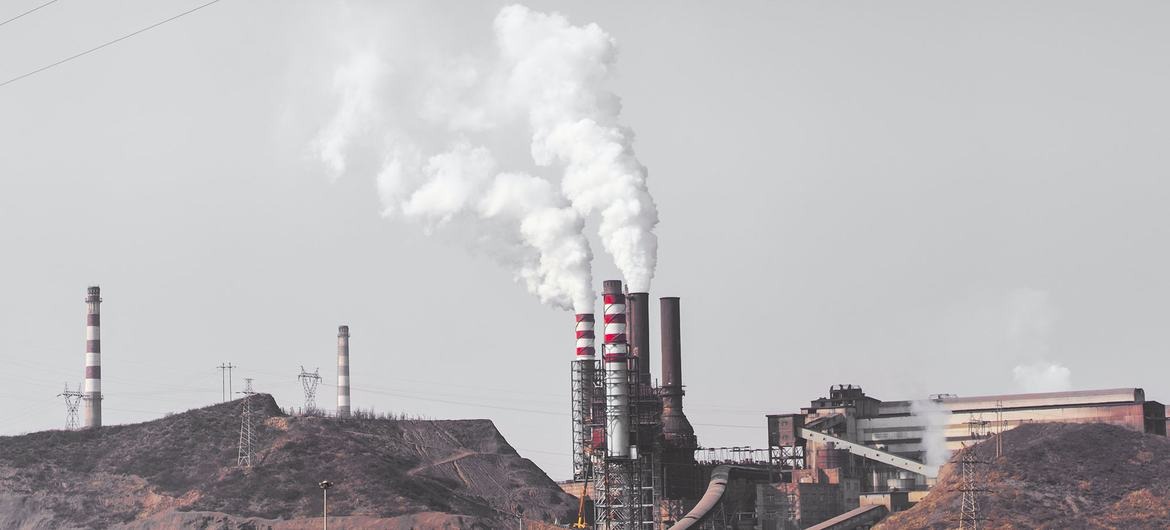
UN General Assembly Backs Historic World Court Climate Crisis Ruling.

New York; May 2026: A landmark General Assembly resolution adopted today (Thursday – 21st May 2026) is a powerful affirmation of international law, climate justice and science, according to UN Chief António Guterres. “I welcome the adoption of the General Assembly resolution on the @CIJ_ICJ’s advisory opinion on climate change, a powerful affirmation of international law, climate justice, science & the responsibility of states to protect people from the escalating climate crisis. Those least responsible for climate change are paying the highest price. That injustice must end”, the UN Chief asserted.
Today’s resolution was drawn up by Vanuatu, which is a Pacific island nation on the frontline of the climate crisis, and several other countries, and the resolution was adopted after intense discussion including multiple proposed amendments with 141 votes in favour, 08 against and 28 abstentions. Those who have voted against were Belarus, Iran, Israel, Liberia, Russia, Saudi Arabia, the US and Yemen.
When the International Court of Justice (ICJ), the UN’s principal judicial body, ruled in July 2025 that States have an obligation to protect the environment from greenhouse gas (GHG) emissions, the decision was hailed as a breakthrough. The UN Chief had then described it simply as “a victory for our planet”.
President of the International Court, Judge Iwasawa Yuji, on the 23rd of July, 2025 had reasoned that:
The Court has used Member State’s commitments to both environmental and human rights treaties to justify this decision.
- Firstly, Member States are parties to a variety of environmental treaties, including ozone layer treaties, the Biodiversity Convention, the Kyoto Protocol, the Paris Agreement and many more, which oblige them to protect the environment for people worldwide and in future generations.
- Secondly, also because “a clean, healthy and sustainable environment is a precondition for the enjoyment of many human rights”, since Member States are parties to numerous human rights treaties, including the Universal Declaration of Human Rights, they are required to guarantee the enjoyment of such rights by addressing climate change.
This includes the obligation under the Paris Agreement on climate change to limit global warming to 1.5°C above pre-industrial levels. The Court had also ruled that if States breach these obligations, they are legally responsible and may be legally required to stop the wrongful conduct, offer guarantees that it won’t happen again, and make full reparation, depending on the circumstances.
Although the ICJ’s advisory opinions are not binding, they carry significant legal and moral authority – helping to clarify and develop international law by defining State’s legal obligations.
Today (May 21st)’s General Assembly adoption following up on the ruling, sends a strong message that tackling the climate crisis is a legal duty under international law, and not just a political choice. “The world’s highest court has spoken. Today, the General Assembly has answered”, responded Guterres.
The resolution calls on all UN Member States to take all possible steps to avoid causing significant damage to the climate and environment, including emissions produced within their borders, and to follow through on their existing climate pledges under the ‘Paris Agreement’.
PARIS AGREEMENT –
The Paris Agreement is a legally binding international treaty on climate change. It was adopted by 195 Parties at the UN Climate Change Conference (COP21) in Paris, France, on 12th December 2015. It entered into force on 04th November 2016. Currently, there are 194 Parties to the Paris Agreement.
Its overarching goal is to hold “the increase in the global average temperature to well below 2°C above pre-industrial levels”, and pursue efforts “to limit the temperature increase to 1.5°C above pre-industrial levels”. However, in recent years, world leaders have stressed the need to limit global warming to 1.5°C by the end of this century.
That’s because the UN’s Intergovernmental Panel on Climate Change indicates that crossing the 1.5°C threshold risks unleashing far more severe climate change impacts, including more frequent and severe droughts, heatwaves and rainfall. In order to limit the global warming to 1.5°C, greenhouse gas emissions must peak before 2025 at the latest and decline 43% by 2030.
The Paris Agreement is a landmark in the multilateral climate change process because, for the first time, a binding agreement brings all nations together to combat climate change and adapt to its effects.
In today’s convention – Governments are urged to cooperate in good faith and continuously coordinate efforts to tackle climate change globally and ensure that climate policies safeguard the rights to life, health, and an adequate standard of living.
In a statement released after the General Assembly vote, Guterres declared that those least responsible for climate change are paying the highest price, and that the path to climate justice “runs through a rapid, just, and equitable transition away from fossil fuels towards renewable energy”.
The UN Secretary-General noted that renewables have proved to be the cheapest and most secure form of energy and that the goal of keeping global temperature rises to no more than 1.5 degrees above pre-industrial levels is still within reach.
Team Maverick.







Shivakumar Says Congress United, Assures Women Will Get Cabinet Berth
Bengaluru, Aug 2026 : Karnataka Chief Minister D.K. Shivakumar on Monday sought to dismiss…

Shivakumar Says Congress United, Assures Women Will Get Cabinet Berth
Bengaluru, Aug 2026 : Karnataka Chief Minister D.K. Shivakumar on Monday sought to dismiss …