Eurosatory 2026: Next-Generation Main Battle Tanks Challenge US Army’s M1E3 Abrams.

Paris; July 2026: At the Eurosatory 2026, it was revealed that the exhibition has become the benchmark for main battle tank technology in 2026, showcasing the digital capabilities expected to shape the next generation of NATO armoured forces and future export markets. As European manufacturers accelerate development of AI-enabled, networked combat vehicles, they are positioning their latest platforms to compete with the US Army’s future M1E3 Abrams tank by emphasising superior connectivity, survivability, and battlefield integration rather than relying solely on firepower and armour.
The tanks those which have been exhibited at the Eurosatory, features artificial intelligence, active protection systems, advanced sensor fusion, open electronic architectures, autonomous systems integration, and network-centric capabilities that transform them into command-and-combat nodes within a broader battlefield ecosystem. Together, these technologies provide a clear picture of the operational requirements that will drive armoured warfare beyond 2026, as NATO armies seek faster decision-making, greater survivability, and enhanced multi-domain combat effectiveness.
The importance of these developments extends well beyond Europe. The war in Ukraine has principally reshaped the military posture of armoured combat, highlighting both the continued necessity of main battle tanks for high-intensity operations and their growing vulnerability to loitering munitions, first-person-view drones, top-attack missiles and precision-guided artillery. Likewise:
- US Army is concentrating on its future M1E3 Abrams tank;
- NATO nations are modernising their armoured forces;
- Russia continues to produce upgraded T-90M tanks;
- China expands its Type 99A fleet.
Against this strategic backdrop, Eurosatory 2026 offered an unprecedented opportunity to evaluate how Western industry is responding to the battlefield of the 2030s.
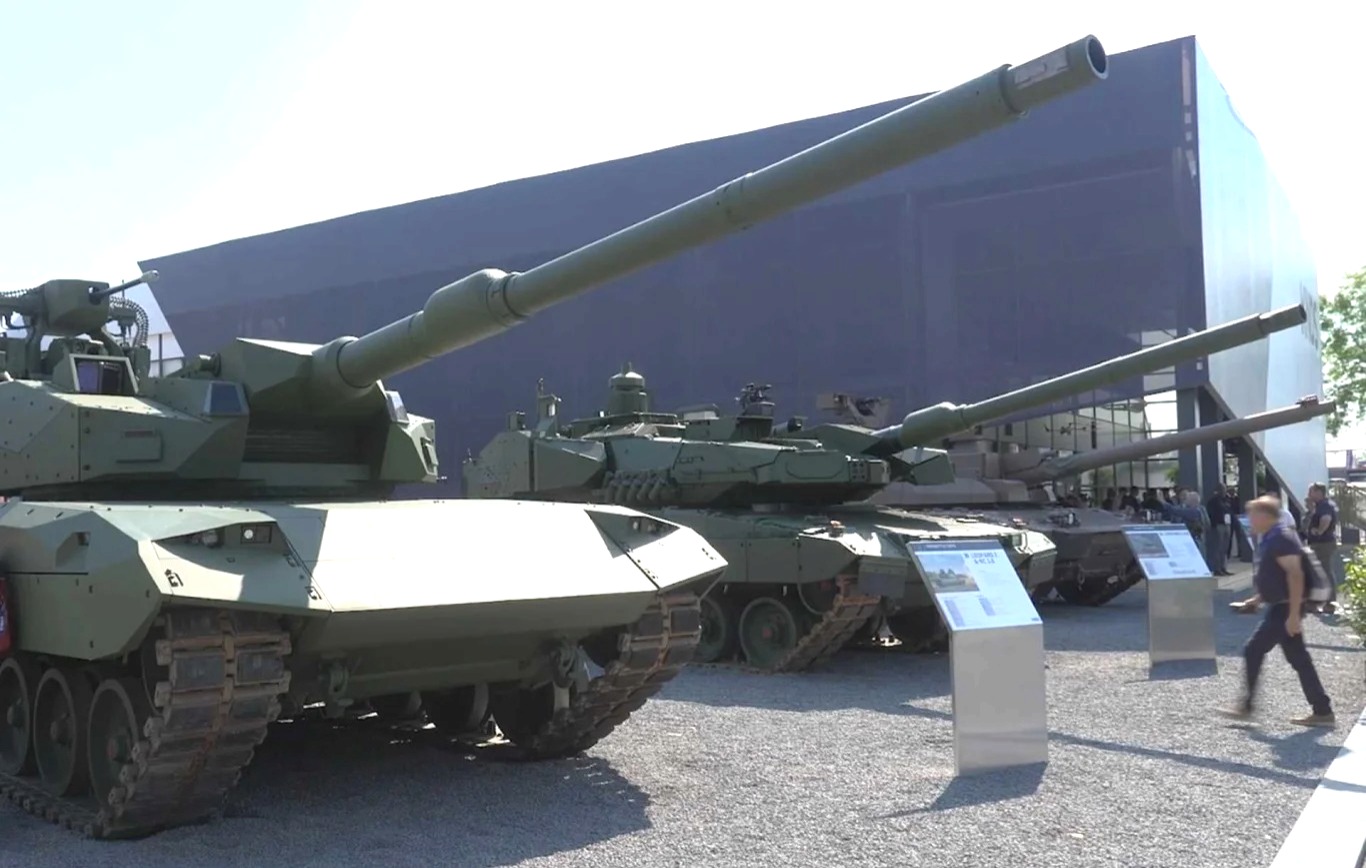
As the Eurosatory gains momentum, 08 of the exhibition’s most significant armoured vehicle developments are gaining stupendous momentum:
- The Tulpar Medium Tank With A 120 MM Cannon From Türkiye’s Otokar,
- The New Italian Main Battle Tank Jointly Developed By Leonardo And Rheinmetall,
- The CFL-120 Karpat From FNSS And Czech Defence Company CSG,
- South Korea’s K2 EX From Hyundai Rotem,
- The Leclerc XLR From KNDS France/Germany,
- Germany’s Leopard 2A8,
- The Leopard 2 ARC 3.0 Next-Generation Main Battle Tank,
- CAPINT tank technology demonstrator from KNDS.
Together, these vehicles demonstrate how Western armoured warfare is entering an era in which software, artificial intelligence, and network integration increasingly define battlefield effectiveness alongside traditional measures of protection, mobility, and firepower. One of the most striking observations throughout Eurosatory 2026 was that there is no single vision for the future main battle tank. Manufacturers are pursuing complementary approaches. Some are introducing entirely new armoured vehicles designed around digital technologies from the outset, while others are extending the operational relevance of proven tanks through comprehensive modernisation programs. Both strategies seek to prepare armoured forces for operational environments expected to dominate the 2030s and beyond.
Tulpar Medium Tank – Türkiye’s Otokar attracted considerable attention with the Tulpar 120mm Medium Tank, representing the latest evolution of the company’s modular tracked armoured vehicle family. Equipped with a NATO-standard 120 mm smoothbore cannon, advanced modular armour, digital fire-control systems and an open electronic architecture, the Tulpar demonstrates Türkiye’s ambition to compete directly in the international main battle tank market. The Tulpar has been engineered around modularity. Protection packages, electronic systems, communications, mission equipment, and future technologies can be integrated according to customer requirements. This flexibility makes the vehicle particularly attractive for nations seeking modern armoured capabilities while maintaining long-term upgrade potential. Furthermore, the Tulpar reflects the remarkable transformation of Türkiye’s defence industry. During the past decade, Turkish manufacturers have expanded from licensed production toward indigenous development across armoured vehicles, artillery, unmanned systems, missiles, and naval programs. The introduction of the Tulpar Heavy Tank further strengthens Türkiye’s position as an increasingly influential supplier within the global armoured vehicle market.
Italian Main Battle Tank – jointly developed by Leonardo and Rheinmetall. Italy selected a collaborative solution combining Rheinmetall’s expertise in heavy armoured vehicle engineering with Leonardo’s advanced command-and-control systems, sensors, mission electronics, and industrial capabilities to replace the Ariete fleet. Beyond replacing Italy’s aging armoured force, the program represents a broader trend within Europe toward multinational defence cooperation. Shared industrial development reduces costs, accelerates technology transfer, and improves interoperability among NATO members while preserving national industrial sovereignty. The new Italian main battle tank incorporates enhanced ballistic protection, modern digital battlefield management systems, advanced optics, a future-ready electronic architecture, and significant growth potential for emerging technologies including active protection systems and artificial intelligence applications.
CFL-120 Karpat – developed in collaboration with the Czech defence group CSG, Karpat combines substantial firepower with improved operational mobility and strategic deployability, offering an alternative to increasingly heavy main battle tanks. Integrating a modern 120 mm cannon onto a lighter tracked combat vehicle architecture provides significant logistical advantages. Lower combat weight improves transportation by rail, road, and air while allowing deployment across infrastructure that cannot support 70-ton-class armoured vehicles. This philosophy addresses an operational challenge that NATO planners increasingly consider important during rapid reinforcement operations across Europe.
K2 EX – the latest export evolution of the K2 Black Panther, widely regarded as one of the world’s most advanced production main battle tanks. Building upon operational experience gained with the Republic of Korea Army while incorporating customer-specific improvements, the K2 EX continues Hyundai Rotem’s expansion into international defence markets. Its automatic loading system reduces crew workload while maintaining high firing rates. The advanced hydropneumatic suspension provides exceptional cross-country mobility and allows variable hull positioning to improve firing effectiveness across difficult terrain. Combined with advanced thermal imaging, digital battlefield management, active protection integration, and modern communications, the K2 EX remains among the most technologically mature export tanks currently available. The K2’s growing international success, particularly following Poland’s acquisition program, has fundamentally changed the competitive landscape of the global armoured vehicle market. South Korea now competes directly with established European manufacturers for major export contracts while expanding industrial partnerships across NATO.
Leclerc XLR – its modernisation program represents France’s strategy for maintaining the operational relevance of its main battle tank well into the coming decades through digital transformation rather than a complete replacement. Integrated within the SCORPION battlefield network, the Leclerc XLR receives major improvements in communications, command systems, protection, electronic architecture, and battlefield connectivity. This modernisation demonstrates how legacy armoured vehicles can remain highly effective through software-driven capability enhancement and network integration.
Leopard 2A8 – continues to represent one of the world’s benchmark production main battle tanks. Its latest evolution incorporates improved protection, upgraded sensors, enhanced crew survivability, expanded digital architecture, and preparation for next-generation active protection technologies. KNDS has steadily evolved the Leopard family to address emerging threats identified through recent operational experience.
Leopard 2 ARC 3.0. – Even more significant was the public presentation of the This concept demonstrates how the Leopard family could evolve into a software-defined combat system capable of integrating artificial intelligence, autonomous systems, advanced sensor fusion, and future battlefield networking technologies. Its open architecture enables rapid software upgrades while simplifying integration of emerging weapons, sensors, and communications systems throughout decades of operational service. This reflects one of the most important trends observed throughout Eurosatory 2026. Future main battle tanks will increasingly evolve through digital modernisation instead of structural redesign.
CAPINT – The demonstrator serves as a technology laboratory exploring the capabilities expected to define the next generation of European armoured combat systems. Instead of focusing solely on traditional improvements in firepower and protection, CAPINT explores how artificial intelligence, digital connectivity, advanced crew interfaces, and integrated battlefield management can fundamentally transform how future main battle tanks operate. While, Artificial Intelligence (AI) occupies a central role within the CAPINT concept; it is the AI-assisted target recognition, automated sensor management, predictive maintenance, mission planning and decision support reduce crew workload improves operational tempo. Future tank crews will increasingly supervise complex digital combat ecosystems while software manages growing volumes of battlefield information. CAPINT also demonstrates KNDS’ broader vision for an armoured fighting system designed from the outset to operate in a fully connected, multi-domain environment, where manned vehicles, unmanned systems, and long-range precision fires continuously exchange tactical data.
These technological developments closely parallel the direction currently being pursued by the US Army’s M1E3 Abrams modernisation program. While details of the future American main battle tank remain under development, the priorities identified by the Pentagon include reduced weight, greater survivability, advanced digital architecture, modular upgrades, artificial intelligence integration and improved onboard power generation. These priorities closely mirror many of the technologies showcased throughout Eurosatory 2026 and demonstrate that Western armoured vehicle manufacturers are converging toward common operational requirements.
The exhibition also demonstrated that the future Main Ground Combat System (MGCS) remains only one element of Europe’s long-term armoured strategy. Modernisation programs, including the Leopard 2A8 and Leclerc XLR, alongside emerging concepts such as the Leopard 2 ARC 3.0, ensure that European armoured forces will continue to evolve well before MGCS eventually enters operational service. This layered approach reduces capability gaps while maintaining industrial expertise and technological momentum.
Beyond technology, Eurosatory 2026 highlighted an increasingly competitive global export market. European manufacturers, Türkiye, and South Korea are now competing aggressively for procurement opportunities across Eastern Europe, the Middle East, Asia-Pacific, and Latin America. Industrial partnerships, local production agreements, and technology transfer have become as important as technical performance in securing future contracts. This competition is expected to intensify as more countries seek to replace Cold War-era armoured fleets with digitally connected combat vehicles capable of surviving modern high-intensity warfare.
Eurosatory 2026 ultimately demonstrated that the future of armoured warfare is no longer defined by a contest between individual main battle tanks. It is becoming a competition among integrated combat ecosystems in which artificial intelligence, active protection systems, digital connectivity, autonomous systems, and network-centric operations determine battlefield effectiveness. The vehicles displayed in Paris collectively illustrate how NATO’s next generation of armoured forces is taking shape and provide a valuable indication of the technological direction that will influence the US Army’s M1E3 Abrams, Europe’s MGCS program, and allied armoured modernisation efforts throughout the 2030s and beyond.
For defence planners, procurement agencies and military commanders, the message from Eurosatory 2026 is clear. The main battle tank remains indispensable for combined-arms warfare, but its future will be determined less by thicker armour or larger guns than by its ability to process information, defeat increasingly sophisticated aerial threats, integrate artificial intelligence, command autonomous systems, and operate seamlessly within a multi-domain combat network.
The armoured fighting vehicles presented at Eurosatory 2026 demonstrate that the next generation of tanks is already emerging, and their technologies will shape the battlefield of the future for decades to come.
Team Maverick.



From a Charity Photo to the World Cup Final: Messi and Yamal Set for Extraordinary Reunion
New York, July 2026 : Football has produced countless remarkable stories over the years, b…

From a Charity Photo to the World Cup Final: Messi and Yamal Set for Extraordinary Reunion
New York, July 2026 : Football has produced countless remarkable stories over the years, …