Japan And Vietnam To Jointly Develop Fast Landing Craft.

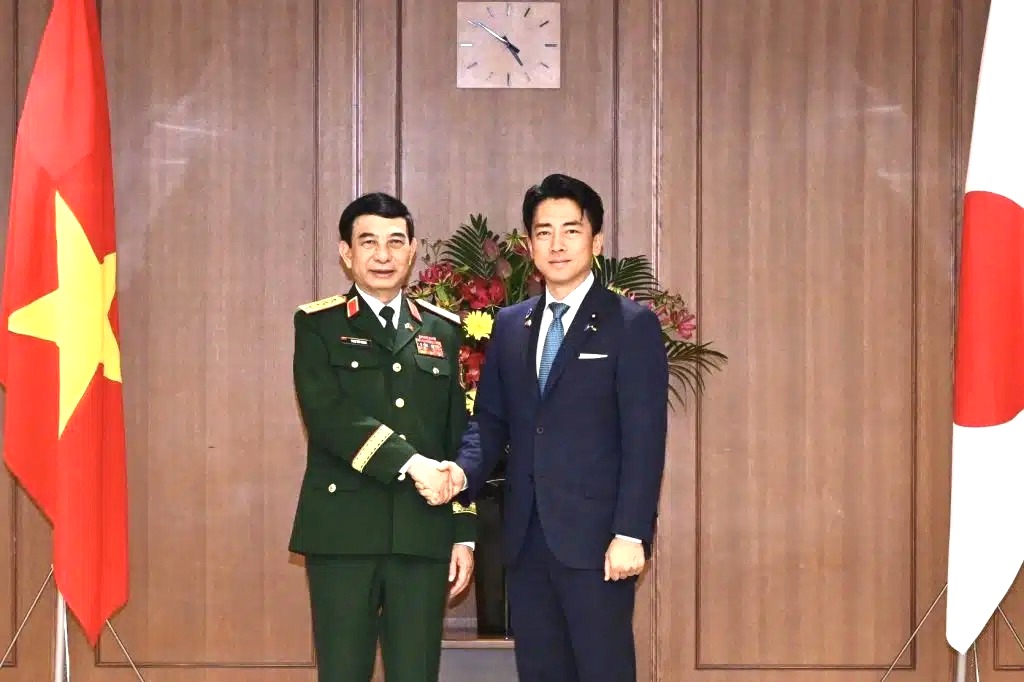
Tokyo; July 2026: The Japanese Defence Minister Shinjiro Koizumi in a post cabinet meeting press meet yesterday (17th July 2026) has announced that:
“I have one item to begin with. From July 12th to 15th, Vietnamese Deputy Prime Minister and Minister of National Defence Giang visited Japan for the first time in five years. During this visit, I had the opportunity to speak with him directly every day, not only through a defence ministerial meeting, but also through a stroll around the National Diet building grounds and a luncheon. It was an opportunity to further deepen my personal relationship of trust with Minister Giang. Furthermore, through the defence ministerial meeting and luncheon, we were able to exchange views on the regional situation and have concrete discussions on how to further develop defence cooperation. Between our two countries, various forms of cooperation are actively taking place in the land, sea, and air forces, including high-level exchanges and people-to-people exchanges through study abroad at the National Defence Academy, as well as mutual visits of troops, port calls of naval vessels and goodwill training, and capacity-building support. We welcomed the progress of this cooperation and confirmed that we will further promote bilateral and multilateral cooperation, including in the fields of peacekeeping operations and cybersecurity, and contribute together to regional peace and stability. In addition, regarding defence equipment and technology cooperation, we agreed to start discussions toward realizing the joint development and joint production of high-speed landing craft under the leadership of myself and Minister Giang. We also confirmed that we will further strengthen our efforts, including promoting cooperation in the defence industry. Vietnam is an important partner in achieving peace and stability in the Indo-Pacific region. In the midst of an increasingly challenging international situation, it is important for both countries to further develop their comprehensive strategic partnership and to concretize cooperation in the security field. We will continue to work to further strengthen cooperation in the defence sector”.
Defence Minister Koizumi has also framed the project as part of Japan’s evolving defence equipment transfer policy, arguing that cooperation with allies and like-minded countries is becoming increasingly important as the regional security environment deteriorates.
While responding to questions by the media personnel’s about the risk of technology leakage given Vietnam’s close ties with China, Koizumi said Japan would protect participating company’s technologies through strict screening, appropriate information management, and close coordination with the Vietnamese government. While a political framework has now been established, almost every technical aspect of the project remains undefined. Neither government has disclosed the vessel’s displacement, payload, propulsion system, speed, industrial workshare, development schedule, or participating shipbuilders.
The agreement was reached during talks in Tokyo on July 13th this week between Japanese Defence Minister Shinjiro Koizumi and Vietnamese Deputy Prime Minister and Minister of National Defence Gen. Phan Van Giang. Aftermath, in a July 15 press release, Japan’s Ministry of Defence said the two ministers had agreed to commence discussions toward realizing concrete defence equipment and technology cooperation, including the possibility of jointly developing and producing fast landing craft.
Perhaps the biggest unanswered question is the type of craft envisioned. Although some observers have speculated that the project could involve a successor to the Japan Maritime Self-Defence Force’s Landing Craft Air Cushion (LCAC), neither government has suggested this. Koizumi referred only to a ‘fast landing craft’, and his description does not indicate whether the future platform will be an air-cushion vehicle, a conventional waterjet-powered landing craft, or another configuration.
Japan’s existing experience provides useful context. The JMSDF operates 06 LCACs embarked aboard its three Osumi-class landing ships: 02 per vessel, providing rapid ship-to-shore transport for troops, vehicles, and heavy equipment. The LCAC hulls, built by US defence manufacturer Textron, were commercially imported through a Japanese trading company, while operational and training support, along with information on component improvements, was provided through the U.S. Foreign Military Sales (FMS) program. Japan therefore possesses extensive operational experience with high-speed amphibious connectors but comparatively limited experience in developing such craft domestically.
At the same time, Japan is no longer starting from scratch. In February 2025, Japan’s Acquisition, Technology and Logistics Agency (ATLA) awarded a contract to Japan Marine United (JMU) and British naval design firm BMT for the Caimen Japan program, the Self-Defence Force’s next-generation high-speed landing craft. Under the arrangement, BMT is responsible for the Caimen landing craft design, while JMU will undertake production design and construction in Japan. The approximately 30-meter craft features a tri-bow hull and is designed to exceed 20 knots.
At present, Caimen Japan appears to be the only Japanese program that could realistically be offered for either export or joint development. With support from the Japanese government, JMU has already explored potential export opportunities for the design, including in the Philippines. If the Japan-Vietnam project moves beyond the discussion stage, Caimen Japan would therefore appear to be the most likely candidate.
However, the relationship between Caimen Japan and the newly announced Japan-Vietnam initiative remains unclear, and neither government has indicated whether the two projects are connected.
For Vietnam, the project would support its long-term objective of strengthening domestic defence-industrial capabilities through technology transfer and local production. For Japan, it reflects a gradual shift from exporting finished defence equipment toward collaborative development with trusted regional partners. Whether the eventual platform proves to be a hovercraft, a conventional landing craft, or an entirely new design, the significance of the announcement lies less in its final configuration than in its industrial model. If the project proceeds, it could become an early example of Japan’s shift toward jointly developing amphibious platforms with trusted Indo-Pacific partners rather than primarily exporting finished defence equipment.
As stated earlier, on July 13th this week, Minister of Defence Koizumi held a meeting with H.E. General Phan Van Giang, Deputy Prime Minister and Minister of National Defence of the Socialist Republic of Viet Nam, who was visiting Japan. On July 15, Minister Koizumi held an official luncheon with Minister Giang.
- At the outset, Minister Koizumi welcomed Minister Giang’s visit to Japan, his first in five years and stated that Vietnam is an important partner in maintaining peace and stability in Indo-Pacific region. He stressed the importance of further strengthening the Comprehensive Strategic Partnership between Japan and Viet Nam and advancing concrete cooperation in the security field amid an increasingly severe international security environment. Minister Giang expressed his concurrence, and the two ministers held substantive discussions aimed at further enhancing defence cooperation between the two countries.
- The two ministers exchanged views extensively on regional affairs, including the situations in the East China Sea and the South China Sea and reaffirmed the importance of respecting freedom of navigation and overflight and of complying with international law, including UNCLOS. They also welcomed the active progress in people-to-people exchanges, including high-level exchanges and the acceptance of Vietnamese cadets at the National Defence Academy and other educational institutions, as well as reciprocal unit visits, port calls and goodwill drill, and capacity building conducted among the ground, maritime, and air services. They confirmed that Japan and Viet Nam would continue to promote bilateral and multilateral cooperation, including in the fields of UN Peacekeeping Operations and cybersecurity, and contribute to regional peace and stability.
- The two ministers concurred that efforts in defence equipment and technology cooperation should be further strengthened. Under their leadership, they agreed to commence discussions toward realizing concrete cooperation, including the possibility of the joint development and production of fast landing craft. They also concurred on further strengthening these efforts by promoting defence industrial cooperation among other areas.
Team Maverick.




From a Charity Photo to the World Cup Final: Messi and Yamal Set for Extraordinary Reunion
New York, July 2026 : Football has produced countless remarkable stories over the years, b…

From a Charity Photo to the World Cup Final: Messi and Yamal Set for Extraordinary Reunion
New York, July 2026 : Football has produced countless remarkable stories over the years, …