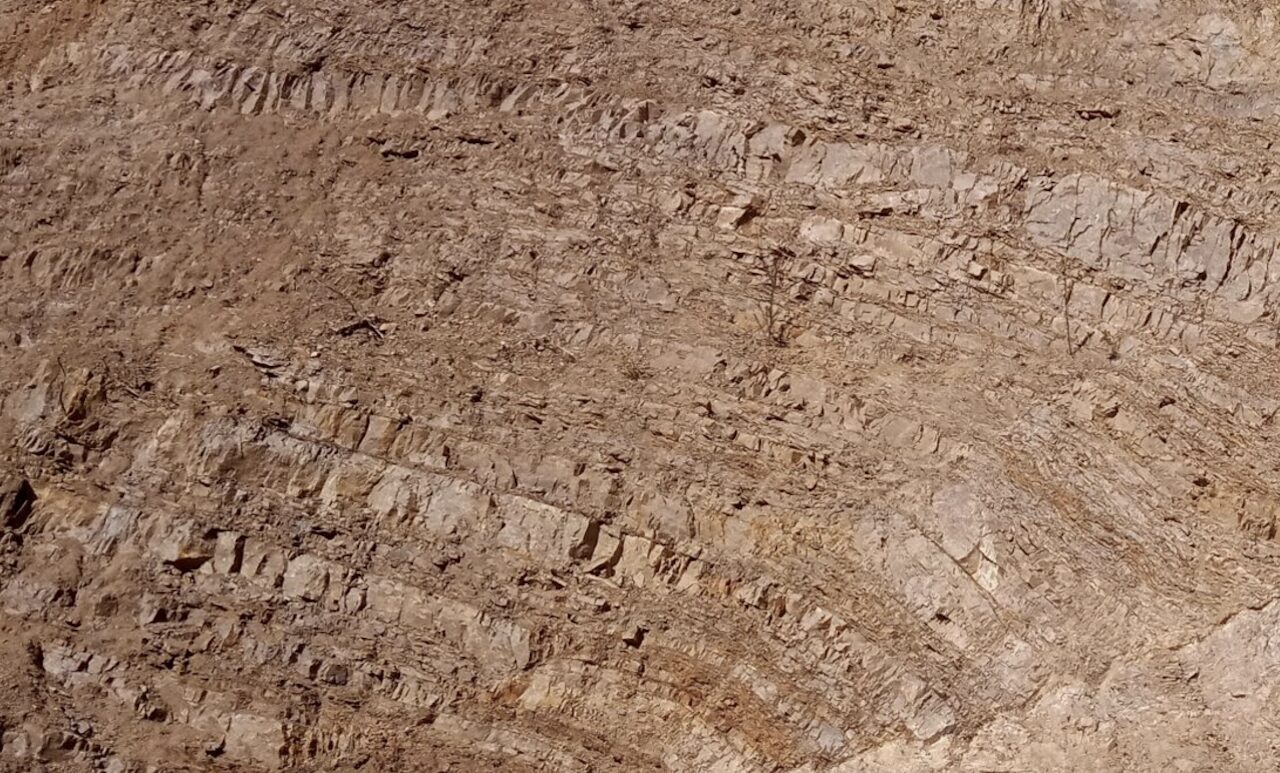
20-Million-Year-Old fossilised Palm Leaf discovered near Kasauli Club in Himachal Pradesh.

In a spectacular breakthrough that bridges centuries of geological research, a 20-million-year-old fossilised palm leaf has been discovered near the historic Kasauli Club by celebrated geologist Ritesh Arya. The fossil, was unearthed during a field workshop on June 11, is being hailed as one of the most significant palaeobotanical finds in the region, breathing new life into forgotten fossil records and reshaping the geological understanding of the Kasauli hills. The discovery came on the third day of a scientific field workshop organised by the Association of Petroleum Geologists (APG), Dehradun. A team of 14 geologists from ONGC and Cairn, led by Dr. Arya and Jagmohan Singh, was exploring the stratigraphic layers of the Kasauli, Dagshai, Subathu, Shimla, Krol, and Shiwalik formations.
While explaining the nuances of the Kasauli Formation near the scenic Gilbert Trail, Dr. Arya, accompanied by geologists Sanjay Gupta and Preetiyush, spotted the well-preserved fossil near the boundary wall of the Kasauli Club. Arya described the moment as a “Eureka experience”, one that instantly transported him back to his student days in the 1980s when he first began collecting fossils from the hills, he calls home. “This palm fossil is a direct link to the past, connecting our present exploration with Medlicott’s pioneering work of 1864”, he said.
The site of the recent discovery lies astonishingly close to the location where Henry Benedict Medlicott, a British geologist, first found palm fossils over 160 years ago. Medlicott’s specimens were later identified as Sabal major Heer by botanist O. Feistmantel. However, over the decades, academic literature largely dismissed the Kasauli region as unfossiliferous. Dr. Arya’s relentless efforts to document and preserve local fossils have thoroughly debunked this myth.
Since beginning his collection in 1987, Dr Arya has curated the largest fossil archive from the region. His collection includes fossilised leaves, flowers, fruits, seeds, stems, silicified wood, and even the first recorded mammalian fossil from the Kasauli Formation — a prehistoric rhinoceros. These findings are now proudly displayed at the Tethys Fossil Museum, located in Dangyari near Kasauli, which Dr Arya founded to showcase the geological journey of the Himalayas and the evolution of the ancient Tethys Ocean.
The palm fossil offers compelling evidence about the region’s ancient past. Palm trees generally thrive in warm, humid, low-altitude environments close to coastal zones. Their presence at the current elevation of 2,000 meters in Kasauli speaks volumes about the tectonic shifts and climate transformations the Indian subcontinent has undergone.
“This single leaf tells the story of a landscape that existed millions of years ago — one that was tropical, lush, and likely near sea level”, explained Dr Arya. “It also indicates that what is now a cool, pine-draped hill station was once a thriving coastal ecosystem, rich with flora like Garcinia, Gluta, Combretum, and Syzygium, which today are found in the Andaman & Nicobar Islands, Malaysia, and Indonesia”.
The discovery reinforces long-held theories in plate tectonics — that the Indian plate, after breaking away from Gondwanaland, drifted northwards across the Tethys Ocean, eventually colliding with the Eurasian plate to give rise to the Himalayas. In doing so, it uplifted ancient tropical sediments like those of the Kasauli Formation to their current towering altitudes.
Arya has dedicated this find to H.B. Medlicott, whose early exploration in the Himalayan foothills laid the groundwork for future generations of geologists. “Medlicott was my inspiration”, reaffirmed Arya. “His forgotten discoveries planted the seeds of curiosity in me. This fossil is more than a scientific specimen — it’s a symbol of continuity, connecting two epochs of geological exploration separated by over a century”.
The palm leaf fossil is now open for public viewing at the Tethys Fossil Museum, where visitors can explore over 500 fossil specimens that narrate the dynamic story of Earth’s deep past, the movement of continents, and the birth of the Himalayan mountain chain. With this extraordinary find, Arya not only adds a crucial piece to the fossil puzzle of the Western Himalayas but also revives interest in the rich, though often overlooked, paleontological history of Kasauli. The hills may now be cloaked in conifers, but buried beneath their surface lies a vivid story of tropical abundance, waiting to be rediscovered.
Team Maverick






Gujarat Titans Post Massive 229 Against CSK After Explosive Batting Display
Ahmedabad, May 2026 : Gujarat Titans delivered a dominant batting performance to post a ma…

Gujarat Titans Post Massive 229 Against CSK After Explosive Batting Display
Ahmedabad, May 2026 : Gujarat Titans delivered a dominant batting performance to post a …