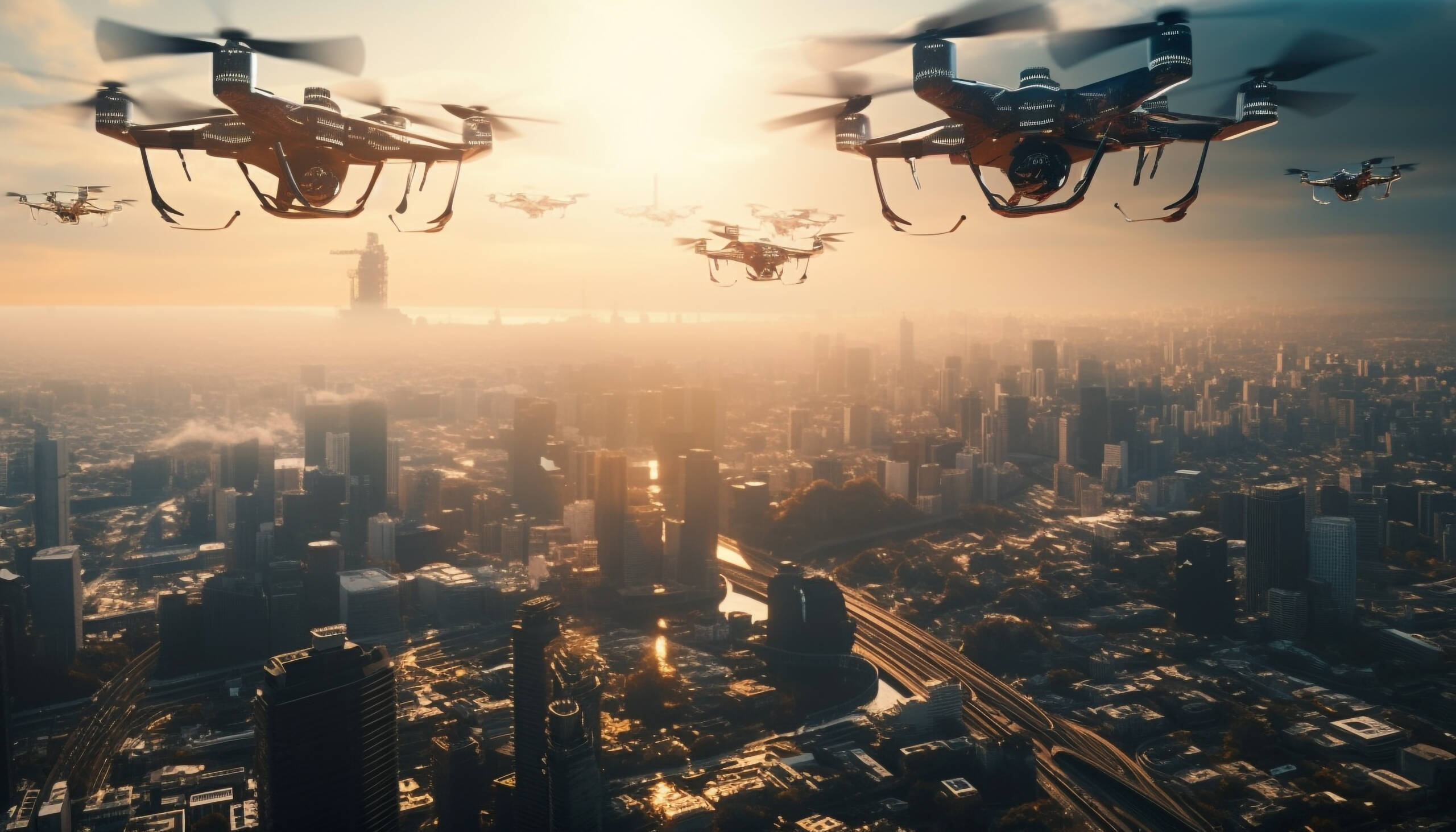
United States mitigating Aerial Threats.

Sept 2025 : Across the contemporary battlespace, from the rugged mountains of Syria to the open fields of Ukraine, small unmanned aerial vehicles (sUAV) are reshaping modern combat. With modest cost, ease of manufacturing, and continually advancing technologies, sUAV have become the quintessential asymmetric threat, dramatically affecting military operations. Despite significant investment in air superiority and air defence, the speed at which adversaries have embraced small drone technologies has far outpaced U.S. defensive preparations.
To counter this emerging threat, the U.S. military must reshape air defence and counterair doctrine, starting with a rigorous reassessment of base defence doctrine and a clearer delineation of responsibilities between the U.S. Army and the Air Force. At the core of this transformation is the need for service components to provide combatant commands the necessary equipment to detect and engage small UAV, deliberately manage electromagnetic spectrum operations (EMSO) and to integrate sUAV counterair command and control across the air, land and sea. These steps ensure U.S. combat forces are best prepared to face this evolving threat.
Historically, U.S. military doctrine and Department of Defence “roles and missions” guidance have designated the Army as the lead component for ground-based air defence. The Army’s mandate has primarily focused on traditional threats such as aircraft, cruise missiles and ballistic missiles. The Air Force, meanwhile, has focused largely on counterair operations, which are doctrinally divided into three subsets—offensive and defensive counterair operations and integrated air and missile defence.
However, sUAV occupy a gray area between these defined roles, challenging traditional delineations. The Air Force lacks organic and doctrinally aligned counter-UAV (C-UAV) capabilities, relying instead on the Army or ad hoc solutions. The absence of a cohesive, clearly defined “lanes-in-the-road” shared doctrine between the two has led to significant gaps between air defence and counterair guidance.
To rectify this, the Air Force and Army must jointly refine air defence and counterair doctrine with the Air Force claiming a portion of the air defence portfolio. The Air Force must modify how it organises, trains and equips its airmen to prepare them to perform air defence duties. Personnel require specialised training and airbases require an updated version of the wing operations centre (WOC). A redefined WOC would combine Army air defence capabilities, the ground-centric base defence operations centre (BDOC), and evolving C-UAV capabilities. This coordinated approach integrates Army ground-based air defence expertise with Air Force C2 competencies, constituting a solid first step toward shoring up airbase defence against modern air threats.
To effectively counter the sUAV threat, the U.S. must acquire and field a comprehensive mix of kinetic and non-kinetic C-UAV capabilities able to be employed at a reasonable cost per effect. These include air and ground-based directed energy systems, electronic warfare tools and traditional kinetic interceptors. However, merely fielding advanced capabilities is insufficient. Effective defence requires integrated detection, tracking, classification and targeting systems feeding into a seamless command and control (C2) framework capable of rapid decision-making down to the lowest tactical echelon.
Militaries around the world have begun deploying several C-UAV systems to detect and engage these threats. Yet, their integration remains fragmented, with distinct capabilities often employed in isolation or controlled at disparate headquarters. To maximise effectiveness, counterair doctrine must clearly define how these diverse capabilities integrate under a unified C2 architecture managed by the joint force air component commander (JFACC).
A modern integrated C2 infrastructure would enable airborne sensors, advanced radars, acoustic detection systems, and electro-optical and infrared sensors to quickly and accurately identify drone threats. In turn, this would allow automated or operator-led engagements using the most appropriate effector, whether jamming a drone’s data link, disabling GPS, spoofing communications, employing directed energy, or using kinetic effects. The effectiveness of this layered defensive architecture rests on interoperable systems connected by common protocols rapidly sharing accurate situational awareness across the battlespace up and down echelons of command at air and ground operational units.
Emerging technologies, particularly automated threat detection and classification systems, artificial intelligence-driven sensor networks, and agile electronic warfare platforms, offer significant promise. To realise their potential, these systems must be fully integrated into the JFACC’s operational architecture and into the area air defence plan. Perhaps the theater air control system/Army air-ground system (TACS/AAGS) offers an appropriate historic example to integrate air and ground combat operations. Successful integration enables seamless, real-time data sharing across multiple sensors and shooters, rapidly closing the detection-to-engagement loop and dramatically enhancing overall battlespace awareness and effectiveness against sUAV by both air and ground forces.
Critical to effective sUAV defence is refining the role of the JFACC. Currently, the JFACC typically functions as the area air defence commander (AADC), responsible for managing and directing joint air defence operations. However, current joint doctrine provides limited authority to manage electromagnetic spectrum operations, leaving critical EMSO capabilities such as jamming, spoofing and electronic attack—poorly integrated with broader air defence strategies. Given that most sUAV rely heavily on electromagnetic signals for command and control, GPS navigation and target identification, EMSO management is indispensable for neutralizing threats effectively.
Expanding the JFACC’s role to explicitly include EMSO would allow for centralized deconfliction procedures and real-time coordination of spectrum operations. This would streamline spectrum utilisation, deconfliction and offensive electromagnetic actions, providing integrated and synchronised defensive measures against small drones while avoiding unintended EMSO fratricide.
Finally, joint doctrine must evolve to explicitly address sUAV threats in air defence and counterair frameworks. Traditional concepts of air superiority, focused on fixed-wing aircraft and large missile threats, are no longer sufficient. Future air superiority doctrine must explicitly address threats from small drones, providing comprehensive layered counterair plans for joint force operations. For instance, sUAV threats require the development of new defensive counterair capabilities and offensive counterair concepts of operation.
This revised doctrine should explicitly outline responsibilities at every command echelon, from the joint force commander down to tactical-level commanders, providing clear guidance on the roles of each service component. Joint planners must proactively anticipate the increasing sophistication and proliferation of adversary sUAV while simultaneously managing increasingly complex friendly (blue) sUAV operations. Airspace control measures, identification friend-or-foe procedures, and rules of engagement must all adapt, while avoiding fratricide within a congested and dynamic battlespace.
The accelerating evolution of sUAV demands immediate and sustained military adaptation and dedicated resourcing. Current doctrinal frameworks leave dangerous gaps that adversaries are already exploiting, placing the deployed joint combat force at unacceptable risk. By clearly defining Army-Air Force C-UAV responsibilities, equipping the combatant commands with necessary sensors and weapons, deliberately managing EMSO operations, integrating C2 structures across ground forces and expanding counterair doctrinal concepts, the U.S. military best counters the sUAV threat. This is a new mission set and requires increased budgetary topline for each service. The cost of failing to adapt is clear—increased risk, compromised mission effectiveness and avoidable casualties. By taking decisive action now, U.S. combatant commands will ensure their continued dominance into the future.
Team Maverick






Adani One Rewards Crosses 5 Million Members in Under a Year, Plans Premium Tier Benefits
Mumbai, July 2026 : Adani Airport Holdings Limited (AAHL) has announced that its digital c…

Adani One Rewards Crosses 5 Million Members in Under a Year, Plans Premium Tier Benefits
Mumbai, July 2026 : Adani Airport Holdings Limited (AAHL) has announced that its digital …