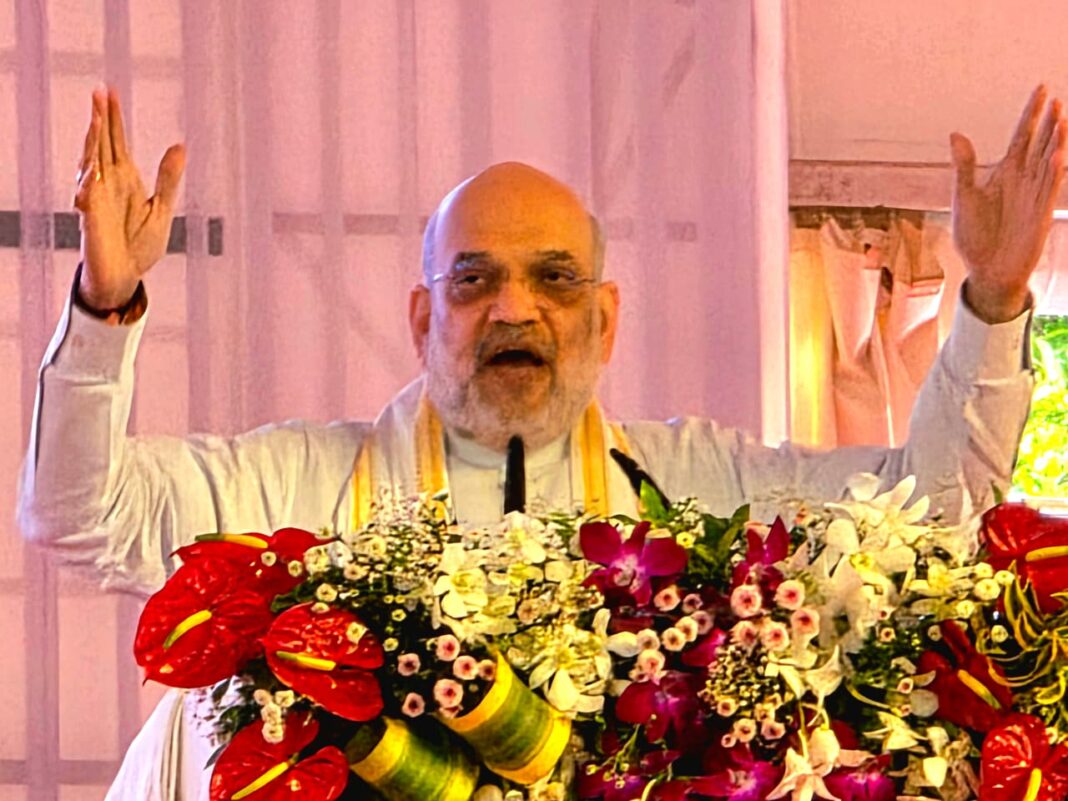
Sahakarmaharshi Shankarrao Kolhe Cooperative Sugar Factory Sets Example of Circular Economy – Union Cooperation Minister Amit Shah

15 Sugar Mills in the Country to Be Prioritized for Setting Up CNG Units
Shirdi, Oct 2025 : Through the production and sale of CNG (Compressed Natural Gas) and potash, the Sahakarmaharshi Shankarrao Kolhe Cooperative Sugar Factory has set an example of a circular economy in the cooperative sector. On similar lines, 15 cooperative sugar factories across the country will be prioritized for establishing such units. The Maharashtra government should take the initiative to ensure maximum participation of the state’s sugar factories, and the Central Government will certainly extend its full cooperation, said Union Home and Cooperation Minister Amit Shah.
The country’s first cooperative-based CBG (Compressed Bio-Gas) project and Spray Dryer Potash Granule Project at the Sahakarmaharshi Shankarrao Kolhe Sugar Factory (Kopargaon) were inaugurated by Union Minister Shah. Present at the event were Chief Minister Devendra Fadnavis, Deputy Chief Ministers Eknath Shinde and Ajit Pawar, Union Minister of State for Cooperation Murlidhar Mohol, Water Resources and Guardian Minister Radhakrishna Vikhe Patil, Water Resources Minister Girish Mahajan, MLA Ashutosh Kale, President of Sanjivani Industries Group Bipin Kolhe, President of the Shankarrao Kolhe Cooperative Sugar Factory Vivek Kolhe, and former MLA Snehalata Kolhe.
Union Minister Shah said that Prime Minister Narendra Modi has envisioned making India self-reliant. The goal is to make India self-sufficient through the use of indigenous products and to place its economy among the world’s top three. The Shankarrao Kolhe Cooperative Sugar Factory has taken the first step toward realizing that dream, he added, emphasizing that other factories should also come forward.
He stated that there is now a need to diversify ethanol projects. Cooperative sugar factories must adopt a circular economy model. They should also focus on ethanol production from fruit juice. If fruit processing happens at the factory level, sugar mills will remain profitable, Shah said.
He further noted that the Shankarrao Kolhe Cooperative Sugar Factory has worked toward green energy. Through primary credit societies, women’s self-help groups, and the initiatives of the Sanjivani Industries Group, the cooperative movement continues to strengthen the rural economy. He said that Prime Minister Modi has always shown a deep sense of empathy for farmers. As a result, the Central Government, through NCDC (National Cooperative Development Corporation), has supported 15 sugar mills.
To achieve self-sufficiency in pulse production, the Centre has launched the “Dalhan Aatmanirbharta Mission” (Pulse Self-Reliance Mission) with a provision of ₹11,300 crore for the next six years. The procurement centers registered with NAFED and NCCF will purchase crops at Minimum Support Price (MSP).
He also mentioned that the Central Government has increased the MSP for lentils, green gram, mustard, chickpea, pigeon pea, as well as jowar, soybean, cotton, and wheat. In addition, 1,000 processing units will be established, and 38 lakh farmers will be provided with high-quality seed kits, ensuring real benefits to them.
Chief Minister Devendra Fadnavis: “Empowering Farmers to Stand on Their Own Feet”
Chief Minister Devendra Fadnavis said, “Today is a historic day. The first CNG project in the cooperative sector is being implemented in this sugar factory. Prime Minister Narendra Modi envisioned that the farmer, who is the provider of food, should also become the provider of energy. The Central Government has introduced various schemes and provided financial assistance to make this possible.”
He said that the sugar industry must survive and create employment, and through ethanol projects, the losses in the sugar sector have been compensated, leading to sustainability.
The Chief Minister added that climate change poses a global challenge. “In our state, it rained in May, and it is still raining now. Farmers have suffered huge losses — around 40% of crops have been damaged. The State Government stands firmly behind the farmers. The Central Government has always extended strong support to Maharashtra. Despite heavy rainfall and damage, the state government will ensure that farmers rise on their own again,” he assured.
He further said that to tackle the impact of climate change, reducing carbon dioxide emissions is essential. Due to the increased use of petrol and diesel, pollution has risen. Hence, the state has implemented solar projects and experimented with fuel blending.
The Compressed Bio-Gas project started by the Shankarrao Kolhe Cooperative Sugar Factory is a circular economy initiative, where waste is converted into gas, and bio-fertilizer is produced from the residue. This renewable energy effort will save 1,10,000 liters of petrol and diesel annually and reduce pollution. Moreover, it will save foreign exchange by avoiding potash imports.
“The Central Government plans to set up many such units across the country, and other factories in Maharashtra should take the lead,” he said, appreciating Vivek Kolhe as the pioneer of this innovative process.
Deputy Chief Minister Eknath Shinde: “Centre Always Supports Maharashtra”
Deputy Chief Minister Eknath Shinde said that this project has made the sugar factory move toward self-reliance, and such initiatives will revolutionize the rural economy. “We are advancing in the fields of education, industry, and banking. As we celebrate 2025 as the International Year of Cooperatives, such projects are crucial in addressing challenges arising from climate change,” he said.
He added that when cooperative sugar factories faced difficulties, the Union Ministry of Cooperation decided to waive ₹10,000 crore in taxes, strengthening the cooperative sector.
Referring to the recent flood situation, he said, “Farmers have lost their land, crops, and houses. The State Government stands firmly behind them, and the Central Government will certainly extend powerful support in this crisis.”
Deputy Chief Minister Ajit Pawar: “Driving the Rural Economy Through Cooperation”
Deputy Chief Minister Ajit Pawar said that Sahakarmaharshi Shankarrao Kolhe had a distinct vision for rural development through cooperation. “Today, Bipin Kolhe and Vivek Kolhe are carrying that vision forward,” he said.
This cooperative sugar factory leads the country in by-product generation and has made a mark through eco-friendly technology and farmer welfare initiatives, ensuring better returns for farmers.
Pawar stated that the government is sensitive to the losses caused by heavy rainfall and assured that no farmer will be abandoned. The State Government is firmly behind the farmers, and the Central Government has always supported Maharashtra in times of crisis. “A decision on assistance will be taken very soon,” he added.






Trump Pushes Iran Deal, Calls for Expansion of Abraham Accords
New Delhi, May 2026 : US President Donald Trump on Sunday said negotiations with Iran are …

Trump Pushes Iran Deal, Calls for Expansion of Abraham Accords
New Delhi, May 2026 : US President Donald Trump on Sunday said negotiations with …