How Easter Island’s Massive Moai Statues Actually “Walked” Themselves.

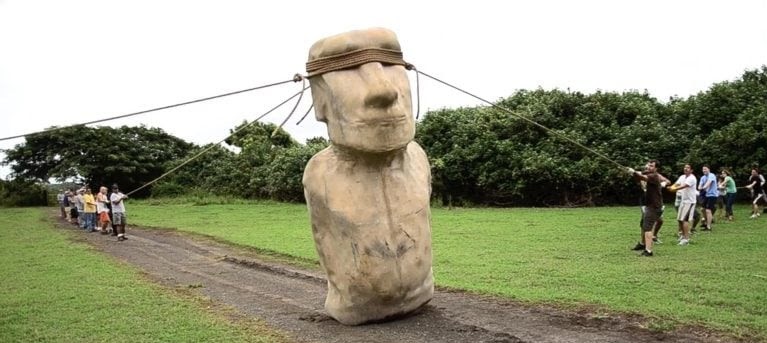
Researchers have finally solved how the ancient people of Rapa Nui moved their massive moai statues across Easter Island. By combining physics, 3D modelling, and real-world experiments, scientists discovered that the statues were designed to “walk” upright through a clever rocking motion.
For generations, scientists have been fascinated by how the ancient people of Rapa Nui managed to move the island’s enormous moai statues. Now, through a mix of physics, 3D modelling, and hands-on experiments, researchers, including faculty from Binghamton University (State University of New York), have shown that the statues could quite literally “walk” with the help of ropes and a surprisingly small group of people.
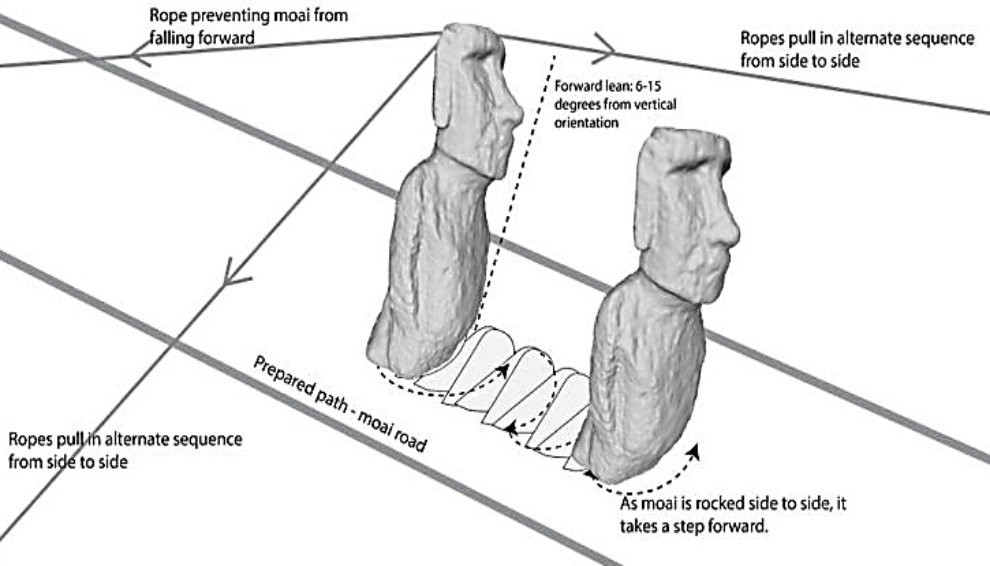
After examining nearly 1,000 of the stone figures, Binghamton University anthropologist Carl Lipo and University of Arizona researcher Terry Hunt concluded that the islanders probably used ropes to rock the statues from side to side, guiding them forward in a zigzag pattern.
How the Moai “Walked” Themselves:
Lipo and his team had earlier demonstrated through practical experiments that the moai could have been moved upright by rocking them back and forth, rather than dragging them horizontally on wooden sleds as older theories suggested.
“Once you get it moving, it isn’t hard at all – people are pulling with one arm. It conserves energy, and it moves really quickly”, said Lipo. “The hard part is getting it rocking in the first place. The question is, if it’s really large, what would it take? Are the things that we saw experimentally consistent with what we would expect from a physics perspective?”.
Testing the Theory With 3D Models and Replica Statues:
To understand how even larger statues might have moved, the researchers built high-resolution 3D models of the moai and pinpointed specific design traits, such as broad D-shaped bases and a forward tilt that made the statues more stable and easier to rock in a walking motion.
The team then tested their hypothesis by constructing a 4.35 ton replica moai featuring the same forward-leaning design. With a team of just 18 people, they successfully moved the replica 100 meters in only 40 minutes, achieving far better results than earlier transport experiments using other methods. “The physics makes sense. What we saw experimentally actually works. And as it gets bigger, it still works. All the attributes that we see about moving gigantic ones only get more and more consistent the bigger and bigger they get, because it becomes the only way you could move it”.
Roads Built for Movement:
Adding to the support for this theory are the roads of Rapa Nui. Measuring 4.5 meters wide with a concave cross-section, the roads were ideal for stabilizing the statues as they moved forward.
“Every time they were moving a statue, it looks like they’re making a road. The road is part of moving the statue”, said Lipo. “We actually see them overlapping each other, and many parallel versions of them. What they are probably doing is clearing a path, moving it, clearing another, clearing it further, and moving it right in certain sequences. So they’re spending a lot of time on the road part”.
Challenging the Skeptics:
Lipo said that nothing else currently explains how the moai were moved. The challenge to anyone else is to prove them wrong. “Find some evidence that shows it couldn’t be walking. Because nothing we’ve seen anywhere disproves that. In fact, everything we ever see and ever thought of keeps strengthening the argument”. Lipo said Rapa Nui is notorious for wild theories backed by zero evidence. This research is an example of putting a theory to the test.
“People have spun all kinds of tales about stuff that’s plausible or possible in some way, but they never go about evaluating the evidence to show that, in fact, you can learn about the past and explain the record that you see in ways that are fully scientific. One of the steps is simply saying, Look, we can build an answer here”.
Honouring the Genius of the Rapa Nui:
Lipo said that the research also honours the people of Rapa Nui, who achieved a monumental engineering feat with limited resources. “It shows that the Rapa Nui people were incredibly smart. They figured this out,” said Lipo. “They’re doing it the way that’s consistent with the resources they have. So, it really gives honour to those people, saying, look at what they were able to achieve, and we have a lot to learn from them in these principles”.
Team Maverick







Solar Defence Showcases Indigenous ‘Bhargavastra’ Counter-Swarm Drone System to Indian Army
New Delhi, July 2026 : Solar Defence and Aerospace Ltd. (SDAL) on Friday showcased its ind…

Solar Defence Showcases Indigenous ‘Bhargavastra’ Counter-Swarm Drone System to Indian Army
New Delhi, July 2026 : Solar Defence and Aerospace Ltd. (SDAL) on Friday showcased …