IATA issues clarifications prior to COP30 scheduled in Brazil.

Nov 2025 : Prior to COP30 in Brazil, it was important to retrospect the developments in cognizance to the efforts striven in decarbonising air transport.
Marie Owens Thomsen, Senior Vice President, Sustainability & Chief Economist of IATA urges the participating governments to provide an early clarity on the airline industry’s path to decarbonisation:
- CORSIA is the first and only global agreement to manage CO2 emissions of an industrial sector. Governments must unambiguously support its success and refrain from undermining it by introducing competing and duplicative taxes and charges.
- Sustainable Aviation Fuel (SAF) is the game changer for decarbonising aviation. Governments must support the production ramp-up of SAF with incentives and policies that clearly make it a winning investment.
At first, let’s clarify who does what in that domain: Domestic air transport falls under the responsibility of national governments and is relevant to the UNFCCC COP process as States need to report on Nationally Determined Contributions (NDC). International aviation has been under the responsibility of the UN special agency, the International Civil Aviation Organisation (ICAO) for 80 years.
It’s been almost a decade since ICAO member States agreed in 2016 to establish a globally harmonised scheme called CORSIA (Carbon Offsetting and Reduction Scheme for International Aviation) to tackle CO2 emissions from international air transport. Early last month, the ICAO Assembly reviewed its progress, looking at how well CORSIA is working. When fully operational, aviation’s international carbon emissions should be stabilised at 85% of 2019 levels.
The significance of CORSIA should not be underestimated in the effort to decarbonise flying. CORSIA is the first and only global agreement to manage CO2 emissions of an industrial sector. Governments have agreed that it will be the only economic measure applied to international aviation, preserving fairness. This principle was reaffirmed at the recent ICAO 42nd Assembly, which was largely possible for ICAO’s quality criteria for CORSIA carbon credits, they are the most sought-after in the carbon credit market. A fully developed, transparent, liquid, and trusted carbon market will be able to raise money from all kinds of global investors for projects in mostly developing countries that generate certified CO2 emissions reductions. What is there not to love?
Over CORSIA’s lifetime until 2035, airlines will likely pay between USD 30-60 billion to be compliant with their obligations under CORSIA, and voluntary demand for credits has great potential. However, countries that have eligible projects may choose to use their credits for other purposes than for air transport, or they might find the necessary administrative and other procedures too difficult to overcome. This has resulted in an acutely under-supplied market where Guyana is currently the only State that has made credits available in the market. It is a most perplexing paradox that the UN Member States in ICAO put an obligation on airlines to buy CORSIA credits, but the same UN Member States under COP are not obliged to make the credits available to airlines.
In that light, it is both exasperating and disappointing that many States are putting forward proposals that undermine CORSIA. That includes the Global Solidarity Levies Task Force, which was initiated at COP28 to investigate novel sources of funding for climate action, as well as the EU’s so far failed attempts to impose its ETS extra-territorially. Such initiatives completely ignore the commitment the same States made at ICAO – that CORSIA should be the single, one and only solution for charging international airlines for their CO2 emissions.
Of course, carbon credits are only one part of air transport’s decarbonisation. The major contribution to our industry’s emissions reductions will be from replacing fossil-based jet fuel with Sustainable Aviation Fuel (SAF). Today though, there is only enough SAF in the world to cover less than 1% of our energy needs. The reason is, because government incentives continue to favour fossil fuels, making these energies a much more lucrative investment than renewable fuels. It is quintessential that ‘CLARITY’ is the common message for governments emanating from the current state of play regarding both SAF and CORSIA.
At the 42nd ICAO Assembly, governments gave us assurances of this clarity. Over the three years until the next Assembly, we need to see this materialising in real policies and initiatives. And over the next weeks at COP30, we count on those same governments to demonstrate their will to enact policies.
Team Maverick

Gujarat Titans Post Massive 229 Against CSK After Explosive Batting Display
Ahmedabad, May 2026 : Gujarat Titans delivered a dominant batting performance to post a ma…
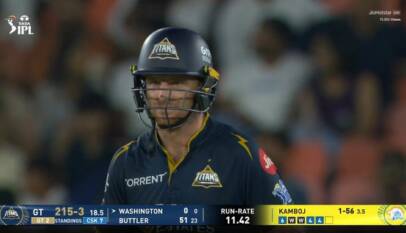
Gujarat Titans Post Massive 229 Against CSK After Explosive Batting Display
Ahmedabad, May 2026 : Gujarat Titans delivered a dominant batting performance to post a …