Maharashtra Becomes First State to Join Nuclear Power Generation Initiative

Maharashtra Becomes the First State in the Country to Participate in Nuclear Energy–Based Power Generation Initiative
Maharashtra Will Become a Leading State in Clean Energy – Chief Minister Devendra Fadnavis
Mahagenco–NPCIL Memorandum of Understanding
Maharashtra’s Historic Journey in the Clean Energy Sector
Mumbai, Nov 2025 : While using nuclear energy for power generation, the Central Government is taking steps to involve states in this sector. Maharashtra is becoming the first state in the country to participate in the nuclear-energy-based electricity generation initiative, and this is an important step taken by Maharashtra towards clean and sustainable energy, Chief Minister Devendra Fadnavis said in praise.
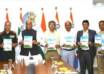
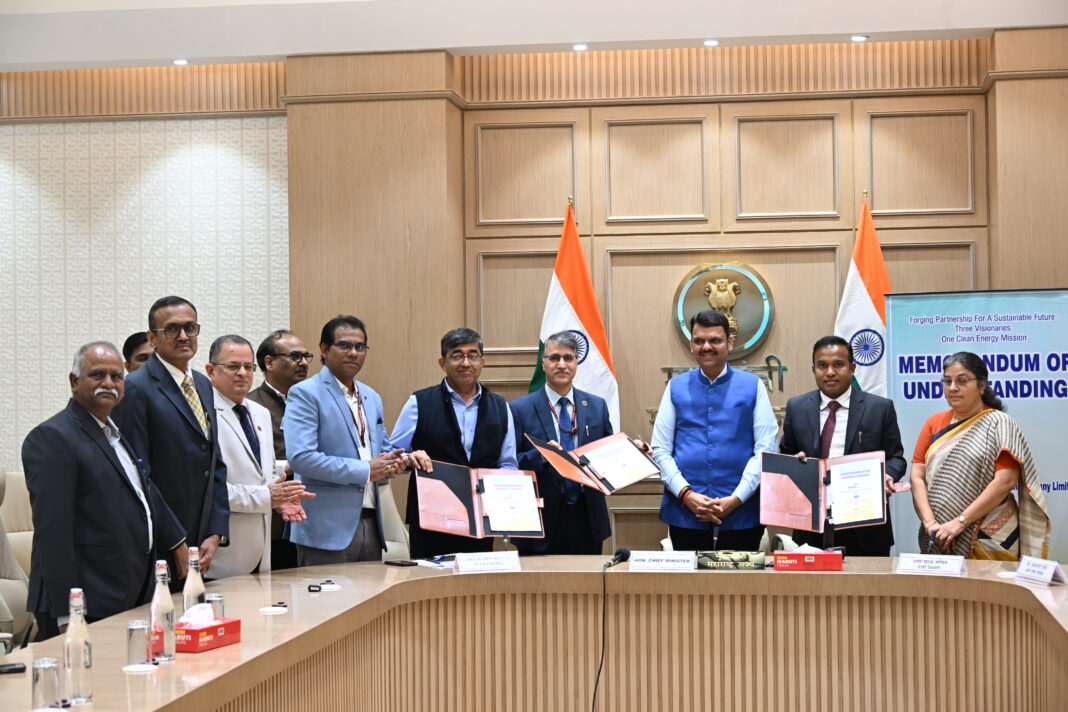
In the presence of Chief Minister Devendra Fadnavis, at Varsha, the official residence, a Memorandum of Understanding (MoU) was signed between Maharashtra State Power Generation Company Limited (Mahagenco) and Nuclear Power Corporation of India Limited (NPCIL).
Attending this programme were Additional Chief Secretary of the Energy Department Abha Shukla, NPCIL Chairman and Managing Director B. C. Pathak, Maharashtra Institute for Transformation (MITRA) Chief Executive Officer Praveen Pardeshi, Mahagenco Chairman and Managing Director Radhakrishnan B., MITRA Co-Chief Executive Officer Aman Mittal, along with senior officers of Mahagenco and NPCIL.
Chief Minister Devendra Fadnavis said, the country is developing rapidly and the main foundation of development is clean and reliable energy. Due to Prime Minister Narendra Modi’s policy of making the nation self-reliant in the energy sector — the ‘Clean Energy-Enabled Nation’ policy — the participation of states in nuclear-based power generation will be increased.
He further said that until now, the nuclear energy sector has been the working domain of the Central Government. But Mahagenco is participating in this initiative with NPCIL for the first time. This MoU has been signed at a very appropriate time. The most important fuel for data centres is clean energy, and for that, this agreement is extremely important. Maharashtra is becoming the ‘Data Centre Capital’ of the country. Nearly 50–60% of data centre capacity is in Maharashtra and is continuously increasing, said Chief Minister Fadnavis.
Chief Minister Fadnavis added that Maharashtra will benefit from NPCIL’s reputation and experience in this sector. The State Government will take initiative in this project, remain active, and provide all necessary cooperation. The step taken by Mahagenco, the Energy Department and MITRA is a historically significant event in the energy sector of Maharashtra, he said with pride.
On this occasion, Mahagenco Chairman and Managing Director Radhakrishnan B. and NPCIL Chairman and Managing Director B. C. Pathak signed the agreement. Present were NPCIL Director (Technical) B. Rajesh, Additional Director Jitesh Arora, Prateek Agrawal, Nitin Jawale, Advisor B. B. S. Shekhar, Director (Projects) N. K. Mitha, and from Mahagenco, Director (Finance) Manish Wagherekar, Director (Operation) Sanjay Marudkar, Executive Director (Projects) Rajesh Patil.
Roadmap for Clean Energy Generation by 2047
In current power generation technologies, traditional fossil fuels and natural sources include factors that impact the environment. Fossil fuels (coal, oil, and natural gas) have remained major sources of global electricity, but their use has brought forward risks such as air and water pollution, environmental effects from power plant emissions, resource depletion, and waste disposal challenges.
In power generation technologies, renewable sources such as solar and wind, along with nuclear energy, are gaining dominance. This includes rapid expansion of renewable energy technologies, integration of energy storage, decentralised generation, and the growth of smart grid technology.
India aims to become a “30-trillion-dollar economy” by 2047, for which major changes are required in the energy sector. To meet growing electricity demand and achieve “net-zero emissions by 2070,” energy generation with minimal lifecycle CO₂ emissions and 24-hour electricity supply will require nuclear energy to play a key role.
The country operates 25 nuclear reactors at 7 locations with an installed capacity of 8,880 MW. Eight nuclear reactors are under construction, including a 500 MW Prototype Fast Breeder Reactor. Planning is underway for ten additional reactors totalling 7,000 MW. For this, the Central Government has allocated ₹20,000 crore for the development of Small Modular Reactors (SMRs).
By 2047, rapid growth in industrial production — especially steel, cement and aluminium — is expected. Nuclear power plants, with high plant factors and minimal interruptions, operate continuously as baseload power stations. In Maharashtra’s industrial development, due to industrial power demand, the use of nuclear energy for 24-hour electricity supply is making the energy sector suitable.


BJP Workers Are Full-Time Politicians, Rahul Gandhi Is Part-Time: Nitin Nabin in Telangana
Hyderabad, June 2026 : Bharatiya Janata Party (BJP) national president Nitin Nabin on Mond…
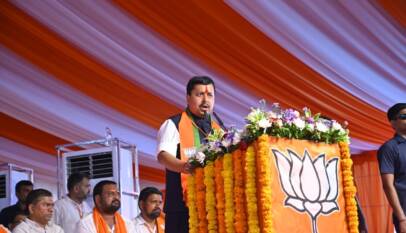
BJP Workers Are Full-Time Politicians, Rahul Gandhi Is Part-Time: Nitin Nabin in Telangana
Hyderabad, June 2026 : Bharatiya Janata Party (BJP) national president Nitin Nabin on Monday …