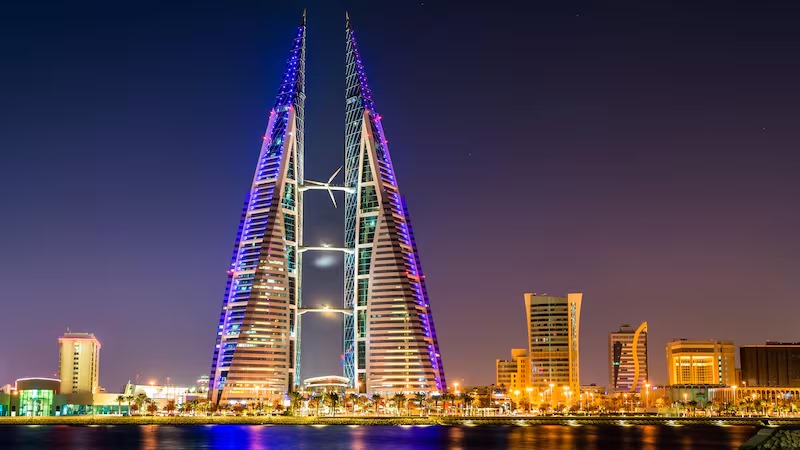
International Monetary Fund Warns Bahrain of Rising Government Debt.

The International Monetary Fund has warned Bahrain about its rising government debt, urging the kingdom to adopt fiscal measures.
After discussions with officials in Manama between November 09th and 20th, this year, IMF has reaffirmed that Bahrain’s fiscal position “continued to deteriorate since the last year”. The fund said the kingdom’s overall fiscal deficit to gross domestic product rose 11%, with gross government debt to GDP increasing to more than 11%.
Earlier on November 27th 2024, The International Monetary Fund had urged Bahrain to press on with its efforts to lower government debt after the country’s fiscal position took a step back the previous year. It was during that period: Bahrain’s government gross debt grew to 123.3% of gross domestic product last year, up from 111.1% in 2022. However, Bahrain’s government gross debt was projected to increase to 125.1% of GDP this year and to 128% of GDP in 2025.
Meanwhile, during the fiscal year 2024-2025, the country’s overall fiscal balance fell to minus 8.5% (-8.5%) of GDP. This marked a change from large improvements over 2021–22, as noted by the IMF after its Article IV consultations with the kingdom. The authorities however agreed that fiscal efforts should continue, beyond the conclusion of the FBP this year, to bring government debt significantly down over the medium term. The IMF also said Bahrain’s ratio of non-hydrocarbon revenue to recurring expenditures was above the kingdom’s Fiscal Balance Programme 40% target last year.
The Washington-based lender’s executive board also commended Bahrain’s economic resilience, which has been supported by efforts to diversify its economy towards the non-hydrocarbon sector.
Bahrain in September 2024 had introduced a new tax on multinational corporations that analysts believe will help the country’s diversification efforts while it remains competitive. Under this domestic minimum top-up tax, multinational companies will be required to pay a tax of at least 15% on profits made inside Bahrain. The kingdom is among a number of Gulf countries in the middle of diversifying their economies away from oil and gas towards other non-hydrocarbon sectors such as technology and tourism.
Bahrain had initiated a $427 million waterfront development project due to be completed by 2026 in an effort to bring in more tourism. Government data also shows that sectors such as transport and storage, information and communications, food service and accommodation were among the kingdom’s top growing sectors in the second quarter of this year.
Bahrain’s Tourism Minister Fatima bint Jaafar Al Sairafi had also announced that during the Gateway Gulf 2024 forum this month the construction of 16 new hotels that will add more than 3,000 hotel rooms. Ms Al Sairafi said the new hotels would help to boost tourism revenue, create hospitality jobs and support small and medium enterprises. During that period, IMF encouraged Bahrain to broaden the VAT base, contain the wage bill, reduce extra-budgetary spending and reform energy subsidies.
While, Bahrain’s economy was projected to grow by 3% in 2024-2025, unchanged from last year’s economic growth, before expanding by 3.5% in 2025.
Non-hydrocarbon activity was projected to generate 90% of Bahrain’s economy by 2029, with the kingdom’s GDP set to expand by 3% in the medium term. Non-hydrocarbon economic growth was projected at 3.7% in 2024-2025 before increasing to 4.1% in 2025-2026.
Inflation was projected to rise to 1.2% in 2024-2025, after falling to 0.1% during 2023-2024r, before steadying at 2% in the coming years. “However, uncertainty is high and downside risks large, including from potential escalation and expansion of regional conflicts, commodity price volatility and greater geoeconomics fragmentation”, the IMF apprehended.
In the present scenario, IMF has warned that inflation rose only modestly last year, while growth was resilient, amid tight financing conditions and geopolitical uncertainty. However, it warned that the kingdom’s debt-to-GDP ratio is expected to further increase if new fiscal measures are not put in place.
“To bring debt down durably and reduce risks, the priority is to commit to a steady, multi-year fiscal consolidation package, with efforts appropriately staggered to smooth the adjustment, alongside structural reforms to boost growth”, IMF Mission Chief John Bluedorn said in a statement.
The fund called on Bahrain to adopt measures including the introduction of a general corporate income tax and reduce broad energy subsidies, while using social transfers to protect vulnerable households. The fund said doing so would help to balance growth and fiscal sustainability.
The IMF said its mission will submit a report to the fund’s executive board, which is scheduled to discuss the Article IV consultation in January.
The statement comes days after S&P Global Ratings downgraded Bahrain’s sovereign credit rating from “B+” to “B” on its fiscal position and rising debt levels. S&P said Bahrain’s outlook was stable.
“The downgrade reflects our view of the risks related to high government debt that has accumulated because of persistently pressured fiscal positions and high fiscal deficits”, S&P analysts said on Friday.
S&P said Bahrain’s economy and budgets remains “susceptible” to volatility in oil prices, “despite hydrocarbons representing only 15% of GDP”. It forecast Bahrain’s government debt to reach 139% of GDP in 2028, up from 118% last year.
Fitch Ratings also lowered Bahrain’s economic outlook from stable to negative this year on fiscal pressures and rising debt.
Bahrain went to the bond market this year to help refinance debt. S&P said it expects Bahrain to continue to rise on softer oil market dynamics and fiscal deficits.
Team Maverick







Baby Do Die Do Movie Review: Huma Qureshi Anchors a Stylish Neo-Noir That Turns Mumbai into Its Most Fascinating Character
Rating: ★★★☆☆ (3/5) Director: Nachiket SamantWriters: Nachiket Samant, Gaurav Sharma (Stor…

Baby Do Die Do Movie Review: Huma Qureshi Anchors a Stylish Neo-Noir That Turns Mumbai into Its Most Fascinating Character
Rating: ★★★☆☆ (3/5) Director: Nachiket SamantWriters: Nachiket Samant, Gaurav Sharma (Story: Jasmeet K. Reen, …